



 Chat with AI
Exam 20: Communities of Organisms

Exam 1: The Nature of Science94 Questions
Exam 2: Evaluating Scientific Claims90 Questions
Exam 3: Chemistry of Life102 Questions
Exam 4: Life Is Cellular88 Questions
Exam 5: How Cells Work89 Questions
Exam 6: Cell Division95 Questions
Exam 7: Patterns of Inheritance83 Questions
Exam 8: Chromosomes and Human Genetics92 Questions
Exam 9: What Genes Are83 Questions
Exam 10: How Genes Work98 Questions
Exam 11: Evidence for Evolution86 Questions
Exam 12: Mechanisms of Evolution84 Questions
Exam 13: Adaptation and Species85 Questions
Exam 14: The History of Life97 Questions
Exam 15: Bacteria and Archaea91 Questions
Exam 16: Plants, Fungi, and Protists84 Questions
Exam 17: Animals and Human Evolution88 Questions
Exam 18: General Principles of Ecology81 Questions
Exam 19: Growth of Populations82 Questions
Exam 20: Communities of Organisms83 Questions
Exam 21: Ecosystems87 Questions
Select questions type


The information presented in the figure below strongly suggests that the ________ is a keystone species in Yellowstone National Park.
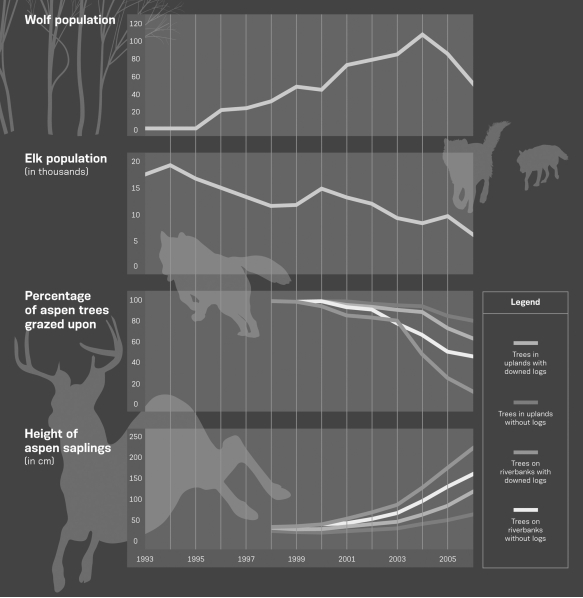
(Short Answer)
4.9/5  (74)
(74) Clown fish have evolved to live safely between the stinging tentacles of certain sea anemones.The fish receive protection from predators,whereas anemone receive some food from the fish.This relationship is an example of
(Multiple Choice)
4.9/5 (83)
(83) Human cells contain mitochondria,which are responsible for processing the energy needed by the cells.The ancestors of mitochondria may once have been free-living prokaryotes.If mitochondria were still considered to be separate organisms within human cells,which of the following would best describe a human's relationship with them?
(Multiple Choice)
4.8/5 (71)
(71) 
Filters
- Essay(0)
- Multiple Choice(0)
- Short Answer(0)
- True False(0)
- Matching(0)