



 Chat with AI
Exam 11: Evidence for Evolution

Exam 1: The Nature of Science94 Questions
Exam 2: Evaluating Scientific Claims90 Questions
Exam 3: Chemistry of Life102 Questions
Exam 4: Life Is Cellular88 Questions
Exam 5: How Cells Work89 Questions
Exam 6: Cell Division95 Questions
Exam 7: Patterns of Inheritance83 Questions
Exam 8: Chromosomes and Human Genetics92 Questions
Exam 9: What Genes Are83 Questions
Exam 10: How Genes Work98 Questions
Exam 11: Evidence for Evolution86 Questions
Exam 12: Mechanisms of Evolution84 Questions
Exam 13: Adaptation and Species85 Questions
Exam 14: The History of Life97 Questions
Exam 15: Bacteria and Archaea91 Questions
Exam 16: Plants, Fungi, and Protists84 Questions
Exam 17: Animals and Human Evolution88 Questions
Exam 18: General Principles of Ecology81 Questions
Exam 19: Growth of Populations82 Questions
Exam 20: Communities of Organisms83 Questions
Exam 21: Ecosystems87 Questions
Select questions type


The E.coli populations that survived the selective pressure of growing at the warmer temperatures did so because of ________ present in their DNA.
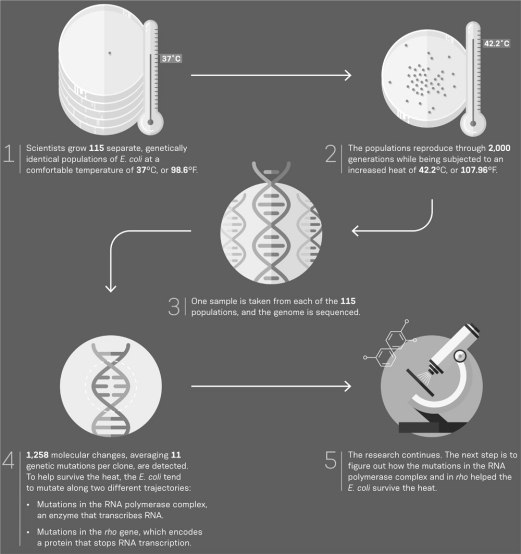
(Short Answer)
4.8/5  (81)
(81) Two fossils of the same species are found in both Africa and South America.What does this indicate?
(Multiple Choice)
4.9/5 (69)
(69) The preserved remains of formerly living organisms are called ________.
(Short Answer)
4.8/5 (82)
(82) A group of scientists proposed that mammals with fur that contrasts with their background are hunted more by predators than mammals with fur that blends in with their background.After running several experiments,the scientists found that dark mice were attacked 25 percent of the time in a dark habitat and 75 percent of the time in a light habitat.The light-colored mice were attacked 25 percent of the time in a light habitat and 75 percent of the time in a dark habitat.These data
(Multiple Choice)
4.8/5 (70)
(70) Placing a human gene into a plant produces the same protein as would be produced in a human.Some of the genes in plants are similar to human genes; others are very different.What does this information indicate about the relationship between humans and plants?
(Essay)
4.8/5 (87)
(87) The result of ________ over evolutionary time spans is that alleles that allow organisms to survive and reproduce at a higher rate than other individuals become more common in the population.
(Multiple Choice)
4.8/5 (82)
(82) By 200 million years ago,parts of the supercontinent of Pangaea had begun to drift away from each other.Laurasia (North America and Eurasia)separated from Gondwanaland (South America,Africa,Antarctica,Australia,and India).Which of the following would you expect to find? 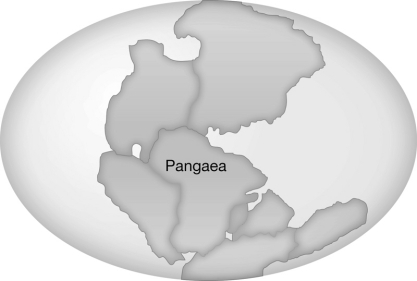
(Multiple Choice)
4.8/5 (86)
(86) Evaluate the DNA sequences presented below to determine which of the organisms (B,C,or D)shares the most closely related ancestor to organism A.Which organism shares the least closely related ancestor to A? Support your answer with DNA sequence similarity evidence from the figure that represents the DNA sequence for a single protein found in all four organisms.

(Essay)
4.7/5 (86)
(86) The genus Lycopodium includes plants that evolved before the breakup of Pangaea.The genus Sequoiadendron (Sequoia trees)evolved after Pangaea split into separate landmasses.Which genus would you expect to have the widest distribution of living representatives across the modern continents?
(Multiple Choice)
4.8/5 (80)
(80) Human embryos have webbing between their fingers and toes,but genes turn on during development that cause this webbing to dissolve before birth.Tiktaalik and other early amphibians had lobed fins or limbs.This evidence supports the hypothesis that humans and amphibians had a ________ in fish.
(Short Answer)
4.9/5 (84)
(84) Fish typically have eyes on the sides of their heads.The embryos of amphibians,birds,and mammals begin with their eyes on the sides of their heads,but the eyes move toward the center of the head during development.What does this suggest about the common ancestor of these diverse animals? Provide additional supporting evidence from your reading.
(Essay)
4.9/5 (70)
(70) Fossils of organisms that lived on Pangaea are likely found
(Multiple Choice)
4.9/5 (80)
(80) Humans simulate the process of natural selection when they use ________ to develop new varieties of crop plants that better meet the needs of farmers.
(Multiple Choice)
4.9/5 (72)
(72) Equus (horses)have a single toe on their hoof,while Hyracotherium (the ancestor to horses)had four toes.Which of the following evidence would support this conclusion?
(Multiple Choice)
4.8/5 (69)
(69) Grasshopper mice prey on venomous scorpions.Though the mice have some level of resistance to the scorpion venom,scorpions with more potent venom are better able to fend off attack by a grasshopper mouse.Over time,the population of scorpions all produce more potent venom.This is an example of ________ selection.
(Short Answer)
4.9/5 (79)
(79) Examine the figure below.According to this figure,which two breeds have the LEAST similar DNA? 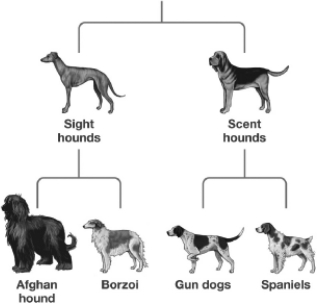
(Multiple Choice)
5.0/5 (81)
(81) The fossils of organisms that existed when the continents were connected are distributed across ________ continents than the fossils of organisms that evolved after the continents separated.
(Multiple Choice)
4.7/5 (85)
(85) Although they are protected in many countries,humans still hunt elephants for their ivory tusks.A mutation that results in tuskless elephants is increasing in frequency in some elephant populations.Is this an example of artificial or natural selection? Support your answer.
(Essay)
4.8/5 (78)
(78) 
Filters
- Essay(0)
- Multiple Choice(0)
- Short Answer(0)
- True False(0)
- Matching(0)