



 Chat with AI
Exam 11: Monopolistic Competition and Oligopoly

Exam 1: Economics: Foundations and Models459 Questions
Exam 2: Trade-Offs, Comparative Advantage, and the Market System495 Questions
Exam 3: Where Prices Come From: The Interaction of Demand and Supply476 Questions
Exam 4: Market Efficiency and Market Failure464 Questions
Exam 5: The Economics of Health Care337 Questions
Exam 6: Firms, The Stock Market, and Corporate Governance456 Questions
Exam 7: Consumer Choice and Elasticity384 Questions
Exam 8: Technology,Production,and Costs274 Questions
Exam 9: Firms in Perfectly Competitive Markets297 Questions
Exam 10: Monopoly and Antitrust Policy279 Questions
Exam 11: Monopolistic Competition and Oligopoly410 Questions
Exam 12: GDP: Measuring Total Production and Income261 Questions
Exam 13: Unemployment and Inflation290 Questions
Exam 14: Economic Growth, The Financial System, and Business Cycles251 Questions
Exam 15: Aggregate Demand and Aggregate Supply Analysis286 Questions
Exam 16: Money,Banks,and the Federal Reserve System278 Questions
Exam 17: Monetary Policy280 Questions
Exam 18: Fiscal Policy292 Questions
Exam 19: Comparative Advantage, International Trade, and Exchange Rates443 Questions
Select questions type


Productive efficiency does not hold for a profit-maximizing,monopolistically competitive firm in the long-run equilibrium because the firm operates along the diseconomies of scale region of its average total cost curve.
(True/False)
4.7/5  (66)
(66) Monopolistically competitive firms have downward-sloping demand curves.In the long run,monopolistically competitive firms earn zero economic profits.These two characteristics imply that in the long run
(Multiple Choice)
4.9/5 (73)
(73) Which of the following is not a characteristic of a monopolistically competitive firm in long-run equilibrium?
(Multiple Choice)
4.9/5 (80)
(80) Is a monopolistically competitive firm allocatively efficient?
(Multiple Choice)
5.0/5 (80)
(80) A fundamental assumption in game theory is that players do not interact with each other.
(True/False)
4.8/5 (82)
(82) Suppose two firms in a duopoly implicitly collude and charge a high price.How might each firm benefit from advertising that it will match the lowest price offered by its competitor?
(Multiple Choice)
4.8/5 (103)
(103) Table 11-15
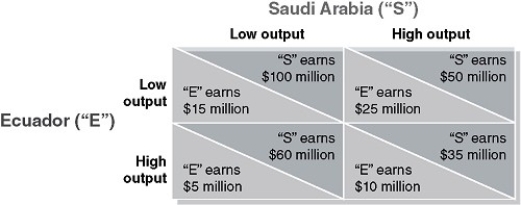 -Refer to Table 11-15.Suppose the payoff matrix in the above figure represents the payoffs to Saudi Arabia and Ecuador for the production of oil.Saudi Arabia and Ecuador must decide how much oil to produce.Since the demand for oil is inelastic,relatively low production rates drive up prices and profits.Saudi Arabia,the world's largest and lowest-cost producer,is able to influence market price; it has an incentive to keep output low.Ecuador,on the other hand,is a relatively high-cost producer with much smaller reserves.Assume Saudi Arabia now decides to try to further influence the oil market by offering to pay Ecuador $15 million to produce a low output.
a.Create a new payoff matrix that reflects Saudi Arabia's willingness to pay Ecuador $15 million to produce a low output.
b.What is the dominant strategy for each country in this new game?
c.What is the new Nash equilibrium?
-Refer to Table 11-15.Suppose the payoff matrix in the above figure represents the payoffs to Saudi Arabia and Ecuador for the production of oil.Saudi Arabia and Ecuador must decide how much oil to produce.Since the demand for oil is inelastic,relatively low production rates drive up prices and profits.Saudi Arabia,the world's largest and lowest-cost producer,is able to influence market price; it has an incentive to keep output low.Ecuador,on the other hand,is a relatively high-cost producer with much smaller reserves.Assume Saudi Arabia now decides to try to further influence the oil market by offering to pay Ecuador $15 million to produce a low output.
a.Create a new payoff matrix that reflects Saudi Arabia's willingness to pay Ecuador $15 million to produce a low output.
b.What is the dominant strategy for each country in this new game?
c.What is the new Nash equilibrium? (Essay)
4.9/5 (73)
(73) Which of the following will not happen as a consequence of a monopolistically competitive firm suffering economic losses in the short run?
(Multiple Choice)
4.8/5 (83)
(83) If a monopolistically competitive firm breaks even,the firm is earning as much in this industry as it could in any other comparable industry.
(True/False)
4.8/5 (86)
(86) Figure 11-16
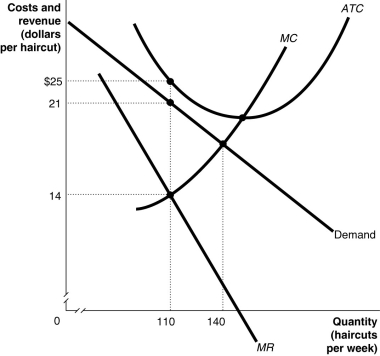 -Refer to Figure 11-16.Figure 11-16 depicts a monopolistically competitive barber shop.Use the diagram to answer the following questions.
a.Suppose the average variable cost of production is $15 when output equals 110 haircuts and $15.25 when output equals 140 haircuts.If the firm wants to maximize its profit or minimize its losses,how many haircuts will it produce and what price should it charge? Explain your answer.
b.Calculate the firm's profit or loss.
c.What is likely to happen in this industry over time as it moves to its new long-run equilibrium?
d.Suppose the barber shop depicted in the diagram remains in the industry.Is this barber shop likely to produce this same quantity of haircuts as in part (a)in the long run?
-Refer to Figure 11-16.Figure 11-16 depicts a monopolistically competitive barber shop.Use the diagram to answer the following questions.
a.Suppose the average variable cost of production is $15 when output equals 110 haircuts and $15.25 when output equals 140 haircuts.If the firm wants to maximize its profit or minimize its losses,how many haircuts will it produce and what price should it charge? Explain your answer.
b.Calculate the firm's profit or loss.
c.What is likely to happen in this industry over time as it moves to its new long-run equilibrium?
d.Suppose the barber shop depicted in the diagram remains in the industry.Is this barber shop likely to produce this same quantity of haircuts as in part (a)in the long run? (Essay)
4.8/5 (79)
(79) Why does a prisoner's dilemma lead to a noncooperative equilibrium?
(Multiple Choice)
4.9/5 (69)
(69) A monopolistically competitive firm that earns an accounting profit in the short run
(Multiple Choice)
4.8/5 (79)
(79) An equilibrium in which each player chooses its best strategy given the strategies chosen by the other players is called a Nash equilibrium.
(True/False)
4.7/5 (87)
(87) Which of the following is not a shortcoming of the concentration ratio as a measure of the extent of competition in an industry?
(Multiple Choice)
4.9/5 (87)
(87) A member of a cartel earns more profits by producing more than its quota and selling at a price higher than the cartel's price.
(True/False)
4.9/5 (80)
(80) A monopolistically competitive firm that earns economic profits in the short run will face a more elastic demand curve in the long run.
(True/False)
4.7/5 (74)
(74) The marginal revenue of a monopolistically competitive firm
(Multiple Choice)
4.8/5 (81)
(81) The "Discount Department Stores" industry is highly concentrated.What does this mean?
(Multiple Choice)
4.8/5 (68)
(68) Which of the following explains why two firms,Apex and Bongo,would engage in implicit collusion,rather than explicit collusion?
(Multiple Choice)
4.7/5 (77)
(77) 
Filters
- Essay(0)
- Multiple Choice(0)
- Short Answer(0)
- True False(0)
- Matching(0)