



 Chat with AI
Exam 11: Monopolistic Competition and Oligopoly

Exam 1: Economics: Foundations and Models459 Questions
Exam 2: Trade-Offs, Comparative Advantage, and the Market System495 Questions
Exam 3: Where Prices Come From: The Interaction of Demand and Supply476 Questions
Exam 4: Market Efficiency and Market Failure464 Questions
Exam 5: The Economics of Health Care337 Questions
Exam 6: Firms, The Stock Market, and Corporate Governance456 Questions
Exam 7: Consumer Choice and Elasticity384 Questions
Exam 8: Technology,Production,and Costs274 Questions
Exam 9: Firms in Perfectly Competitive Markets297 Questions
Exam 10: Monopoly and Antitrust Policy279 Questions
Exam 11: Monopolistic Competition and Oligopoly410 Questions
Exam 12: GDP: Measuring Total Production and Income261 Questions
Exam 13: Unemployment and Inflation290 Questions
Exam 14: Economic Growth, The Financial System, and Business Cycles251 Questions
Exam 15: Aggregate Demand and Aggregate Supply Analysis286 Questions
Exam 16: Money,Banks,and the Federal Reserve System278 Questions
Exam 17: Monetary Policy280 Questions
Exam 18: Fiscal Policy292 Questions
Exam 19: Comparative Advantage, International Trade, and Exchange Rates443 Questions
Select questions type


Table 11-13
 Two rival oligopolists in the coffee industry, Wide Awake and Zuma, have to decide on their pricing strategy. Each can choose either a high price or a low price. Table 11-13 shows the payoff matrix with the profits that each firm can expect to earn depending on the pricing strategy it adopts.
-Refer to Table 11-13.If the firms act out of individual self-interest,which prices will they select?
Two rival oligopolists in the coffee industry, Wide Awake and Zuma, have to decide on their pricing strategy. Each can choose either a high price or a low price. Table 11-13 shows the payoff matrix with the profits that each firm can expect to earn depending on the pricing strategy it adopts.
-Refer to Table 11-13.If the firms act out of individual self-interest,which prices will they select? (Multiple Choice)
4.8/5  (86)
(86) In contrast with perfect competition,excess capacity characterizes monopolistic competition.Excess capacity is due to which of the following?
(Multiple Choice)
4.8/5 (92)
(92) When a monopolistically competitive firm cuts its price to increase its sales,it experiences a gain in revenue due to the
(Multiple Choice)
4.8/5 (76)
(76) Figure 11-3
 -Refer to Figure 11-3.The marginal revenue from one additional unit sold is the sum of the gain in revenue from selling the additional unit and the loss in revenue from having to charge a lower price to sell the additional unit.Based on the diagram in the figure
 (Multiple Choice)
4.9/5 (79)
(79) Figure 11-8
 Figure 11-8 shows cost and demand curves for a monopolistically competitive producer of iced tea.
-Refer to Figure 11-8.What is the firm's profit-maximizing price?
Figure 11-8 shows cost and demand curves for a monopolistically competitive producer of iced tea.
-Refer to Figure 11-8.What is the firm's profit-maximizing price? (Multiple Choice)
4.7/5 (99)
(99) Table 11-11
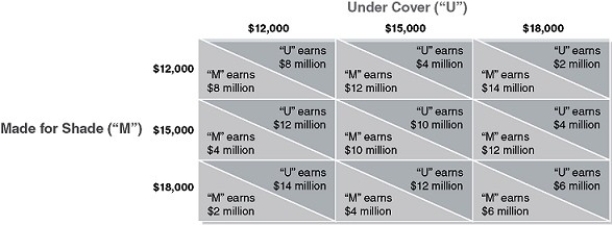 There are two custom carport manufacturers in Louisiana, Under Cover (U) and Made for Shade (M). Under Cover has been in the market for a long time and must now compete with newcomer, Made for Shade. Suppose that Under Cover believes that Made for Shade will match any price it sets. Use Table 11-11 to answer the following question and assume throughout that Under Cover believes that Made for Shade will match any price it sets.
-Refer to Table 11-11.What price will Under Cover charge and what profit does Under Cover expect to make?
There are two custom carport manufacturers in Louisiana, Under Cover (U) and Made for Shade (M). Under Cover has been in the market for a long time and must now compete with newcomer, Made for Shade. Suppose that Under Cover believes that Made for Shade will match any price it sets. Use Table 11-11 to answer the following question and assume throughout that Under Cover believes that Made for Shade will match any price it sets.
-Refer to Table 11-11.What price will Under Cover charge and what profit does Under Cover expect to make? (Multiple Choice)
4.8/5 (92)
(92) What is an oligopoly? Give two examples of oligopolistic industries in the United States.
(Essay)
4.9/5 (82)
(82) OPEC periodically meets to agree to restrict the cartel's oil output,and yet almost every member of OPEC produces more than its own output quota.This suggests that OPEC has
(Multiple Choice)
4.9/5 (80)
(80) Which of the following describes a difference between the marginal revenue and demand curves of a perfectly competitive firm and a monopolistically competitive firm?
(Multiple Choice)
4.8/5 (80)
(80) In economics,the study of the decisions of firms in industries where the profits of each firm depend on its interactions with other firms is called
(Multiple Choice)
4.7/5 (82)
(82) All of the following are examples of oligopolistic markets except
(Multiple Choice)
4.9/5 (72)
(72) Explain the difference between a cooperative equilibrium and a noncooperative equilibrium in game theory.
(Essay)
4.7/5 (79)
(79) If the marginal revenue is negative then the revenue lost from receiving a lower price on all the units that could have been sold at the original price is smaller than the additional revenue from selling one more unit of the good.
(True/False)
4.9/5 (73)
(73) Figure 11-17
 -Refer to Figure 11-17.In the long run,why will the firm produce Qf units and not Qg units,which has a lower its average cost of production?
 (Multiple Choice)
4.9/5 (80)
(80) A game in which pursuing dominant strategies results in noncooperation that leaves all parties worse off is a
(Multiple Choice)
4.8/5 (76)
(76) Does the fact that monopolistically competitive firms do not achieve productive efficiency or allocative efficiency mean that there is a significant loss in consumer welfare?
(Essay)
4.8/5 (77)
(77) Is a monopolistically competitive firm productively efficient?
(Multiple Choice)
4.8/5 (89)
(89) 
Filters
- Essay(0)
- Multiple Choice(0)
- Short Answer(0)
- True False(0)
- Matching(0)