



 Chat with AI
Exam 11: Monopolistic Competition and Oligopoly

Exam 1: Economics: Foundations and Models459 Questions
Exam 2: Trade-Offs, Comparative Advantage, and the Market System495 Questions
Exam 3: Where Prices Come From: The Interaction of Demand and Supply476 Questions
Exam 4: Market Efficiency and Market Failure464 Questions
Exam 5: The Economics of Health Care337 Questions
Exam 6: Firms, The Stock Market, and Corporate Governance456 Questions
Exam 7: Consumer Choice and Elasticity384 Questions
Exam 8: Technology,Production,and Costs274 Questions
Exam 9: Firms in Perfectly Competitive Markets297 Questions
Exam 10: Monopoly and Antitrust Policy279 Questions
Exam 11: Monopolistic Competition and Oligopoly410 Questions
Exam 12: GDP: Measuring Total Production and Income261 Questions
Exam 13: Unemployment and Inflation290 Questions
Exam 14: Economic Growth, The Financial System, and Business Cycles251 Questions
Exam 15: Aggregate Demand and Aggregate Supply Analysis286 Questions
Exam 16: Money,Banks,and the Federal Reserve System278 Questions
Exam 17: Monetary Policy280 Questions
Exam 18: Fiscal Policy292 Questions
Exam 19: Comparative Advantage, International Trade, and Exchange Rates443 Questions
Select questions type


All of the following characteristics are common to both monopolistic competition and perfect competition except
(Multiple Choice)
4.9/5  (85)
(85) If some monopolistically competitive firms exit their market after suffering short-run losses,the demand curves of remaining firms will shift to the right.
(True/False)
4.9/5 (82)
(82) Table 11-1
Quantity Price (dollars) Total Revenue (dollars) 1 \ 7.50 \ 7.50 2 7.00 14.00 3 6.50 19.50 4 6.00 24.00 5 5.50 27.50 6 5.00 30.00
-Refer to Table 11-1.What portion of the marginal revenue of the 4th unit is due to the output effect and what portion is due to the price effect?
(Multiple Choice)
4.8/5 (81)
(81) An example of a government-imposed barrier to entry gives a firm the exclusive right to a new product for a period of 20 years from the date the product is invented.This entry barrier is known as
(Multiple Choice)
4.9/5 (83)
(83) A monopolistically competitive firm can increase its profits beyond the long-run equilibrium break-even level by deliberately lowering its price to force some of its competitors out of the market.
(True/False)
4.8/5 (77)
(77) A monopolistic competitor does not earn profits in the long run unless it can successfully differentiate its product in the minds of its consumers.
(True/False)
4.8/5 (87)
(87) Which of the following is not a characteristic of an oligopoly?
(Multiple Choice)
4.9/5 (78)
(78) If a monopolistically competitive firm lowers its price and,as a result,its total revenue decreases then
(Multiple Choice)
4.8/5 (84)
(84) When a monopolistically competitive firm breaks even in the long run,this is equivalent to earning a zero accounting profit.
(True/False)
4.7/5 (67)
(67) A monopolistically competitive industry that earns economic profits in the short run will
(Multiple Choice)
5.0/5 (81)
(81) Figure 11-19
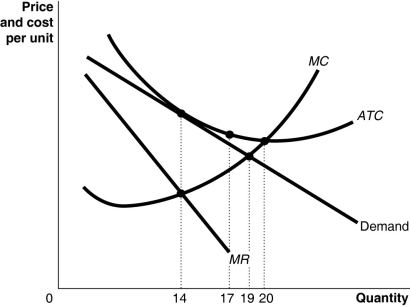 -Refer to Figure 11-19 to answer the following questions.
a.What is the productively efficient output?
b.What is the allocatively efficient output?
c.What is the amount of excess capacity?
d.Suppose the firm is currently producing 14 units.What happens if it increases output to 17 units?
-Refer to Figure 11-19 to answer the following questions.
a.What is the productively efficient output?
b.What is the allocatively efficient output?
c.What is the amount of excess capacity?
d.Suppose the firm is currently producing 14 units.What happens if it increases output to 17 units? (Essay)
4.9/5 (72)
(72) You are planning to open a new Italian restaurant in your hometown where there are three other Italian restaurants.You plan to distinguish your restaurant from your competitors by offering northern Italian cuisine and using locally grown organic produce.What is likely to happen in the restaurant market in your hometown after you open?
(Multiple Choice)
4.9/5 (86)
(86) Figure 11-8
 Figure 11-8 shows cost and demand curves for a monopolistically competitive producer of iced tea.
-Refer to Figure 11-8.What is the profit-maximizing output level?
Figure 11-8 shows cost and demand curves for a monopolistically competitive producer of iced tea.
-Refer to Figure 11-8.What is the profit-maximizing output level? (Multiple Choice)
4.8/5 (86)
(86) What is the profit-maximizing rule for a monopolistically competitive firm?
(Multiple Choice)
4.8/5 (77)
(77) Economies of scale will create a barrier to entry in an oligopoly when
(Multiple Choice)
4.8/5 (82)
(82) Figure 11-4
 Figure 11-4 shows short-run cost and demand curves for a monopolistically competitive firm in the market for designer watches.
-Refer to Figure 11-4.What is the area that represents the total revenue made by the firm?
Figure 11-4 shows short-run cost and demand curves for a monopolistically competitive firm in the market for designer watches.
-Refer to Figure 11-4.What is the area that represents the total revenue made by the firm? (Multiple Choice)
4.9/5 (71)
(71) Table 11-6
 LimoZeenz and AirPorter and are the only two airport shuttle and limousine rental service companies in the mid-sized town of Shady Shores. Each firm must decide on whether to offer its customers a mid-week discount for airport transportation. Table 11-6 shows the payoff matrix for profits earned by each company based on either offering or not offering the discount.
-Refer to Table 11-6.Is there a dominant strategy for LimoZeenz and if so,what is it?
LimoZeenz and AirPorter and are the only two airport shuttle and limousine rental service companies in the mid-sized town of Shady Shores. Each firm must decide on whether to offer its customers a mid-week discount for airport transportation. Table 11-6 shows the payoff matrix for profits earned by each company based on either offering or not offering the discount.
-Refer to Table 11-6.Is there a dominant strategy for LimoZeenz and if so,what is it? (Multiple Choice)
4.8/5 (78)
(78) In 2011,Red Robin announced that it would open 12 fast-casual restaurants,and in 2016 the company decided to abandon the fast-casual restaurant business.Which of the following reasons relating to the characteristics of monopolistic competition did the company give for getting out of the fast-casual restaurant business?
(Multiple Choice)
4.9/5 (77)
(77) 
Filters
- Essay(0)
- Multiple Choice(0)
- Short Answer(0)
- True False(0)
- Matching(0)