



 Chat with AI
Exam 18: Fiscal Policy

Exam 1: Economics: Foundations and Models459 Questions
Exam 2: Trade-Offs, Comparative Advantage, and the Market System495 Questions
Exam 3: Where Prices Come From: The Interaction of Demand and Supply476 Questions
Exam 4: Market Efficiency and Market Failure464 Questions
Exam 5: The Economics of Health Care337 Questions
Exam 6: Firms, The Stock Market, and Corporate Governance456 Questions
Exam 7: Consumer Choice and Elasticity384 Questions
Exam 8: Technology,Production,and Costs274 Questions
Exam 9: Firms in Perfectly Competitive Markets297 Questions
Exam 10: Monopoly and Antitrust Policy279 Questions
Exam 11: Monopolistic Competition and Oligopoly410 Questions
Exam 12: GDP: Measuring Total Production and Income261 Questions
Exam 13: Unemployment and Inflation290 Questions
Exam 14: Economic Growth, The Financial System, and Business Cycles251 Questions
Exam 15: Aggregate Demand and Aggregate Supply Analysis286 Questions
Exam 16: Money,Banks,and the Federal Reserve System278 Questions
Exam 17: Monetary Policy280 Questions
Exam 18: Fiscal Policy292 Questions
Exam 19: Comparative Advantage, International Trade, and Exchange Rates443 Questions
Select questions type


The government purchases multiplier equals the change in ________ divided by the change in ________.

Free
(Multiple Choice)
4.8/5  (70)
(70) Correct Answer: Verified
B
Suppose Congress increased spending by $100 billion and raised taxes by $100 billion to keep the budget balanced.What will happen to real equilibrium GDP?
Free
(Multiple Choice)
4.9/5 (78)
(78) Correct Answer:Verified
VerifiedB
Included in government expenditures are government purchases and transfer payments.
Free
(True/False)
4.9/5 (73)
(73) Correct Answer:Verified
VerifiedTrue
If real GDP is $300 billion below potential GDP and the tax multiplier equals -1.5,then how much would the government need to change taxes to bring the economy to equilibrium at potential?
(Essay)
4.9/5 (79)
(79) President Trump's proposed increase in spending on infrastructure projects is an example of discretionary fiscal policy aimed at increasing
(Multiple Choice)
4.9/5 (87)
(87) Which of the following is considered contractionary fiscal policy?
(Multiple Choice)
4.9/5 (83)
(83) The cyclically adjusted budget deficit or surplus measures what the deficit or surplus would be if the economy was
(Multiple Choice)
5.0/5 (76)
(76) Suppose the government spending multiplier is 2.The federal government cuts spending by $40 billion.What is the change in GDP if the price level is not held constant?
(Multiple Choice)
4.7/5 (69)
(69) Which of the following statements about the Social Security,Medicare,and Medicaid programs is true?
(Multiple Choice)
4.9/5 (87)
(87) In 2017,the Congressional Budget Office forecast that real GDP would grow at an average annual rate of ________ for the years 2017-2027.
(Multiple Choice)
4.8/5 (71)
(71) The three categories of federal government expenditures,in addition to government purchases,are
(Multiple Choice)
4.8/5 (90)
(90) The aggregate demand curve will shift to the left ________ the initial decrease in government purchases.
(Multiple Choice)
4.8/5 (76)
(76) Accumulating debt poses a problem for the U.S.federal government because
(Multiple Choice)
4.8/5 (69)
(69) Figure 18-5
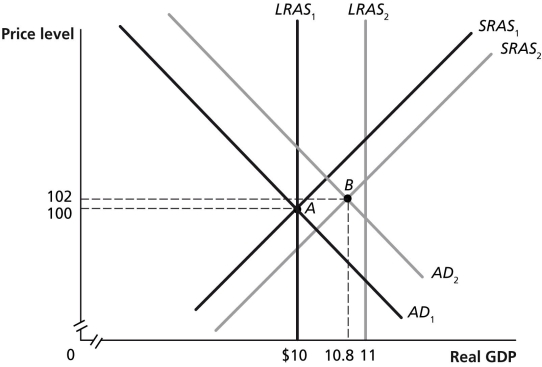 -Refer to Figure 18-5.In the dynamic model of AD-AS in the figure above,if the economy is at point A in year 1 and is expected to go to point B in year 2,Congress and the president would most likely
 (Multiple Choice)
4.7/5 (65)
(65) Contractionary fiscal policy involves decreasing government purchases or increasing taxes.
(True/False)
4.9/5 (92)
(92) Expansionary fiscal policy ________ the price level and ________ equilibrium real GDP.
(Multiple Choice)
4.9/5 (88)
(88) Congress and the president carry out fiscal policy through changes in
(Multiple Choice)
4.9/5 (68)
(68) Data indicates that recessions following financial crises ________ recessions which do not follow financial crises.
(Multiple Choice)
4.8/5 (77)
(77) 
Filters
- Essay(0)
- Multiple Choice(0)
- Short Answer(0)
- True False(0)
- Matching(0)