



 Chat with AI
Exam 18: Fiscal Policy

Exam 1: Economics: Foundations and Models459 Questions
Exam 2: Trade-Offs, Comparative Advantage, and the Market System495 Questions
Exam 3: Where Prices Come From: The Interaction of Demand and Supply476 Questions
Exam 4: Market Efficiency and Market Failure464 Questions
Exam 5: The Economics of Health Care337 Questions
Exam 6: Firms, The Stock Market, and Corporate Governance456 Questions
Exam 7: Consumer Choice and Elasticity384 Questions
Exam 8: Technology,Production,and Costs274 Questions
Exam 9: Firms in Perfectly Competitive Markets297 Questions
Exam 10: Monopoly and Antitrust Policy279 Questions
Exam 11: Monopolistic Competition and Oligopoly410 Questions
Exam 12: GDP: Measuring Total Production and Income261 Questions
Exam 13: Unemployment and Inflation290 Questions
Exam 14: Economic Growth, The Financial System, and Business Cycles251 Questions
Exam 15: Aggregate Demand and Aggregate Supply Analysis286 Questions
Exam 16: Money,Banks,and the Federal Reserve System278 Questions
Exam 17: Monetary Policy280 Questions
Exam 18: Fiscal Policy292 Questions
Exam 19: Comparative Advantage, International Trade, and Exchange Rates443 Questions
Select questions type


Suppose real GDP is $13 trillion,potential real GDP is $13.5 trillion,and Congress and the president plan to use fiscal policy to restore the economy to potential real GDP.Assuming a constant price level,Congress and the president would need to increase government purchases by
(Multiple Choice)
4.8/5  (79)
(79) Prior to the 1930s,the majority of dollars spent by government was spent at the state and local levels.
(True/False)
4.9/5 (79)
(79) If policymakers implement an expansionary fiscal policy but do not take into account the potential for crowding out,the new equilibrium level of GDP is likely to
(Multiple Choice)
4.9/5 (92)
(92) As a percentage of GDP,federal expenditures ________ from 1992 to 2001,________ from 2001 to 2011,and have ________ since 2011.
(Multiple Choice)
4.9/5 (72)
(72) Which of the following would be most likely to induce Congress and the president to conduct expansionary fiscal policy? A significant
(Multiple Choice)
4.8/5 (92)
(92) If the federal budget goes from a budget deficit in Year 1 to a budget surplus in Year 2,does it follow that the federal government acted to raise taxes or cut government spending in Year 2?
(Essay)
4.8/5 (78)
(78) For the years 2017-2027,the Congressional Budget Office expects that population growth will be much slower than growth in hours worked.
(True/False)
4.8/5 (76)
(76) Table 18-3
Year Potential Real GDP Real GDP Price Level 2018 \ 18.0 trillion \ 18.0 trillion 150 2019 18.5 trillion 18.2 trillion 152
-Refer to Table 18-3.Consider the hypothetical information in the table above for potential real GDP,real GDP,and the price level in 2018 and in 2019 if Congress and the president do not use fiscal policy.If Congress and the president use fiscal policy successfully to keep real GDP at its potential level in 2019,which of the following will be higher than if Congress and the president had taken no action?
(Multiple Choice)
4.9/5 (97)
(97) Figure 18-7
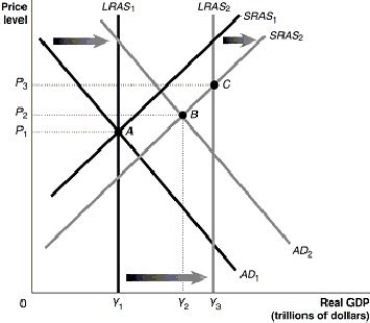 -Refer to Figure 18-7.Given that the economy has moved from A to B in the graph above,which of the following would be the appropriate fiscal policy to achieve potential GDP?
 (Multiple Choice)
4.9/5 (71)
(71) A tax rebate,which is expected to be offered in this and all future years,will
(Multiple Choice)
4.8/5 (91)
(91) Figure 18-1
 -Refer to Figure 18-1.Suppose the economy is in short-run equilibrium above potential GDP and wages and prices are rising.If contractionary policy is used to move the economy back to long run equilibrium,this would be depicted as a movement from ________ using the basic AD-AS model in the figure above.
 (Multiple Choice)
4.8/5 (81)
(81) The Federal Reserve plays a larger role than Congress and the president in stabilizing the economy because
(Multiple Choice)
4.9/5 (91)
(91) As the tax wedge associated with a given economic activity gets smaller,we would expect
(Multiple Choice)
4.9/5 (66)
(66) The long-run growth rate of real GDP depends primarily on the growth in the number of hours worked and the growth rate of labor productivity.
(True/False)
4.8/5 (74)
(74) Which of the following is considered expansionary fiscal policy?
(Multiple Choice)
4.8/5 (69)
(69) 
Filters
- Essay(0)
- Multiple Choice(0)
- Short Answer(0)
- True False(0)
- Matching(0)