



 Chat with AI
Exam 18: Fiscal Policy

Exam 1: Economics: Foundations and Models459 Questions
Exam 2: Trade-Offs, Comparative Advantage, and the Market System495 Questions
Exam 3: Where Prices Come From: The Interaction of Demand and Supply476 Questions
Exam 4: Market Efficiency and Market Failure464 Questions
Exam 5: The Economics of Health Care337 Questions
Exam 6: Firms, The Stock Market, and Corporate Governance456 Questions
Exam 7: Consumer Choice and Elasticity384 Questions
Exam 8: Technology,Production,and Costs274 Questions
Exam 9: Firms in Perfectly Competitive Markets297 Questions
Exam 10: Monopoly and Antitrust Policy279 Questions
Exam 11: Monopolistic Competition and Oligopoly410 Questions
Exam 12: GDP: Measuring Total Production and Income261 Questions
Exam 13: Unemployment and Inflation290 Questions
Exam 14: Economic Growth, The Financial System, and Business Cycles251 Questions
Exam 15: Aggregate Demand and Aggregate Supply Analysis286 Questions
Exam 16: Money,Banks,and the Federal Reserve System278 Questions
Exam 17: Monetary Policy280 Questions
Exam 18: Fiscal Policy292 Questions
Exam 19: Comparative Advantage, International Trade, and Exchange Rates443 Questions
Select questions type


Economists who believe the supply-side effects of tax cuts are small essentially believe that
(Multiple Choice)
4.9/5  (77)
(77) Some economists argue that the federal government should normally run a deficit at potential GDP,with the borrowed funds applied to
(Multiple Choice)
4.8/5 (77)
(77) To complement actions by the Fed to reduce inflation,Congress and the President can cut spending and/or raise taxes.
(True/False)
5.0/5 (81)
(81) If government increases taxes by the same amount it increases government spending,there will be no effect on aggregate demand: the increase in government spending is offset by an equal decrease in consumption spending by households.
(True/False)
4.9/5 (78)
(78) Suppose real GDP is $13 trillion and potential real GDP is $13.5 trillion.If Congress and the president increase government purchases by $500 billion,then the economy will be brought to equilibrium at potential real GDP.
(True/False)
4.7/5 (70)
(70) The automatic budget surpluses and budget deficits that occur in the federal budget over the business cycle
(Multiple Choice)
4.9/5 (97)
(97) Contractionary fiscal policy to prevent real GDP from rising above potential real GDP would cause the inflation rate to be ________ and real GDP to be ________.
(Multiple Choice)
4.9/5 (84)
(84) An increase in government spending may expedite recovery from a recession in the short run,but in the long run this policy may
(Multiple Choice)
4.8/5 (70)
(70) How does expansionary monetary policy increase spending in the economy compared to how expansionary fiscal policy increases spending in the economy?
(Essay)
4.9/5 (74)
(74) An economic expansion tends to cause the federal budget deficit to ________ because tax revenues ________ and government spending on transfer payments ________.
(Multiple Choice)
4.8/5 (76)
(76) Of the $840 billion American Recovery and Reinvestment Act stimulus package which was enacted in 2009,approximately one-third took the form of ________ and two-thirds took the form of increases in ________.
(Multiple Choice)
4.9/5 (73)
(73) Figure 18-9
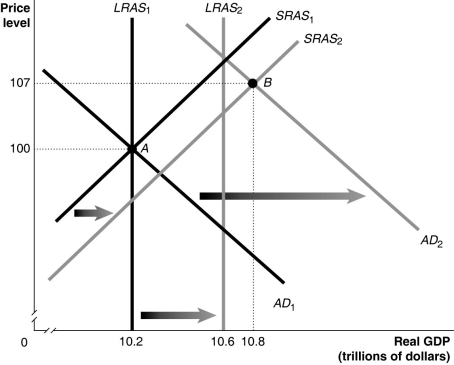 -Refer to Figure 18-9.Given that the economy has moved from point A to point B in the graph above,which of the following would be the appropriate fiscal policy to achieve potential GDP?
 (Multiple Choice)
4.8/5 (83)
(83) Long lags associated with the legislative process in implementing fiscal policy make it more difficult to use than monetary policy.
(True/False)
4.8/5 (85)
(85) An equal increase in government purchases and taxes will cause
(Multiple Choice)
4.9/5 (89)
(89) Expansionary fiscal policy to prevent real GDP from falling below potential real GDP would cause the inflation rate to be ________ and real GDP to be ________.
(Multiple Choice)
4.8/5 (74)
(74) Which of the following is a government expenditure,but is not a government purchase?
(Multiple Choice)
4.8/5 (83)
(83) The Trump administration hopes to expand apprenticeship programs that provide skills needed by workers.This would ________ the employment-population ratio,which would increase ________.
(Multiple Choice)
4.9/5 (71)
(71) The federal government debt ________ when the federal government runs a deficit and ________ when the federal government runs a surplus.
(Multiple Choice)
4.8/5 (89)
(89) The federal budget exhibited a $128.7 billion surplus in 2001 but moved to a deficit of $157.8 billion in 2002.Some argued the deficit was opened up because of the Bush 2001 tax cuts,but others argued that the deficit grew because of the recession suffered in 2001.Evaluate the validity of the second argument.
(Essay)
4.8/5 (76)
(76) 
Filters
- Essay(0)
- Multiple Choice(0)
- Short Answer(0)
- True False(0)
- Matching(0)