



 Chat with AI
Exam 18: Fiscal Policy

Exam 1: Economics: Foundations and Models459 Questions
Exam 2: Trade-Offs, Comparative Advantage, and the Market System495 Questions
Exam 3: Where Prices Come From: The Interaction of Demand and Supply476 Questions
Exam 4: Market Efficiency and Market Failure464 Questions
Exam 5: The Economics of Health Care337 Questions
Exam 6: Firms, The Stock Market, and Corporate Governance456 Questions
Exam 7: Consumer Choice and Elasticity384 Questions
Exam 8: Technology,Production,and Costs274 Questions
Exam 9: Firms in Perfectly Competitive Markets297 Questions
Exam 10: Monopoly and Antitrust Policy279 Questions
Exam 11: Monopolistic Competition and Oligopoly410 Questions
Exam 12: GDP: Measuring Total Production and Income261 Questions
Exam 13: Unemployment and Inflation290 Questions
Exam 14: Economic Growth, The Financial System, and Business Cycles251 Questions
Exam 15: Aggregate Demand and Aggregate Supply Analysis286 Questions
Exam 16: Money,Banks,and the Federal Reserve System278 Questions
Exam 17: Monetary Policy280 Questions
Exam 18: Fiscal Policy292 Questions
Exam 19: Comparative Advantage, International Trade, and Exchange Rates443 Questions
Select questions type


Which of the following provides health-care coverage to people age 65 and over?
(Multiple Choice)
4.9/5  (87)
(87) An increase in government purchases of $200 billion will shift the aggregate demand curve to the right by
(Multiple Choice)
4.9/5 (73)
(73) Increasing the federal budget deficit will contribute to increasing the federal government debt.
(True/False)
4.9/5 (89)
(89) Figure 18-1
 -Refer to Figure 18-1.Suppose the economy is in short-run equilibrium above potential GDP and no policy is pursued.Using the basic AD-AS model in the figure above,this would be depicted as a movement from
 (Multiple Choice)
4.8/5 (81)
(81) Describe the differences (in sign and relative magnitude)between the government purchases multiplier and the tax multiplier.
(Essay)
4.7/5 (77)
(77) The cyclically adjusted budget deficit calculates the budget surplus or deficit at
(Multiple Choice)
4.9/5 (71)
(71) Tax cuts on business income increase aggregate demand by increasing
(Multiple Choice)
4.9/5 (75)
(75) The multiplier effect following an increase in expenditure is generated by induced increases in consumption expenditure as income rises.
(True/False)
4.9/5 (86)
(86) Decreasing government spending ________ the price level and ________ equilibrium real GDP.
(Multiple Choice)
4.8/5 (76)
(76) Consider the following statement,"The Federal Reserve fights recessions by increasing the money supply so people will have more money to spend." What is wrong with the statement and how can it be corrected?
(Essay)
4.8/5 (73)
(73) Figure 18-3
 -Refer to Figure 18-3.In the graph above,suppose the economy is initially at point A.The movement of the economy to point B as shown in the graph illustrates the effect of which of the following policy actions by Congress and the president?
 (Multiple Choice)
4.9/5 (82)
(82) When the Social Security program was in its infancy in 1940,the ratio of workers to retirees was more than 150 to 1.Currently,the ratio of workers to retirees is
(Multiple Choice)
5.0/5 (84)
(84) To combat a recession with discretionary fiscal policy,Congress and the president should
(Multiple Choice)
4.8/5 (86)
(86) Contractionary fiscal policy is used to decrease aggregate demand in an attempt to fight rising inflation.
(True/False)
4.9/5 (80)
(80) Figure 18-11
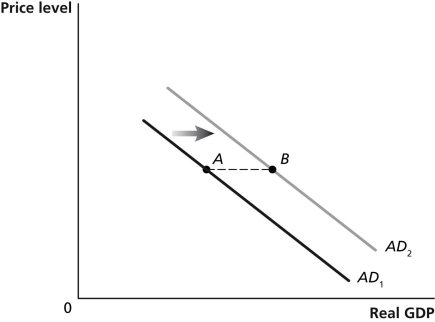 -Refer to Figure 18-11.In the graph above,the shift from AD₁ to AD₂ represents the total change in aggregate demand.If government purchases increased by $50 billion,then the distance from point A to point B ________ $50 billion.
 (Multiple Choice)
4.7/5 (61)
(61) Poorly timed discretionary policy can do more harm than good.Getting the timing right with fiscal policy is generally
(Multiple Choice)
4.8/5 (67)
(67) The aggregate demand curve will shift to the right ________ the initial decrease in taxes.
(Multiple Choice)
5.0/5 (80)
(80) 
Filters
- Essay(0)
- Multiple Choice(0)
- Short Answer(0)
- True False(0)
- Matching(0)