



 Chat with AI
Exam 50: Sensory and Motor Mechanisms

Exam 1: Introduction: Evolution and Themes of Biology70 Questions
Exam 2: The Chemical Context of Life90 Questions
Exam 3: Water and Life80 Questions
Exam 4: Carbon and the Molecular Diversity of Life78 Questions
Exam 5: The Structure and Function of Large Biological Molecules117 Questions
Exam 6: A Tour of the Cell96 Questions
Exam 7: Membrane Structure and Function78 Questions
Exam 8: An Introduction to Metabolism88 Questions
Exam 9: Cellular Respiration and Fermentation117 Questions
Exam 10: Photosynthesis89 Questions
Exam 11: Cell Communication77 Questions
Exam 12: The Cell Cycle83 Questions
Exam 13: Meiosis and Sexual Life Cycles74 Questions
Exam 14: Mendel and the Gene Idea82 Questions
Exam 15: The Chromosomal Basis of Inheritance66 Questions
Exam 16: The Molecular Basis of Inheritance67 Questions
Exam 17: From Gene to Protein91 Questions
Exam 18: Regulation of Gene Expression107 Questions
Exam 19: Viruses53 Questions
Exam 20: Dna Tools and Biotechnology72 Questions
Exam 21: Genomes and Their Evolution52 Questions
Exam 22: Descent With Modification: a Darwinian View of Life63 Questions
Exam 23: The Evolution of Populations86 Questions
Exam 24: The Origin of Species71 Questions
Exam 25: The History of Life on Earth83 Questions
Exam 26: Phylogeny and the Tree of Life81 Questions
Exam 27: Bacteria and Archaea86 Questions
Exam 28: Protists84 Questions
Exam 29: Plant Diversity I: How Plants Colonized Land82 Questions
Exam 30: Plant Diversity Ii: the Evolution of Seed Plants110 Questions
Exam 31: Fungi97 Questions
Exam 32: An Overview of Animal Diversity82 Questions
Exam 33: An Introduction to Invertebrates101 Questions
Exam 34: The Origin and Evolution of Vertebrates117 Questions
Exam 35: Plant Structure, Growth, and Development75 Questions
Exam 36: Resource Acquisition and Transport in Vascular Plants89 Questions
Exam 37: Soil and Plant Nutrition91 Questions
Exam 38: Angiosperm Reproduction and Biotechnology94 Questions
Exam 39: Plant Responses to Internal and External Signals116 Questions
Exam 40: Basic Principles of Animal Form and Function86 Questions
Exam 41: Animal Nutrition73 Questions
Exam 42: Circulation and Gas Exchange100 Questions
Exam 43: The Immune System110 Questions
Exam 44: Osmoregulation and Excretion79 Questions
Exam 45: Hormones and the Endocrine System82 Questions
Exam 46: Animal Reproduction104 Questions
Exam 47: Animal Development98 Questions
Exam 48: Neurons, Synapses, and Signalling81 Questions
Exam 49: Nervous Systems73 Questions
Exam 50: Sensory and Motor Mechanisms91 Questions
Exam 51: Animal Behaviour79 Questions
Exam 52: An Introduction to Ecology and the Biosphere81 Questions
Exam 53: Population Ecology87 Questions
Exam 54: Community Ecology85 Questions
Exam 55: Ecosystems and Restoration Ecology89 Questions
Exam 56: Conservation Biology and Global Change75 Questions
Select questions type


When ascending in an airplane, you feel your ears pop. This equalization of pressure is due to which auditory structure?
(Multiple Choice)
4.9/5  (86)
(86) Proteins coded by a very large family of related genes are active in the sensory transduction of
(Multiple Choice)
4.7/5 (78)
(78) Use the following figure to answer the questions below.
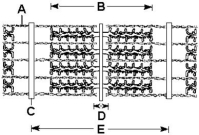 -The structure pictured in the figure is found in
 (Multiple Choice)
4.8/5 (87)
(87) The lateral line system in fish transduces sensory information in a manner that, among these choices, is most similar to
(Multiple Choice)
4.9/5 (76)
(76) Most of the chemosensory neurons arising in the nasal cavity have axonal projections that terminate in the
(Multiple Choice)
4.9/5 (86)
(86) A skeletal muscle with abnormally low levels of calcium ions would be impaired in
(Multiple Choice)
4.8/5 (79)
(79) Use the following figure to answer the questions below.
-Myosin filaments without actin overlap are in which section of the figure?
-Myosin filaments without actin overlap are in which section of the figure? (Multiple Choice)
4.7/5 (99)
(99) The calcium ions released into the cytosol during excitation of skeletal muscle bind to
(Multiple Choice)
5.0/5 (80)
(80) Lateral inhibition via amacrine cells in the mammalian retina
(Multiple Choice)
4.8/5 (83)
(83) Use the following information to answer the next few questions.
In science class, you are identifying and dissecting several fish species. In fish #1, you observe that the muscle tissue is primarily light coloured, while fish #2 has dark muscle tissue.
-What assumption can you make about fish #1? I. The fish would fatigue quickly.
II. Muscle fibres have a large diameter.
III. Fibres have very little myoglobin.
(Multiple Choice)
4.9/5 (74)
(74) Immediately after putting on a shirt, your skin might feel itchy. However, this perception soon fades due to
(Multiple Choice)
4.9/5 (83)
(83) Most of the ATP supplies for a skeletal muscle undergoing one hour of sustained exercise come from
(Multiple Choice)
4.7/5 (82)
(82) The 11 pairs of appendages projecting from the rostral area of star-nosed moles are
(Multiple Choice)
4.9/5 (73)
(73) 
Filters
- Essay(0)
- Multiple Choice(0)
- Short Answer(0)
- True False(0)
- Matching(0)