



 Chat with AI
Exam 44: Osmoregulation and Excretion

Exam 1: Introduction: Evolution and Themes of Biology70 Questions
Exam 2: The Chemical Context of Life90 Questions
Exam 3: Water and Life80 Questions
Exam 4: Carbon and the Molecular Diversity of Life78 Questions
Exam 5: The Structure and Function of Large Biological Molecules117 Questions
Exam 6: A Tour of the Cell96 Questions
Exam 7: Membrane Structure and Function78 Questions
Exam 8: An Introduction to Metabolism88 Questions
Exam 9: Cellular Respiration and Fermentation117 Questions
Exam 10: Photosynthesis89 Questions
Exam 11: Cell Communication77 Questions
Exam 12: The Cell Cycle83 Questions
Exam 13: Meiosis and Sexual Life Cycles74 Questions
Exam 14: Mendel and the Gene Idea82 Questions
Exam 15: The Chromosomal Basis of Inheritance66 Questions
Exam 16: The Molecular Basis of Inheritance67 Questions
Exam 17: From Gene to Protein91 Questions
Exam 18: Regulation of Gene Expression107 Questions
Exam 19: Viruses53 Questions
Exam 20: Dna Tools and Biotechnology72 Questions
Exam 21: Genomes and Their Evolution52 Questions
Exam 22: Descent With Modification: a Darwinian View of Life63 Questions
Exam 23: The Evolution of Populations86 Questions
Exam 24: The Origin of Species71 Questions
Exam 25: The History of Life on Earth83 Questions
Exam 26: Phylogeny and the Tree of Life81 Questions
Exam 27: Bacteria and Archaea86 Questions
Exam 28: Protists84 Questions
Exam 29: Plant Diversity I: How Plants Colonized Land82 Questions
Exam 30: Plant Diversity Ii: the Evolution of Seed Plants110 Questions
Exam 31: Fungi97 Questions
Exam 32: An Overview of Animal Diversity82 Questions
Exam 33: An Introduction to Invertebrates101 Questions
Exam 34: The Origin and Evolution of Vertebrates117 Questions
Exam 35: Plant Structure, Growth, and Development75 Questions
Exam 36: Resource Acquisition and Transport in Vascular Plants89 Questions
Exam 37: Soil and Plant Nutrition91 Questions
Exam 38: Angiosperm Reproduction and Biotechnology94 Questions
Exam 39: Plant Responses to Internal and External Signals116 Questions
Exam 40: Basic Principles of Animal Form and Function86 Questions
Exam 41: Animal Nutrition73 Questions
Exam 42: Circulation and Gas Exchange100 Questions
Exam 43: The Immune System110 Questions
Exam 44: Osmoregulation and Excretion79 Questions
Exam 45: Hormones and the Endocrine System82 Questions
Exam 46: Animal Reproduction104 Questions
Exam 47: Animal Development98 Questions
Exam 48: Neurons, Synapses, and Signalling81 Questions
Exam 49: Nervous Systems73 Questions
Exam 50: Sensory and Motor Mechanisms91 Questions
Exam 51: Animal Behaviour79 Questions
Exam 52: An Introduction to Ecology and the Biosphere81 Questions
Exam 53: Population Ecology87 Questions
Exam 54: Community Ecology85 Questions
Exam 55: Ecosystems and Restoration Ecology89 Questions
Exam 56: Conservation Biology and Global Change75 Questions
Select questions type


An excretory system that is partly based on the filtration of fluid under high hydrostatic pressure is the
(Multiple Choice)
4.8/5  (85)
(85) In a laboratory experiment with three groups of students, one group drinks pure water, a second group drinks an equal amount of beer, and a third group drinks an equal amount of concentrated salt solution, all during the same time period. Their urine production is monitored for several hours. Which groups are expected to have the greatest and least amounts of urine, respectively?
(Multiple Choice)
4.8/5 (78)
(78) In humans, the transport epithelial cells in the ascending loop of Henle
(Multiple Choice)
4.8/5 (76)
(76) The osmoregulatory/excretory system of an earthworm is based on the operation of
(Multiple Choice)
4.8/5 (78)
(78) Excretory structures known as protonephridia are present in
(Multiple Choice)
4.9/5 (83)
(83) After blood flow is artificially reduced at one kidney, you would expect that kidney to secrete more of the hormone known as
(Multiple Choice)
4.8/5 (67)
(67) Human urine is usually more acidic than most other body fluids because
(Multiple Choice)
4.9/5 (82)
(82) Use the following structural formulas to identify the following items.
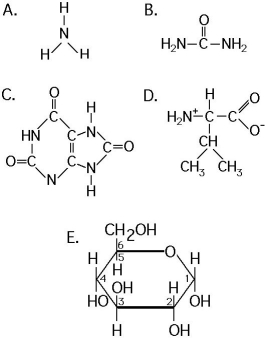 -Which of the following is synthesized by mammals, most amphibians, sharks, and some bony fishes, and has lower toxicity than its nitrogenous substrate?
 (Multiple Choice)
4.8/5 (77)
(77) The high osmolarity of the renal medulla is maintained by all of the following except
(Multiple Choice)
4.9/5 (84)
(84) Within a normally functioning kidney, blood can be found in
(Multiple Choice)
4.9/5 (89)
(89) Excretory organs known as Malpighian tubules are present in
(Multiple Choice)
4.9/5 (91)
(91) The porbeagle shark (Lamana nasus), found on the continental shelf between Newfoundland and Labrador and Gulf of Maine, excretes ________ which is produced in the ________.
(Multiple Choice)
4.8/5 (87)
(87) A primary reason that the kidneys have one of the highest metabolic rates of all body organs is that
(Multiple Choice)
4.8/5 (78)
(78) A human who has no access to fresh water but is forced to drink sea water instead
(Multiple Choice)
4.9/5 (68)
(68) When stimulated by aldosterone, the reabsorption of Na⁺ is increased along
(Multiple Choice)
4.7/5 (74)
(74) In animals, nitrogenous wastes are produced mostly from the catabolism of
(Multiple Choice)
4.9/5 (80)
(80) 
Filters
- Essay(0)
- Multiple Choice(0)
- Short Answer(0)
- True False(0)
- Matching(0)