



 Chat with AI
Exam 29: Plant Diversity I: How Plants Colonized Land

Exam 1: Introduction: Evolution and Themes of Biology70 Questions
Exam 2: The Chemical Context of Life90 Questions
Exam 3: Water and Life80 Questions
Exam 4: Carbon and the Molecular Diversity of Life78 Questions
Exam 5: The Structure and Function of Large Biological Molecules117 Questions
Exam 6: A Tour of the Cell96 Questions
Exam 7: Membrane Structure and Function78 Questions
Exam 8: An Introduction to Metabolism88 Questions
Exam 9: Cellular Respiration and Fermentation117 Questions
Exam 10: Photosynthesis89 Questions
Exam 11: Cell Communication77 Questions
Exam 12: The Cell Cycle83 Questions
Exam 13: Meiosis and Sexual Life Cycles74 Questions
Exam 14: Mendel and the Gene Idea82 Questions
Exam 15: The Chromosomal Basis of Inheritance66 Questions
Exam 16: The Molecular Basis of Inheritance67 Questions
Exam 17: From Gene to Protein91 Questions
Exam 18: Regulation of Gene Expression107 Questions
Exam 19: Viruses53 Questions
Exam 20: Dna Tools and Biotechnology72 Questions
Exam 21: Genomes and Their Evolution52 Questions
Exam 22: Descent With Modification: a Darwinian View of Life63 Questions
Exam 23: The Evolution of Populations86 Questions
Exam 24: The Origin of Species71 Questions
Exam 25: The History of Life on Earth83 Questions
Exam 26: Phylogeny and the Tree of Life81 Questions
Exam 27: Bacteria and Archaea86 Questions
Exam 28: Protists84 Questions
Exam 29: Plant Diversity I: How Plants Colonized Land82 Questions
Exam 30: Plant Diversity Ii: the Evolution of Seed Plants110 Questions
Exam 31: Fungi97 Questions
Exam 32: An Overview of Animal Diversity82 Questions
Exam 33: An Introduction to Invertebrates101 Questions
Exam 34: The Origin and Evolution of Vertebrates117 Questions
Exam 35: Plant Structure, Growth, and Development75 Questions
Exam 36: Resource Acquisition and Transport in Vascular Plants89 Questions
Exam 37: Soil and Plant Nutrition91 Questions
Exam 38: Angiosperm Reproduction and Biotechnology94 Questions
Exam 39: Plant Responses to Internal and External Signals116 Questions
Exam 40: Basic Principles of Animal Form and Function86 Questions
Exam 41: Animal Nutrition73 Questions
Exam 42: Circulation and Gas Exchange100 Questions
Exam 43: The Immune System110 Questions
Exam 44: Osmoregulation and Excretion79 Questions
Exam 45: Hormones and the Endocrine System82 Questions
Exam 46: Animal Reproduction104 Questions
Exam 47: Animal Development98 Questions
Exam 48: Neurons, Synapses, and Signalling81 Questions
Exam 49: Nervous Systems73 Questions
Exam 50: Sensory and Motor Mechanisms91 Questions
Exam 51: Animal Behaviour79 Questions
Exam 52: An Introduction to Ecology and the Biosphere81 Questions
Exam 53: Population Ecology87 Questions
Exam 54: Community Ecology85 Questions
Exam 55: Ecosystems and Restoration Ecology89 Questions
Exam 56: Conservation Biology and Global Change75 Questions
Select questions type


Which of the following characteristics helped seedless plants better adapt to life on land?
(Multiple Choice)
4.8/5  (65)
(65) Refer to the following information to answer the next few questions.
Researchers decided to test the hypothesis that if the 2-m tall Polytrichum gametophyte- sporophyte plants had acted as a physical buffer, then they would have reduced water's ability to erode the soil and carry away its nitrogen. They began with four equal-sized areas where Polytrichum mosses grew to a height of 2 m above the soil surface. One of the four areas was not modified. In the second area, the mosses were trimmed to a height of 1 m above the soil surface. In the third area, the mosses were trimmed to a height of 0.5 m above the soil surface. In the fourth area, the mosses were trimmed all the way to the ground, leaving only the rhizoids. Water, simulating rainfall, was then added in a controlled fashion to all plots over the course of one year. The figure below presents four graphs that depict potential results of this experiment.
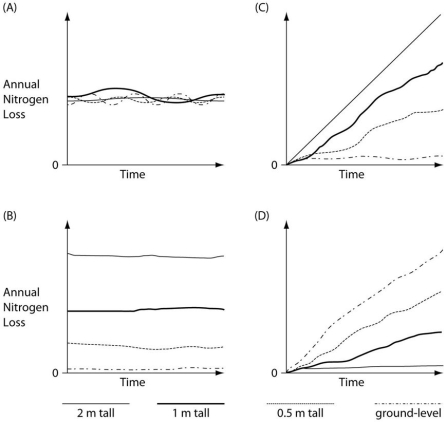 -Why should we expect the soil's nitrogen not to be contained solely within the rhizoids of the Polytrichum mosses?
 (Multiple Choice)
4.8/5 (88)
(88) Evidence indicates that plants increase the number of stomata in their leaves as atmospheric CO₂ levels decline. Increasing the number of stomata per unit surface area should have the effect of doing which of the following? 1. increase dehydration of leaf tissues
2. decrease dehydration of leaf tissues
3. counter the effect of declining CO₂ on photosynthesis
4. reinforce the effect of declining CO₂ on photosynthesis
5. decrease the O₂ content of air next to the leaves to a level lower than it would otherwise be
6. increase the O₂ content of air next to the leaves to a level higher than it would otherwise be
(Multiple Choice)
4.9/5 (79)
(79) If humans had been present to build log structures during the Carboniferous period (they weren't), which plant types would have been suitable sources of logs?
(Multiple Choice)
4.9/5 (77)
(77) Use the following figure to answer the questions below.
 -Which of the following should be most helpful in distinguishing the clades depicted on the tree in the above figure from each other?
 (Multiple Choice)
4.8/5 (89)
(89) Use the information that follows to answer the questions below.
Big Bend National Park in Texas is mostly Chihuahuan desert, where rainfall averages about 10 inches per year. Yet, it is not uncommon when hiking in this bone-dry desert to encounter mosses and ferns. One such plant is called "flower of stone." It is not a flowering plant, nor does it produce seeds. Under arid conditions, its leaflike structures curl up. However, when it rains, it unfurls its leaves, which form a bright green rosette on the desert floor. Consequently, it is sometimes called the "resurrection plant." At first glance, it could be a fern, a true moss, or a spike moss.
-What feature of both true mosses and ferns makes it most surprising that they can survive for many generations in dry deserts?
(Multiple Choice)
4.9/5 (92)
(92) All of the following are common to both charophytes and land plants except
(Multiple Choice)
4.8/5 (90)
(90) Use the information that follows to answer the questions below.
Big Bend National Park in Texas is mostly Chihuahuan desert, where rainfall averages about 10 inches per year. Yet, it is not uncommon when hiking in this bone-dry desert to encounter mosses and ferns. One such plant is called "flower of stone." It is not a flowering plant, nor does it produce seeds. Under arid conditions, its leaflike structures curl up. However, when it rains, it unfurls its leaves, which form a bright green rosette on the desert floor. Consequently, it is sometimes called the "resurrection plant." At first glance, it could be a fern, a true moss, or a spike moss.
-Which of the following characteristics is (are)possessed in common by true mosses, ferns, and spike mosses, and therefore becomes useless at helping to determine to which of these groups flower of stone belongs? 1. a sporophyte generation that is dominant
2. true leaves and roots
3. flagellated sperm
4. strobili
5. alternation of generations
(Multiple Choice)
4.8/5 (71)
(71) If you are looking for structures that transfer water and nutrients from a bryophyte gametophyte to a bryophyte sporophyte, then on which part of the sporophyte should you focus your attention?
(Multiple Choice)
4.8/5 (73)
(73) Which of the following statements correctly describes the alternation of generation cycle of a fern?
(Multiple Choice)
4.9/5 (75)
(75) You are hiking in a forest and come upon a mysterious plant, which you determine is either a lycophyte sporophyte or a pterophyte sporophyte. Which of the following would be most helpful in determining the correct classification of the plant?
(Multiple Choice)
4.8/5 (90)
(90) Which taxon is essentially equivalent to the "embryophytes"?
(Multiple Choice)
4.8/5 (83)
(83) Refer to the following information to answer the next few questions.
Researchers decided to test the hypothesis that if the 2-m tall Polytrichum gametophyte- sporophyte plants had acted as a physical buffer, then they would have reduced water's ability to erode the soil and carry away its nitrogen. They began with four equal-sized areas where Polytrichum mosses grew to a height of 2 m above the soil surface. One of the four areas was not modified. In the second area, the mosses were trimmed to a height of 1 m above the soil surface. In the third area, the mosses were trimmed to a height of 0.5 m above the soil surface. In the fourth area, the mosses were trimmed all the way to the ground, leaving only the rhizoids. Water, simulating rainfall, was then added in a controlled fashion to all plots over the course of one year. The figure below presents four graphs that depict potential results of this experiment.
-Which of these potential results of applying a metabolic poison to the rhizoids of Polytrichum should interfere the least with the ability to draw valid conclusions from this experiment?
-Which of these potential results of applying a metabolic poison to the rhizoids of Polytrichum should interfere the least with the ability to draw valid conclusions from this experiment? (Multiple Choice)
4.8/5 (86)
(86) In animal cells and in the meristem cells of land plants, the nuclear envelope disintegrates during mitosis. This disintegration does not occur in the cells of most protists and fungi. According to our current knowledge of plant evolution, which group of organisms should feature mitosis most similar to that of land plants?
(Multiple Choice)
4.8/5 (60)
(60) Use the following figure to answer the questions below.
-What is true of the phylogenetic tree in the figure above? 1. It depicts uncertainty about whether the bryophytes or the vascular plants evolved first.
2. It is hypothetical.
3. It includes polytomies.
4. It shows that ferns (phylum Pterophyta)are the closest living relatives to the seed plants.
5. It indicates that seeds are a shared ancestral character of all vascular plants.
-What is true of the phylogenetic tree in the figure above? 1. It depicts uncertainty about whether the bryophytes or the vascular plants evolved first.
2. It is hypothetical.
3. It includes polytomies.
4. It shows that ferns (phylum Pterophyta)are the closest living relatives to the seed plants.
5. It indicates that seeds are a shared ancestral character of all vascular plants. (Multiple Choice)
4.9/5 (84)
(84) Which of the following are land plants that use the same means of getting sperm to egg that algae use?
(Multiple Choice)
4.7/5 (77)
(77) In terms of evolutionary time, which phyla are the oldest and which are the most recent (respectively)?
(Multiple Choice)
5.0/5 (71)
(71) Use the following figure to answer the questions below.
-The resolution of the relationships indicated by dashed lines in the figure above will most probably come from
-The resolution of the relationships indicated by dashed lines in the figure above will most probably come from (Multiple Choice)
4.8/5 (80)
(80) 
Filters
- Essay(0)
- Multiple Choice(0)
- Short Answer(0)
- True False(0)
- Matching(0)