



 Chat with AI
Exam 29: Plant Diversity I: How Plants Colonized Land

Exam 1: Introduction: Evolution and Themes of Biology70 Questions
Exam 2: The Chemical Context of Life90 Questions
Exam 3: Water and Life80 Questions
Exam 4: Carbon and the Molecular Diversity of Life78 Questions
Exam 5: The Structure and Function of Large Biological Molecules117 Questions
Exam 6: A Tour of the Cell96 Questions
Exam 7: Membrane Structure and Function78 Questions
Exam 8: An Introduction to Metabolism88 Questions
Exam 9: Cellular Respiration and Fermentation117 Questions
Exam 10: Photosynthesis89 Questions
Exam 11: Cell Communication77 Questions
Exam 12: The Cell Cycle83 Questions
Exam 13: Meiosis and Sexual Life Cycles74 Questions
Exam 14: Mendel and the Gene Idea82 Questions
Exam 15: The Chromosomal Basis of Inheritance66 Questions
Exam 16: The Molecular Basis of Inheritance67 Questions
Exam 17: From Gene to Protein91 Questions
Exam 18: Regulation of Gene Expression107 Questions
Exam 19: Viruses53 Questions
Exam 20: Dna Tools and Biotechnology72 Questions
Exam 21: Genomes and Their Evolution52 Questions
Exam 22: Descent With Modification: a Darwinian View of Life63 Questions
Exam 23: The Evolution of Populations86 Questions
Exam 24: The Origin of Species71 Questions
Exam 25: The History of Life on Earth83 Questions
Exam 26: Phylogeny and the Tree of Life81 Questions
Exam 27: Bacteria and Archaea86 Questions
Exam 28: Protists84 Questions
Exam 29: Plant Diversity I: How Plants Colonized Land82 Questions
Exam 30: Plant Diversity Ii: the Evolution of Seed Plants110 Questions
Exam 31: Fungi97 Questions
Exam 32: An Overview of Animal Diversity82 Questions
Exam 33: An Introduction to Invertebrates101 Questions
Exam 34: The Origin and Evolution of Vertebrates117 Questions
Exam 35: Plant Structure, Growth, and Development75 Questions
Exam 36: Resource Acquisition and Transport in Vascular Plants89 Questions
Exam 37: Soil and Plant Nutrition91 Questions
Exam 38: Angiosperm Reproduction and Biotechnology94 Questions
Exam 39: Plant Responses to Internal and External Signals116 Questions
Exam 40: Basic Principles of Animal Form and Function86 Questions
Exam 41: Animal Nutrition73 Questions
Exam 42: Circulation and Gas Exchange100 Questions
Exam 43: The Immune System110 Questions
Exam 44: Osmoregulation and Excretion79 Questions
Exam 45: Hormones and the Endocrine System82 Questions
Exam 46: Animal Reproduction104 Questions
Exam 47: Animal Development98 Questions
Exam 48: Neurons, Synapses, and Signalling81 Questions
Exam 49: Nervous Systems73 Questions
Exam 50: Sensory and Motor Mechanisms91 Questions
Exam 51: Animal Behaviour79 Questions
Exam 52: An Introduction to Ecology and the Biosphere81 Questions
Exam 53: Population Ecology87 Questions
Exam 54: Community Ecology85 Questions
Exam 55: Ecosystems and Restoration Ecology89 Questions
Exam 56: Conservation Biology and Global Change75 Questions
Select questions type


If a fern gametophyte is a hermaphrodite (that is, has both male and female gametangia on the same plant), then it
(Multiple Choice)
4.9/5  (72)
(72) Use the information that follows to answer the questions below.
Big Bend National Park in Texas is mostly Chihuahuan desert, where rainfall averages about 10 inches per year. Yet, it is not uncommon when hiking in this bone-dry desert to encounter mosses and ferns. One such plant is called "flower of stone." It is not a flowering plant, nor does it produce seeds. Under arid conditions, its leaflike structures curl up. However, when it rains, it unfurls its leaves, which form a bright green rosette on the desert floor. Consequently, it is sometimes called the "resurrection plant." At first glance, it could be a fern, a true moss, or a spike moss.
-Upon closer inspection of the leaves of flower of stone, one can observe tiny, cone-like structures. Each cone-like structure emits spores of two different sizes. Consequently, which of the following is the closest living relative of flower of stone?
(Multiple Choice)
5.0/5 (102)
(102) The following questions refer to the description below.
There are many advantages for plants to living in an aqueous environment. For example, water provides support, the temperature of water fluctuates much less than on land, and external fertilization is facilitated in water. Nevertheless, plants successfully invaded land and diversified.
-What evidence in the fossil record would you look for that would indicate that plants had successfully colonized land?
(Multiple Choice)
4.9/5 (80)
(80) Two small, poorly drained lakes lie close to each other in a northern forest. The basins of both lakes are composed of the same geologic substratum. One lake is surrounded by a dense Sphagnum mat; the other is not. Compared to the pond with Sphagnum, the pond lacking the moss mat should have
(Multiple Choice)
4.8/5 (82)
(82) Use the information that follows to answer the questions below.
Big Bend National Park in Texas is mostly Chihuahuan desert, where rainfall averages about 10 inches per year. Yet, it is not uncommon when hiking in this bone-dry desert to encounter mosses and ferns. One such plant is called "flower of stone." It is not a flowering plant, nor does it produce seeds. Under arid conditions, its leaflike structures curl up. However, when it rains, it unfurls its leaves, which form a bright green rosette on the desert floor. Consequently, it is sometimes called the "resurrection plant." At first glance, it could be a fern, a true moss, or a spike moss.
-Which of the following features is most important in order for true mosses and ferns to survive and reproduce in the desert?
(Multiple Choice)
4.8/5 (88)
(88) A botanist discovers a new species of plant in a tropical rain forest. After observing its anatomy and life cycle, he notes the following characteristics: flagellated sperm, xylem with tracheids, separate gametophyte and sporophyte generations with the sporophyte dominant, and no seeds. This plant is probably most closely related to
(Multiple Choice)
4.9/5 (79)
(79) Refer to the following information to answer the next few questions.
Researchers decided to test the hypothesis that if the 2-m tall Polytrichum gametophyte- sporophyte plants had acted as a physical buffer, then they would have reduced water's ability to erode the soil and carry away its nitrogen. They began with four equal-sized areas where Polytrichum mosses grew to a height of 2 m above the soil surface. One of the four areas was not modified. In the second area, the mosses were trimmed to a height of 1 m above the soil surface. In the third area, the mosses were trimmed to a height of 0.5 m above the soil surface. In the fourth area, the mosses were trimmed all the way to the ground, leaving only the rhizoids. Water, simulating rainfall, was then added in a controlled fashion to all plots over the course of one year. The figure below presents four graphs that depict potential results of this experiment.
 -The 2-m height attainable by Polytrichum moss is at the upper end of the size range reached by mosses. What accounts for the relative height of Polytrichum?
 (Multiple Choice)
4.7/5 (69)
(69) Refer to the following information to answer the next few questions.
Researchers decided to test the hypothesis that if the 2-m tall Polytrichum gametophyte- sporophyte plants had acted as a physical buffer, then they would have reduced water's ability to erode the soil and carry away its nitrogen. They began with four equal-sized areas where Polytrichum mosses grew to a height of 2 m above the soil surface. One of the four areas was not modified. In the second area, the mosses were trimmed to a height of 1 m above the soil surface. In the third area, the mosses were trimmed to a height of 0.5 m above the soil surface. In the fourth area, the mosses were trimmed all the way to the ground, leaving only the rhizoids. Water, simulating rainfall, was then added in a controlled fashion to all plots over the course of one year. The figure below presents four graphs that depict potential results of this experiment.
-Which graph of soil nitrogen loss over time in the figure most strongly supports the hypothesis that if the 2-m tall Polytrichum gametophyte-sporophyte plants had acted as a physical buffer, then they would have reduced water's ability to erode the soil and carry away its nitrogen?
-Which graph of soil nitrogen loss over time in the figure most strongly supports the hypothesis that if the 2-m tall Polytrichum gametophyte-sporophyte plants had acted as a physical buffer, then they would have reduced water's ability to erode the soil and carry away its nitrogen? (Multiple Choice)
4.8/5 (71)
(71) The following traits provide supporting evidence that charophyceans are the closest relatives of land plants, with the exception of the fact that
(Multiple Choice)
4.8/5 (69)
(69) Increasing the number of stomata per unit surface area of a leaf when atmospheric CO₂ levels decline is most analogous to a human
(Multiple Choice)
4.8/5 (83)
(83) In which of the following taxa does the mature sporophyte depend completely on the gametophyte for nutrition?
(Multiple Choice)
4.9/5 (72)
(72) If researchers found that charophyte algae lack certain traits that land plants have, can we conclude that charophytes are not the closest relatives of land plants?
(Multiple Choice)
4.9/5 (77)
(77) The structural integrity of bacteria is to peptidoglycan as the structural integrity of plant spores is to
(Multiple Choice)
4.8/5 (78)
(78) As is true of the gametophytes of all land plants, the gametophytes of true mosses lack stomata. Yet, the feather moss Pleurozium harbors nitrogen-fixing cyanobacteria. Which of the following is a feature of moss gametophytes that is most important for the continued survival of these cyanobacteria in the tissues of the feather moss gametophyte?
(Multiple Choice)
4.9/5 (86)
(86) Researchers tested nitrogen loss from soil where the moss Polytrichum was growing, and compared it to soil from which Polytrichum had been removed. The data are presented below.
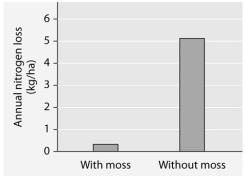 -Loss of soil nitrogen via "gaseous emission" was found to be negligible. Rather, most loss of soil nitrogen was due to water erosion of the soil. Which of these hypotheses is least likely to account for the observed results?
 (Multiple Choice)
4.9/5 (74)
(74) Which of the following was not a challenge for survival of the first land plants?
(Multiple Choice)
4.7/5 (65)
(65) Which of the following characteristics of plants is absent in their closest relatives, the charophyte algae?
(Multiple Choice)
4.9/5 (74)
(74) 
Filters
- Essay(0)
- Multiple Choice(0)
- Short Answer(0)
- True False(0)
- Matching(0)