



 Chat with AI
Exam 27: Bacteria and Archaea

Exam 1: Introduction: Evolution and Themes of Biology70 Questions
Exam 2: The Chemical Context of Life90 Questions
Exam 3: Water and Life80 Questions
Exam 4: Carbon and the Molecular Diversity of Life78 Questions
Exam 5: The Structure and Function of Large Biological Molecules117 Questions
Exam 6: A Tour of the Cell96 Questions
Exam 7: Membrane Structure and Function78 Questions
Exam 8: An Introduction to Metabolism88 Questions
Exam 9: Cellular Respiration and Fermentation117 Questions
Exam 10: Photosynthesis89 Questions
Exam 11: Cell Communication77 Questions
Exam 12: The Cell Cycle83 Questions
Exam 13: Meiosis and Sexual Life Cycles74 Questions
Exam 14: Mendel and the Gene Idea82 Questions
Exam 15: The Chromosomal Basis of Inheritance66 Questions
Exam 16: The Molecular Basis of Inheritance67 Questions
Exam 17: From Gene to Protein91 Questions
Exam 18: Regulation of Gene Expression107 Questions
Exam 19: Viruses53 Questions
Exam 20: Dna Tools and Biotechnology72 Questions
Exam 21: Genomes and Their Evolution52 Questions
Exam 22: Descent With Modification: a Darwinian View of Life63 Questions
Exam 23: The Evolution of Populations86 Questions
Exam 24: The Origin of Species71 Questions
Exam 25: The History of Life on Earth83 Questions
Exam 26: Phylogeny and the Tree of Life81 Questions
Exam 27: Bacteria and Archaea86 Questions
Exam 28: Protists84 Questions
Exam 29: Plant Diversity I: How Plants Colonized Land82 Questions
Exam 30: Plant Diversity Ii: the Evolution of Seed Plants110 Questions
Exam 31: Fungi97 Questions
Exam 32: An Overview of Animal Diversity82 Questions
Exam 33: An Introduction to Invertebrates101 Questions
Exam 34: The Origin and Evolution of Vertebrates117 Questions
Exam 35: Plant Structure, Growth, and Development75 Questions
Exam 36: Resource Acquisition and Transport in Vascular Plants89 Questions
Exam 37: Soil and Plant Nutrition91 Questions
Exam 38: Angiosperm Reproduction and Biotechnology94 Questions
Exam 39: Plant Responses to Internal and External Signals116 Questions
Exam 40: Basic Principles of Animal Form and Function86 Questions
Exam 41: Animal Nutrition73 Questions
Exam 42: Circulation and Gas Exchange100 Questions
Exam 43: The Immune System110 Questions
Exam 44: Osmoregulation and Excretion79 Questions
Exam 45: Hormones and the Endocrine System82 Questions
Exam 46: Animal Reproduction104 Questions
Exam 47: Animal Development98 Questions
Exam 48: Neurons, Synapses, and Signalling81 Questions
Exam 49: Nervous Systems73 Questions
Exam 50: Sensory and Motor Mechanisms91 Questions
Exam 51: Animal Behaviour79 Questions
Exam 52: An Introduction to Ecology and the Biosphere81 Questions
Exam 53: Population Ecology87 Questions
Exam 54: Community Ecology85 Questions
Exam 55: Ecosystems and Restoration Ecology89 Questions
Exam 56: Conservation Biology and Global Change75 Questions
Select questions type


The following questions refer to the information and figure below.
In this eight-year experiment, 12 populations of E. coli, each begun from a single cell, were grown in low-glucose conditions for 20 000 generations. Each culture was introduced to fresh growth medium every 24 hours. Occasionally, samples were removed from the populations, and their fitness in low-glucose conditions was tested against that of members sampled from the ancestral (common ancestor) E. coli population.
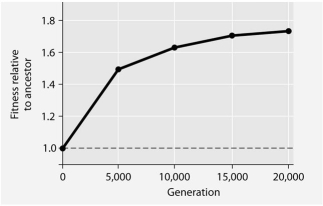 -Which term best describes what has occurred among the experimental populations of cells over this eight-year period?
 (Multiple Choice)
4.9/5  (79)
(79) The following table depicts characteristics of five prokaryotic species (A-E). Use the information in the table to answer the following questions.
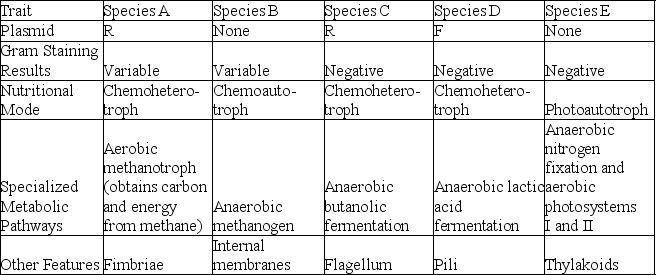 -Which species is most likely to be found both in sewage treatment plants and in the guts of cattle?
 (Multiple Choice)
4.8/5 (95)
(95) The figure below depicts changes to the amount of DNA present in a recipient cell that is engaged in conjugation with an Hfr cell. Hfr cell DNA begins entering the recipient cell at Time A. Assume that reciprocal crossing over occurs (in other words, a fragment of the recipient's chromosome is exchanged for a homologous fragment from the Hfr cell's DNA). Use this figure to answer the following questions.
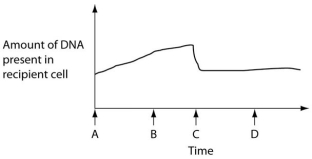 -How is the recipient cell different at Time D than it was at Time A?
 (Multiple Choice)
4.7/5 (79)
(79) You were asked to classify a number of unknown prokaryotes. Which feature of the organisms would allow you to make a positive distinction as to whether they belong to the domain Bacteria or Archaea?
(Multiple Choice)
4.8/5 (90)
(90) In a hypothetical situation, a bacterium lives on the surface of a leaf, where it obtains nutrition from the leaf's nonliving, waxy covering while inhibiting the growth of other microbes that are plant pathogens. If this bacterium gains access to the inside of a leaf, however, it causes a fatal disease in the plant. Once the plant dies, the bacterium and its offspring decompose the plant. What is the correct sequence of ecological roles played by the bacterium in the situation described here? Use only those that apply. 1. nutrient recycler
2. mutualist
3. commensal
4. parasite
5. primary producer
(Multiple Choice)
4.7/5 (87)
(87) Carl Woese and collaborators identified two major branches of prokaryotic evolution. What was the basis for dividing prokaryotes into two domains?
(Multiple Choice)
4.9/5 (88)
(88) Which of the following is least associated with the others?
(Multiple Choice)
4.8/5 (71)
(71) Chloramphenicol is an antibiotic that targets prokaryotic (70S)ribosomes, but not eukaryotic (80S)ribosomes. Which of these questions stems from this observation, plus an understanding of eukaryotic origins?
(Multiple Choice)
4.7/5 (67)
(67) Data were collected from the heterocysts of a nitrogen-fixing cyanobacterium inhabiting equatorial ponds. Study the following graph and choose the most likely explanation for the shape of the curve. 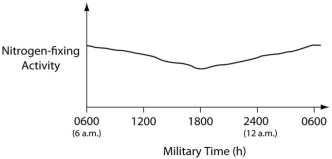
(Multiple Choice)
4.9/5 (83)
(83) In Fred Griffith's experiments, harmless R strain pneumococcus became lethal S strain pneumococcus as the result of which of the following? 1. horizontal gene transfer
2. transduction
3. conjugation
4. transformation
5. genetic recombination
(Multiple Choice)
4.8/5 (66)
(66) Prokaryotes' essential genetic information is located in the
(Multiple Choice)
4.8/5 (76)
(76) The following questions refer to the information and figure below.
In this eight-year experiment, 12 populations of E. coli, each begun from a single cell, were grown in low-glucose conditions for 20 000 generations. Each culture was introduced to fresh growth medium every 24 hours. Occasionally, samples were removed from the populations, and their fitness in low-glucose conditions was tested against that of members sampled from the ancestral (common ancestor) E. coli population.
-Which of the following, if it occurs in the absence of any other type of adaptation listed here, is least reasonable in terms of promoting bacterial survival over evolutionary time in a? low-glucose environment?
-Which of the following, if it occurs in the absence of any other type of adaptation listed here, is least reasonable in terms of promoting bacterial survival over evolutionary time in a? low-glucose environment? (Multiple Choice)
4.9/5 (81)
(81) If the vertical axis of the above figure refers to "Darwinian fitness," then which of the following is the most valid and accurate measure of fitness?
(Multiple Choice)
4.9/5 (79)
(79) The following table depicts characteristics of five prokaryotic species (A-E). Use the information in the table to answer the following questions.
-Gram-variable prokaryotes are, sometimes, those without any peptidoglycan. Which two species are most likely to be archaeans?
-Gram-variable prokaryotes are, sometimes, those without any peptidoglycan. Which two species are most likely to be archaeans? (Multiple Choice)
4.9/5 (83)
(83) Though plants, fungi, and prokaryotes all have cell walls, we place them in different taxa. Which of these observations comes closest to explaining the basis for placing these organisms in different taxa, well before relevant data from molecular systematics became available?
(Multiple Choice)
4.9/5 (76)
(76) Which of the following involves metabolic cooperation among prokaryotic cells?
(Multiple Choice)
4.9/5 (85)
(85) Use the information in the following paragraph to answer the next few questions.
A hypothetical bacterium swims among human intestinal contents until it finds a suitable location on the intestinal lining. It adheres to the intestinal lining using a feature that also protects it from phagocytes, bacteriophages, and dehydration. Fecal matter from a human in whose intestine this bacterium lives can spread the bacterium, even after being mixed with water and boiled. The bacterium is not susceptible to the penicillin family of antibiotics. It contains no plasmids and relatively little peptidoglycan.
-This bacterium derives nutrition by digesting human intestinal contents (in other words, food). Humans lacking this bacterium have no measurable reproductive advantage or disadvantage relative to humans who harbour this bacterium. Consequently, the bacterium can be properly described as which of the following? 1. symbiont
2. endosymbiont
3. mutualist
4. commensal
(Multiple Choice)
5.0/5 (68)
(68) Members of Bacteria and Archaea benefit humans in all the following ways, with the exception of
(Multiple Choice)
4.9/5 (81)
(81) The figure below depicts changes to the amount of DNA present in a recipient cell that is engaged in conjugation with an Hfr cell. Hfr cell DNA begins entering the recipient cell at Time A. Assume that reciprocal crossing over occurs (in other words, a fragment of the recipient's chromosome is exchanged for a homologous fragment from the Hfr cell's DNA). Use this figure to answer the following questions.
-During which two times can the recipient accurately be described as "recombinant: due to the sequence of events portrayed in the above figure?
-During which two times can the recipient accurately be described as "recombinant: due to the sequence of events portrayed in the above figure? (Multiple Choice)
4.8/5 (87)
(87) 
Filters
- Essay(0)
- Multiple Choice(0)
- Short Answer(0)
- True False(0)
- Matching(0)