



 Chat with AI
Exam 27: Bacteria and Archaea

Exam 1: Introduction: Evolution and Themes of Biology70 Questions
Exam 2: The Chemical Context of Life90 Questions
Exam 3: Water and Life80 Questions
Exam 4: Carbon and the Molecular Diversity of Life78 Questions
Exam 5: The Structure and Function of Large Biological Molecules117 Questions
Exam 6: A Tour of the Cell96 Questions
Exam 7: Membrane Structure and Function78 Questions
Exam 8: An Introduction to Metabolism88 Questions
Exam 9: Cellular Respiration and Fermentation117 Questions
Exam 10: Photosynthesis89 Questions
Exam 11: Cell Communication77 Questions
Exam 12: The Cell Cycle83 Questions
Exam 13: Meiosis and Sexual Life Cycles74 Questions
Exam 14: Mendel and the Gene Idea82 Questions
Exam 15: The Chromosomal Basis of Inheritance66 Questions
Exam 16: The Molecular Basis of Inheritance67 Questions
Exam 17: From Gene to Protein91 Questions
Exam 18: Regulation of Gene Expression107 Questions
Exam 19: Viruses53 Questions
Exam 20: Dna Tools and Biotechnology72 Questions
Exam 21: Genomes and Their Evolution52 Questions
Exam 22: Descent With Modification: a Darwinian View of Life63 Questions
Exam 23: The Evolution of Populations86 Questions
Exam 24: The Origin of Species71 Questions
Exam 25: The History of Life on Earth83 Questions
Exam 26: Phylogeny and the Tree of Life81 Questions
Exam 27: Bacteria and Archaea86 Questions
Exam 28: Protists84 Questions
Exam 29: Plant Diversity I: How Plants Colonized Land82 Questions
Exam 30: Plant Diversity Ii: the Evolution of Seed Plants110 Questions
Exam 31: Fungi97 Questions
Exam 32: An Overview of Animal Diversity82 Questions
Exam 33: An Introduction to Invertebrates101 Questions
Exam 34: The Origin and Evolution of Vertebrates117 Questions
Exam 35: Plant Structure, Growth, and Development75 Questions
Exam 36: Resource Acquisition and Transport in Vascular Plants89 Questions
Exam 37: Soil and Plant Nutrition91 Questions
Exam 38: Angiosperm Reproduction and Biotechnology94 Questions
Exam 39: Plant Responses to Internal and External Signals116 Questions
Exam 40: Basic Principles of Animal Form and Function86 Questions
Exam 41: Animal Nutrition73 Questions
Exam 42: Circulation and Gas Exchange100 Questions
Exam 43: The Immune System110 Questions
Exam 44: Osmoregulation and Excretion79 Questions
Exam 45: Hormones and the Endocrine System82 Questions
Exam 46: Animal Reproduction104 Questions
Exam 47: Animal Development98 Questions
Exam 48: Neurons, Synapses, and Signalling81 Questions
Exam 49: Nervous Systems73 Questions
Exam 50: Sensory and Motor Mechanisms91 Questions
Exam 51: Animal Behaviour79 Questions
Exam 52: An Introduction to Ecology and the Biosphere81 Questions
Exam 53: Population Ecology87 Questions
Exam 54: Community Ecology85 Questions
Exam 55: Ecosystems and Restoration Ecology89 Questions
Exam 56: Conservation Biology and Global Change75 Questions
Select questions type


In a bacterium that possesses antibiotic resistance and the potential to persist through very adverse conditions, such as freezing, drying, or high temperatures, DNA should be located within, or be part of, which structures? 1. nucleoid region
2. endospore
3. fimbriae
4. plasmids
(Multiple Choice)
4.9/5  (81)
(81) Match the numbered terms to the description that follows. Choose all appropriate terms. 1. autotroph
2. heterotroph
3. phototroph
4. chemotroph
Description: an organism that relies on photons to excite electrons within its membranes
(Multiple Choice)
4.9/5 (74)
(74) Which of the following factors does not contribute to genetic diversity in prokaryotes?
(Multiple Choice)
4.9/5 (79)
(79) Which statement about the genomes of prokaryotes is correct?
(Multiple Choice)
4.8/5 (77)
(77) If new genetic variation in the experimental populations arose solely by spontaneous mutations, then the most effective process for subsequently increasing the prevalence of the beneficial mutations in the population over the course of generations is
(Multiple Choice)
4.7/5 (75)
(75) Match the numbered terms to the description that follows. Choose all appropriate terms. 1. autotroph
2. heterotroph
3. phototroph
4. chemotroph
Description: an organism that obtains both carbon and energy by ingesting prey
(Multiple Choice)
5.0/5 (67)
(67) The following table depicts characteristics of five prokaryotic species (A-E). Use the information in the table to answer the following questions.
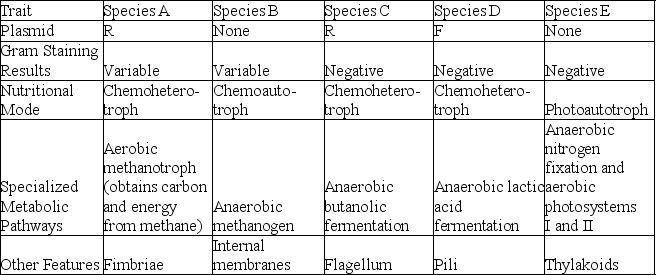 -Which species should be able to respond most readily to taxes (plural of taxis)?
 (Multiple Choice)
4.9/5 (65)
(65) Mitochondria are thought to be the descendants of certain alpha proteobacteria. They are, however, no longer able to lead independent lives because most genes originally present on their chromosome have moved to the nuclear genome. Which phenomenon accounts for the movement of these genes?
(Multiple Choice)
5.0/5 (80)
(80) Regarding prokaryotic genetics, which statement is correct?
(Multiple Choice)
4.8/5 (90)
(90) Assuming that each of these possesses a cell wall, which prokaryotes should be expected to be most strongly resistant to plasmolysis in hypertonic environments?
(Multiple Choice)
4.7/5 (72)
(72) Use the information in the following paragraph to answer the next few questions.
A hypothetical bacterium swims among human intestinal contents until it finds a suitable location on the intestinal lining. It adheres to the intestinal lining using a feature that also protects it from phagocytes, bacteriophages, and dehydration. Fecal matter from a human in whose intestine this bacterium lives can spread the bacterium, even after being mixed with water and boiled. The bacterium is not susceptible to the penicillin family of antibiotics. It contains no plasmids and relatively little peptidoglycan.
-This bacterium's ability to survive in a human who is taking penicillin pills may be due to the presence of 1. penicillin-resistance genes.
2. a secretory system that removes penicillin from the cell.
3. a gram-positive cell wall.
4. a gram-negative cell wall.
5. an endospore.
(Multiple Choice)
4.9/5 (62)
(62) Use the following information to answer the questions below.
Nitrogenase, the enzyme that catalyzes nitrogen fixation, is inhibited whenever free O₂ reaches a critical concentration. Consequently, nitrogen fixation cannot occur in cells wherein photosynthesis produces free O₂. Consider the colonial aquatic cyanobacterium, Anabaena, whose heterocytes are described as having "…a thickened cell wall that restricts entry of O₂ produced by neighbouring cells. Intracellular connections allow heterocysts to transport fixed nitrogen to neighbouring cells in exchange for carbohydrates."
-Given that the enzymes that catalyze nitrogen fixation are inhibited by oxygen, what are two "strategies" that nitrogen-fixing prokaryotes might use to protect these enzymes from oxygen? 1. couple them with photosystem II (the photosystem that splits water molecules)
2. package them in membranes that are impermeable to all gases
3. be obligate anaerobes
4. be strict aerobes
5. package these enzymes in specialized cells or compartments that inhibit oxygen entry
(Multiple Choice)
4.8/5 (79)
(79) Which two structures play direct roles in permitting bacteria to adhere to each other, or to other surfaces? 1. capsules
2. endospores
3. fimbriae
4. plasmids
5. flagella
(Multiple Choice)
4.9/5 (73)
(73) Prokaryotic ribosomes differ from those present in eukaryotic cytosol. Because of this, which of the following is correct?
(Multiple Choice)
4.8/5 (77)
(77) Use the information in the following paragraph to answer the next few questions.
A hypothetical bacterium swims among human intestinal contents until it finds a suitable location on the intestinal lining. It adheres to the intestinal lining using a feature that also protects it from phagocytes, bacteriophages, and dehydration. Fecal matter from a human in whose intestine this bacterium lives can spread the bacterium, even after being mixed with water and boiled. The bacterium is not susceptible to the penicillin family of antibiotics. It contains no plasmids and relatively little peptidoglycan.
-What should be true of the cell wall of this bacterium?
(Multiple Choice)
4.8/5 (83)
(83) The figure below depicts changes to the amount of DNA present in a recipient cell that is engaged in conjugation with an Hfr cell. Hfr cell DNA begins entering the recipient cell at Time A. Assume that reciprocal crossing over occurs (in other words, a fragment of the recipient's chromosome is exchanged for a homologous fragment from the Hfr cell's DNA). Use this figure to answer the following questions.
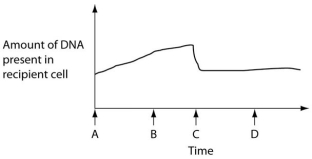 -What is occurring at Time C that is decreasing the DNA content?
 (Multiple Choice)
4.9/5 (93)
(93) In a hypothetical situation, the genes for sex pilus construction and for tetracycline resistance are located together on the same plasmid within a particular bacterium. If this bacterium readily performs conjugation involving a copy of this plasmid, then the result should be
(Multiple Choice)
4.9/5 (88)
(88) The predatory bacterium, Bdellovibrio bacteriophorus, drills into a prey bacterium and, once inside, digests it. In an attack upon a gram-negative bacterium that has a slimy cell covering, what is the correct sequence of structures penetrated by B. bacteriophorus on its way to the prey's cytoplasm? 1. membrane composed mostly of lipopolysaccharide
2. membrane composed mostly of phospholipids
3. peptidoglycan
4. capsule
(Multiple Choice)
4.9/5 (69)
(69) 
Filters
- Essay(0)
- Multiple Choice(0)
- Short Answer(0)
- True False(0)
- Matching(0)