



 Chat with AI
Exam 10: Photosynthesis

Exam 1: Introduction: Evolution and Themes of Biology70 Questions
Exam 2: The Chemical Context of Life90 Questions
Exam 3: Water and Life80 Questions
Exam 4: Carbon and the Molecular Diversity of Life78 Questions
Exam 5: The Structure and Function of Large Biological Molecules117 Questions
Exam 6: A Tour of the Cell96 Questions
Exam 7: Membrane Structure and Function78 Questions
Exam 8: An Introduction to Metabolism88 Questions
Exam 9: Cellular Respiration and Fermentation117 Questions
Exam 10: Photosynthesis89 Questions
Exam 11: Cell Communication77 Questions
Exam 12: The Cell Cycle83 Questions
Exam 13: Meiosis and Sexual Life Cycles74 Questions
Exam 14: Mendel and the Gene Idea82 Questions
Exam 15: The Chromosomal Basis of Inheritance66 Questions
Exam 16: The Molecular Basis of Inheritance67 Questions
Exam 17: From Gene to Protein91 Questions
Exam 18: Regulation of Gene Expression107 Questions
Exam 19: Viruses53 Questions
Exam 20: Dna Tools and Biotechnology72 Questions
Exam 21: Genomes and Their Evolution52 Questions
Exam 22: Descent With Modification: a Darwinian View of Life63 Questions
Exam 23: The Evolution of Populations86 Questions
Exam 24: The Origin of Species71 Questions
Exam 25: The History of Life on Earth83 Questions
Exam 26: Phylogeny and the Tree of Life81 Questions
Exam 27: Bacteria and Archaea86 Questions
Exam 28: Protists84 Questions
Exam 29: Plant Diversity I: How Plants Colonized Land82 Questions
Exam 30: Plant Diversity Ii: the Evolution of Seed Plants110 Questions
Exam 31: Fungi97 Questions
Exam 32: An Overview of Animal Diversity82 Questions
Exam 33: An Introduction to Invertebrates101 Questions
Exam 34: The Origin and Evolution of Vertebrates117 Questions
Exam 35: Plant Structure, Growth, and Development75 Questions
Exam 36: Resource Acquisition and Transport in Vascular Plants89 Questions
Exam 37: Soil and Plant Nutrition91 Questions
Exam 38: Angiosperm Reproduction and Biotechnology94 Questions
Exam 39: Plant Responses to Internal and External Signals116 Questions
Exam 40: Basic Principles of Animal Form and Function86 Questions
Exam 41: Animal Nutrition73 Questions
Exam 42: Circulation and Gas Exchange100 Questions
Exam 43: The Immune System110 Questions
Exam 44: Osmoregulation and Excretion79 Questions
Exam 45: Hormones and the Endocrine System82 Questions
Exam 46: Animal Reproduction104 Questions
Exam 47: Animal Development98 Questions
Exam 48: Neurons, Synapses, and Signalling81 Questions
Exam 49: Nervous Systems73 Questions
Exam 50: Sensory and Motor Mechanisms91 Questions
Exam 51: Animal Behaviour79 Questions
Exam 52: An Introduction to Ecology and the Biosphere81 Questions
Exam 53: Population Ecology87 Questions
Exam 54: Community Ecology85 Questions
Exam 55: Ecosystems and Restoration Ecology89 Questions
Exam 56: Conservation Biology and Global Change75 Questions
Select questions type


In metabolic processes of cell respiration and photosynthesis, prosthetic groups such as heme and iron-sulphur complexes are encountered in components of the electron transport chain. What do they do?
(Multiple Choice)
4.8/5  (79)
(79) In any ecosystem, terrestrial or aquatic, what group(s)is (are)always necessary?
(Multiple Choice)
4.8/5 (73)
(73) It is a particularly hot, dry summer. The town has banned excessive water use and so you cannot water your lawn. After a few weeks the grass has gone brown, except a few patches where the grass seems to be doing fine. You notice that this grass has a broader leaf and is not the same species as most of your lawn. You conclude that this grass is a
(Multiple Choice)
5.0/5 (93)
(93) Use the following figure to answer the questions below.
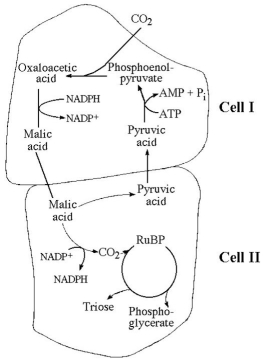 -Referring to the figure above, oxygen would inhibit the CO₂ fixation reactions in
 (Multiple Choice)
4.8/5 (67)
(67) Which of the following are products of the light reactions of photosynthesis that are utilized in the Calvin cycle?
(Multiple Choice)
4.9/5 (79)
(79) Use the following figure and the compounds labelled A, B, C, D, and E to answer the following questions.
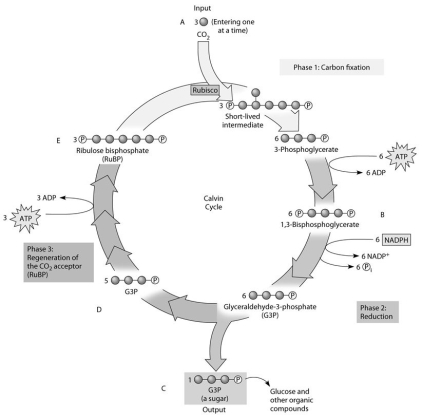 -If ATP used by this plant is labelled with radioactive phosphorus, which molecule or molecules of the Calvin cycle will be radioactively labelled first?
 (Multiple Choice)
4.9/5 (70)
(70) According to the endosymbiotic theory, the original chloroplast was a
(Multiple Choice)
4.8/5 (80)
(80) Where do the enzymatic reactions of the Calvin cycle take place?
(Multiple Choice)
4.8/5 (76)
(76) Cyclic electron flow may be photoprotective (protective to light-induced damage). Which of the following experiments could provide information on this phenomenon?
(Multiple Choice)
4.8/5 (81)
(81) Chemiosmosis in chloroplasts and mitochondria share all but one of the following conditions.
(Multiple Choice)
4.9/5 (93)
(93) Three "turns" of the Calvin cycle generate a "surplus" molecule of glyceraldehyde 3-phosphate (G3P). Which of the following is a consequence of this?
(Multiple Choice)
4.8/5 (65)
(65) In C₃ photosynthesis, the reactions that require ATP take place in
(Multiple Choice)
4.7/5 (80)
(80) Some photosynthetic organisms contain chloroplasts that lack photosystem II, yet are able to survive. The best way to detect the lack of photosystem II in these organisms would be
(Multiple Choice)
4.7/5 (86)
(86) As a research scientist, you measure the amount of ATP and NADPH consumed by the Calvin cycle in 1 hour. You find 30 000 molecules of ATP consumed, but only 20 000 molecules of NADPH. Where did the extra ATP molecules come from?
(Multiple Choice)
4.9/5 (75)
(75) When oxygen is released as a result of photosynthesis, it is a direct by-product of
(Multiple Choice)
4.8/5 (95)
(95) Suppose the interior of the thylakoids of isolated chloroplasts were made acidic and then transferred in the dark to a pH 8 solution. What would be likely to happen?
(Multiple Choice)
4.9/5 (83)
(83) Carotenoids are often found in foods that are considered to have antioxidant properties in human nutrition. What related function do they have in plants?
(Multiple Choice)
4.8/5 (77)
(77) 
Filters
- Essay(0)
- Multiple Choice(0)
- Short Answer(0)
- True False(0)
- Matching(0)