



 Chat with AI
Exam 10: Photosynthesis

Exam 1: Introduction: Evolution and Themes of Biology70 Questions
Exam 2: The Chemical Context of Life90 Questions
Exam 3: Water and Life80 Questions
Exam 4: Carbon and the Molecular Diversity of Life78 Questions
Exam 5: The Structure and Function of Large Biological Molecules117 Questions
Exam 6: A Tour of the Cell96 Questions
Exam 7: Membrane Structure and Function78 Questions
Exam 8: An Introduction to Metabolism88 Questions
Exam 9: Cellular Respiration and Fermentation117 Questions
Exam 10: Photosynthesis89 Questions
Exam 11: Cell Communication77 Questions
Exam 12: The Cell Cycle83 Questions
Exam 13: Meiosis and Sexual Life Cycles74 Questions
Exam 14: Mendel and the Gene Idea82 Questions
Exam 15: The Chromosomal Basis of Inheritance66 Questions
Exam 16: The Molecular Basis of Inheritance67 Questions
Exam 17: From Gene to Protein91 Questions
Exam 18: Regulation of Gene Expression107 Questions
Exam 19: Viruses53 Questions
Exam 20: Dna Tools and Biotechnology72 Questions
Exam 21: Genomes and Their Evolution52 Questions
Exam 22: Descent With Modification: a Darwinian View of Life63 Questions
Exam 23: The Evolution of Populations86 Questions
Exam 24: The Origin of Species71 Questions
Exam 25: The History of Life on Earth83 Questions
Exam 26: Phylogeny and the Tree of Life81 Questions
Exam 27: Bacteria and Archaea86 Questions
Exam 28: Protists84 Questions
Exam 29: Plant Diversity I: How Plants Colonized Land82 Questions
Exam 30: Plant Diversity Ii: the Evolution of Seed Plants110 Questions
Exam 31: Fungi97 Questions
Exam 32: An Overview of Animal Diversity82 Questions
Exam 33: An Introduction to Invertebrates101 Questions
Exam 34: The Origin and Evolution of Vertebrates117 Questions
Exam 35: Plant Structure, Growth, and Development75 Questions
Exam 36: Resource Acquisition and Transport in Vascular Plants89 Questions
Exam 37: Soil and Plant Nutrition91 Questions
Exam 38: Angiosperm Reproduction and Biotechnology94 Questions
Exam 39: Plant Responses to Internal and External Signals116 Questions
Exam 40: Basic Principles of Animal Form and Function86 Questions
Exam 41: Animal Nutrition73 Questions
Exam 42: Circulation and Gas Exchange100 Questions
Exam 43: The Immune System110 Questions
Exam 44: Osmoregulation and Excretion79 Questions
Exam 45: Hormones and the Endocrine System82 Questions
Exam 46: Animal Reproduction104 Questions
Exam 47: Animal Development98 Questions
Exam 48: Neurons, Synapses, and Signalling81 Questions
Exam 49: Nervous Systems73 Questions
Exam 50: Sensory and Motor Mechanisms91 Questions
Exam 51: Animal Behaviour79 Questions
Exam 52: An Introduction to Ecology and the Biosphere81 Questions
Exam 53: Population Ecology87 Questions
Exam 54: Community Ecology85 Questions
Exam 55: Ecosystems and Restoration Ecology89 Questions
Exam 56: Conservation Biology and Global Change75 Questions
Select questions type


A gardener is concerned that her greenhouse is getting too hot from too much light, and seeks to shade her plants with coloured translucent plastic sheets. What colour should she use to reduce overall light energy, but still maximize plant growth?
(Multiple Choice)
4.9/5  (71)
(71) Use the following information to answer the questions below.
Theodor W. Engelmann illuminated a filament of algae with light that passed through a prism, thus exposing different segments of algae to different wavelengths of light. He added aerobic bacteria and then noted in which areas the bacteria congregated. He noted that the largest groups were found in the areas illuminated by the red and blue light.
-If you ran the same experiment without passing light through a prism, what would you predict?
(Multiple Choice)
4.9/5 (67)
(67) Use the following information to answer the questions below.
Theodor W. Engelmann illuminated a filament of algae with light that passed through a prism, thus exposing different segments of algae to different wavelengths of light. He added aerobic bacteria and then noted in which areas the bacteria congregated. He noted that the largest groups were found in the areas illuminated by the red and blue light.
-What did Engelmann conclude about the congregation of bacteria in the red and blue areas?
(Multiple Choice)
4.8/5 (78)
(78) In an experiment studying photosynthesis performed during the day, you provide a plant with radioactive carbon (¹⁴C)dioxide as a metabolic tracer. The ¹⁴C is incorporated first into oxaloacetate. The plant is best characterized as a
(Multiple Choice)
4.9/5 (89)
(89) Which of the following sequences correctly represents the flow of electrons during photosynthesis?
(Multiple Choice)
4.9/5 (82)
(82) You have isolated pigments from an unknown plant and are studying their spectral absorption. You irradiate them with a specific wavelength, yet you see no fluorescence. What is the likely explanation?
(Multiple Choice)
5.0/5 (82)
(82) If plant gene alterations cause the plants to be deficient in photorespiration, what would most probably occur?
(Multiple Choice)
4.8/5 (72)
(72) If atmospheric CO₂ concentrations increase twofold or more, how will plants be affected, disregarding any changes in climate?
(Multiple Choice)
4.8/5 (70)
(70) Use the following figure to answer the questions below.
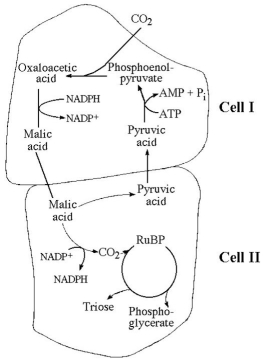 -Which of the following statements is true concerning the figure above?
 (Multiple Choice)
4.8/5 (72)
(72) Use the following figure and the compounds labelled A, B, C, D, and E to answer the following questions.
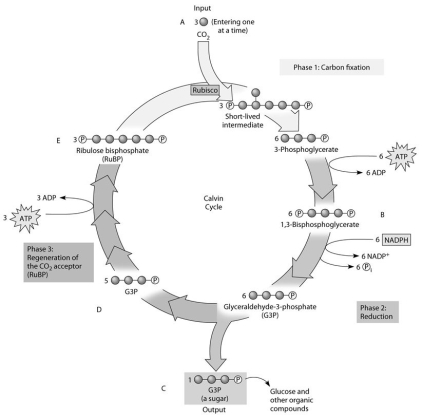 -Which molecule(s)of the Calvin cycle is (are)also found in glycolysis?
 (Multiple Choice)
5.0/5 (91)
(91) Some photosynthetic bacteria (e.g., purple sulphur bacteria)have only photosystem I, whereas others (e.g., cyanobacteria)have both photosystem I and photosystem II. Which of the following might this observation imply?
(Multiple Choice)
4.8/5 (79)
(79) Use the following figure to answer the questions below.
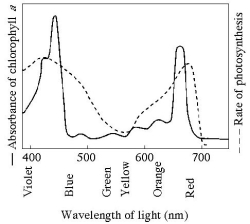 -The figure above shows the absorption spectrum for chlorophyll a and the action spectrum for photosynthesis. Why are they different?
 (Multiple Choice)
4.8/5 (69)
(69) The phylogenetic distribution of the enzyme Rubisco is limited to
(Multiple Choice)
4.9/5 (82)
(82) In mitochondria, chemiosmosis translocates protons from the matrix into the intermembrane space, whereas in chloroplasts, chemiosmosis translocates protons from
(Multiple Choice)
4.8/5 (73)
(73) Which of the following does not occur during the Calvin cycle?
(Multiple Choice)
4.9/5 (79)
(79) 
Filters
- Essay(0)
- Multiple Choice(0)
- Short Answer(0)
- True False(0)
- Matching(0)