



 Chat with AI
Exam 6: A Tour of the Cell

Exam 1: Introduction: Evolution and Themes of Biology70 Questions
Exam 2: The Chemical Context of Life90 Questions
Exam 3: Water and Life80 Questions
Exam 4: Carbon and the Molecular Diversity of Life78 Questions
Exam 5: The Structure and Function of Large Biological Molecules117 Questions
Exam 6: A Tour of the Cell96 Questions
Exam 7: Membrane Structure and Function78 Questions
Exam 8: An Introduction to Metabolism88 Questions
Exam 9: Cellular Respiration and Fermentation117 Questions
Exam 10: Photosynthesis89 Questions
Exam 11: Cell Communication77 Questions
Exam 12: The Cell Cycle83 Questions
Exam 13: Meiosis and Sexual Life Cycles74 Questions
Exam 14: Mendel and the Gene Idea82 Questions
Exam 15: The Chromosomal Basis of Inheritance66 Questions
Exam 16: The Molecular Basis of Inheritance67 Questions
Exam 17: From Gene to Protein91 Questions
Exam 18: Regulation of Gene Expression107 Questions
Exam 19: Viruses53 Questions
Exam 20: Dna Tools and Biotechnology72 Questions
Exam 21: Genomes and Their Evolution52 Questions
Exam 22: Descent With Modification: a Darwinian View of Life63 Questions
Exam 23: The Evolution of Populations86 Questions
Exam 24: The Origin of Species71 Questions
Exam 25: The History of Life on Earth83 Questions
Exam 26: Phylogeny and the Tree of Life81 Questions
Exam 27: Bacteria and Archaea86 Questions
Exam 28: Protists84 Questions
Exam 29: Plant Diversity I: How Plants Colonized Land82 Questions
Exam 30: Plant Diversity Ii: the Evolution of Seed Plants110 Questions
Exam 31: Fungi97 Questions
Exam 32: An Overview of Animal Diversity82 Questions
Exam 33: An Introduction to Invertebrates101 Questions
Exam 34: The Origin and Evolution of Vertebrates117 Questions
Exam 35: Plant Structure, Growth, and Development75 Questions
Exam 36: Resource Acquisition and Transport in Vascular Plants89 Questions
Exam 37: Soil and Plant Nutrition91 Questions
Exam 38: Angiosperm Reproduction and Biotechnology94 Questions
Exam 39: Plant Responses to Internal and External Signals116 Questions
Exam 40: Basic Principles of Animal Form and Function86 Questions
Exam 41: Animal Nutrition73 Questions
Exam 42: Circulation and Gas Exchange100 Questions
Exam 43: The Immune System110 Questions
Exam 44: Osmoregulation and Excretion79 Questions
Exam 45: Hormones and the Endocrine System82 Questions
Exam 46: Animal Reproduction104 Questions
Exam 47: Animal Development98 Questions
Exam 48: Neurons, Synapses, and Signalling81 Questions
Exam 49: Nervous Systems73 Questions
Exam 50: Sensory and Motor Mechanisms91 Questions
Exam 51: Animal Behaviour79 Questions
Exam 52: An Introduction to Ecology and the Biosphere81 Questions
Exam 53: Population Ecology87 Questions
Exam 54: Community Ecology85 Questions
Exam 55: Ecosystems and Restoration Ecology89 Questions
Exam 56: Conservation Biology and Global Change75 Questions
Select questions type


The chemical reactions involved in respiration are virtually identical between prokaryotic and eukaryotic cells. In eukaryotic cells, ATP is synthesized primarily on the inner membrane of the mitochondria. In light of the endosymbiont theory for the evolutionary origin of mitochondria, where is most ATP synthesis likely to occur in prokaryotic cells?
(Multiple Choice)
4.9/5  (81)
(81) Recent evidence shows that signals from the extracellular matrix (ECM)can regulate the expression of genes in the cell nucleus. A likely mechanism is that
(Multiple Choice)
4.9/5 (72)
(72) The liver is involved in detoxification of many poisons and drugs. Which of the following structures is primarily involved in this process and therefore abundant in liver cells?
(Multiple Choice)
4.8/5 (74)
(74) In a liver cell detoxifying alcohol and some other poisons, the enzymes of the peroxisome remove hydrogen from these molecules and
(Multiple Choice)
4.8/5 (85)
(85) Use the following information to answer the questions below.
You are investigating different live cells using a light microscope. The first cells you observe are part of a larger organism. They have a clear area in the middle, a defined shape, and you can see many greenish ovals pressed up along the outer edges.
-You look at another group of cells; it looks entirely different. They appear independent of each other and are constantly changing shape and "crawling" across the slide. There are large and small structures moving around inside the cells. You identify these cells as
(Multiple Choice)
4.9/5 (83)
(83) Large numbers of ribosomes are present in cells that specialize in producing which of the following molecules?
(Multiple Choice)
4.7/5 (87)
(87) What do the cell walls of plants and the extracellular matrix of animal cells have in common?
(Multiple Choice)
4.8/5 (81)
(81) What is the reason that a modern electron microscope (TEM)can resolve biological images to the subnanometer level, as opposed to tens of nanometers achievable for the best?super-resolution light microscope?
(Multiple Choice)
4.9/5 (79)
(79) 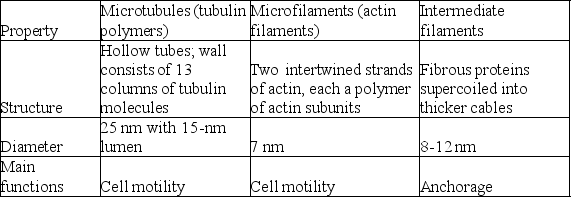 -The differences among the three categories of cytoskeletal elements outlined in the table above would suggest that each of the following has specialized roles. Which of the following is a correct match? (All three elements are involved in the maintenance of cell shape.)
 (Multiple Choice)
4.7/5 (75)
(75) A biologist ground up some plant leaf cells and then centrifuged the mixture to fractionate the organelles. Organelles in one of the heavier fractions could produce ATP in the light, whereas organelles in the lighter fraction could produce ATP in the dark. The heavier and lighter fractions are most likely to contain, respectively,
(Multiple Choice)
4.9/5 (80)
(80) A cell has the following molecules and structures: enzymes, DNA, ribosomes, plasma membrane, and mitochondria. It could be a cell from
(Multiple Choice)
4.9/5 (83)
(83) Use the following information to answer the questions below.
You are investigating different live cells using a light microscope. The first cells you observe are part of a larger organism. They have a clear area in the middle, a defined shape, and you can see many greenish ovals pressed up along the outer edges.
-The clear area in the middle is most likely the
(Multiple Choice)
4.9/5 (74)
(74) One of the key innovations in the evolution of eukaryotes from a prokaryotic ancestor is the endomembrane system. What eukaryotic organelles or features might have evolved as a part of, or as an elaboration of, the endomembrane system?
(Multiple Choice)
4.8/5 (84)
(84) Which animal cell organelle contains enzymes that transfer hydrogen from various substrates to oxygen?
(Multiple Choice)
4.8/5 (69)
(69) The cell walls of bacteria, fungi, and plant cells and the extracellular matrix of animal cells are all external to the plasma membrane. Which of the following is a characteristic common to all of these extracellular structures?
(Multiple Choice)
4.7/5 (88)
(88) Movement of vesicles within the cell depends on what cellular structures?
(Multiple Choice)
4.9/5 (76)
(76) Motor proteins provide for molecular motion in cells by interacting with what types of cellular structures?
(Multiple Choice)
5.0/5 (90)
(90) 
Filters
- Essay(0)
- Multiple Choice(0)
- Short Answer(0)
- True False(0)
- Matching(0)