



 Chat with AI
Exam 22: Developing Countries: Growth, Crisis, and Reform

Exam 1: Introduction37 Questions
Exam 2: World Trade: an Overview18 Questions
Exam 3: Labor Productivity and Comparative Advantage: the Ricardian Model47 Questions
Exam 4: Specific Factors and Income Distribution62 Questions
Exam 5: Resources and Trade: the Heckscher-Ohlin Model66 Questions
Exam 6: The Standard Trade Model45 Questions
Exam 7: External Economies of Scale and the International Location of Production37 Questions
Exam 8: Firms in the Global Economy: Export Decisions, Outsourcing, and Multinational Enterprises69 Questions
Exam 9: The Instruments of Trade Policy71 Questions
Exam 10: The Political Economy of Trade Policy57 Questions
Exam 11: Trade Policy in Developing Countries33 Questions
Exam 12: Controversies in Trade Policy46 Questions
Exam 13: National Income Accounting and the Balance of Payments72 Questions
Exam 14: Exchange Rates and the Foreign Exchange Market: an Asset Approach73 Questions
Exam 15: Money, Interest Rates, and Exchange Rates64 Questions
Exam 16: Price Levels and the Exchange Rate in the Long Run74 Questions
Exam 17: Output and the Exchange Rate in the Short Run114 Questions
Exam 18: Fixed Exchange Rates and Foreign Exchange Intervention72 Questions
Exam 19: International Monetary Systems: an Historical Overview153 Questions
Exam 20: Financial Globalization: Opportunity and Crisis113 Questions
Exam 21: Optimum Currency Areas and the Euro100 Questions
Exam 22: Developing Countries: Growth, Crisis, and Reform112 Questions
Select questions type


Explain why despite enormous natural resources, much of Latin America's population remains in poverty and the region has been repeatedly experiencing financial crises.
(Essay)
4.8/5  (74)
(74) While many developing countries have reformed their economies in order to imitate the success of the successful industrial economies, the process remains incomplete and most developing countries tend to be characterized by all of the following EXCEPT
(Multiple Choice)
4.9/5 (84)
(84) For many developing countries, natural resources or agricultural commodities make up a ________ share of exports.
(Multiple Choice)
4.8/5 (77)
(77) Which of the following does NOT explain why developing countries encouraged new manufacturing industries of their own in the mid 20th century?
(Multiple Choice)
4.8/5 (77)
(77) In the early 1960s South Korea was an extremely poor country. However, in 1963, the country began a remarkable economic ascent. What was a direct cause of this?
(Multiple Choice)
4.9/5 (87)
(87) Over the post-war era, the gaps between countries' living standards
(Multiple Choice)
4.8/5 (78)
(78) Which of the following is NOT a common characteristic of a developing country?
(Multiple Choice)
4.9/5 (78)
(78) Over the post-war era, the gaps between industrial countries' living standards
(Multiple Choice)
4.9/5 (86)
(86) Please consider Table 22-2 below.
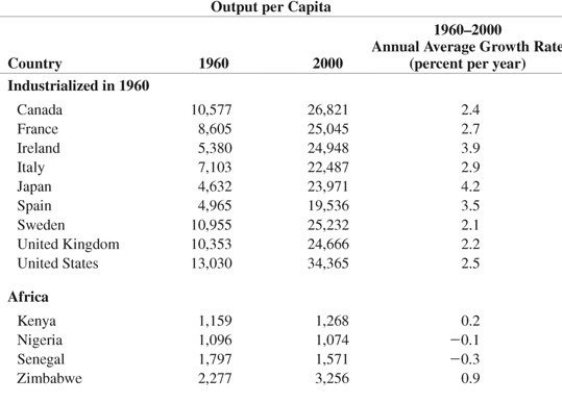
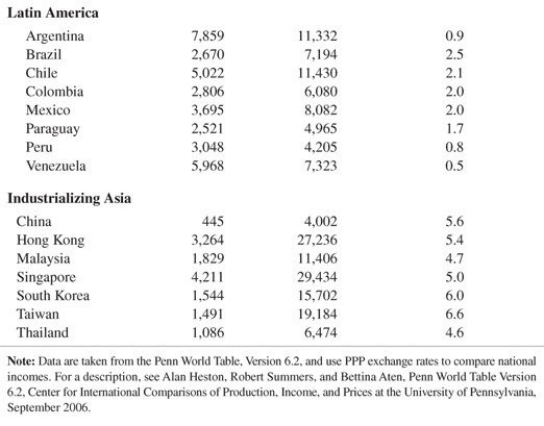 At that Annual Average Growth Rate, how many years does it take for the output per capita to double in both the United States and South Korea.
 (Essay)
4.8/5 (72)
(72) Which of the following countries had a larger growth rate since 1960?
(Multiple Choice)
5.0/5 (75)
(75) The main reason for the crisis in Argentina in 2001 and 2002, has to do with exchange rate policy, i.e., the continued peg of the exchange rate to the dollar. Discuss.
(Essay)
4.8/5 (89)
(89) With which country did the Debt Crisis of the early 1980s begin?
(Multiple Choice)
4.8/5 (89)
(89) Describe some of the features hindering developing countries from growing faster.
(Essay)
4.9/5 (78)
(78) 
Filters
- Essay(0)
- Multiple Choice(0)
- Short Answer(0)
- True False(0)
- Matching(0)