



 Chat with AI
Exam 22: Developing Countries: Growth, Crisis, and Reform

Exam 1: Introduction37 Questions
Exam 2: World Trade: an Overview18 Questions
Exam 3: Labor Productivity and Comparative Advantage: the Ricardian Model47 Questions
Exam 4: Specific Factors and Income Distribution62 Questions
Exam 5: Resources and Trade: the Heckscher-Ohlin Model66 Questions
Exam 6: The Standard Trade Model45 Questions
Exam 7: External Economies of Scale and the International Location of Production37 Questions
Exam 8: Firms in the Global Economy: Export Decisions, Outsourcing, and Multinational Enterprises69 Questions
Exam 9: The Instruments of Trade Policy71 Questions
Exam 10: The Political Economy of Trade Policy57 Questions
Exam 11: Trade Policy in Developing Countries33 Questions
Exam 12: Controversies in Trade Policy46 Questions
Exam 13: National Income Accounting and the Balance of Payments72 Questions
Exam 14: Exchange Rates and the Foreign Exchange Market: an Asset Approach73 Questions
Exam 15: Money, Interest Rates, and Exchange Rates64 Questions
Exam 16: Price Levels and the Exchange Rate in the Long Run74 Questions
Exam 17: Output and the Exchange Rate in the Short Run114 Questions
Exam 18: Fixed Exchange Rates and Foreign Exchange Intervention72 Questions
Exam 19: International Monetary Systems: an Historical Overview153 Questions
Exam 20: Financial Globalization: Opportunity and Crisis113 Questions
Exam 21: Optimum Currency Areas and the Euro100 Questions
Exam 22: Developing Countries: Growth, Crisis, and Reform112 Questions
Select questions type


Since foreign credit dries up in crises when it is most needed, developing countries can protect themselves from default by
(Multiple Choice)
4.7/5  (79)
(79) What are the five major channels, which developing countries use to finance their external deficit?
(Essay)
4.9/5 (75)
(75) Please consider Table 22-2 below.
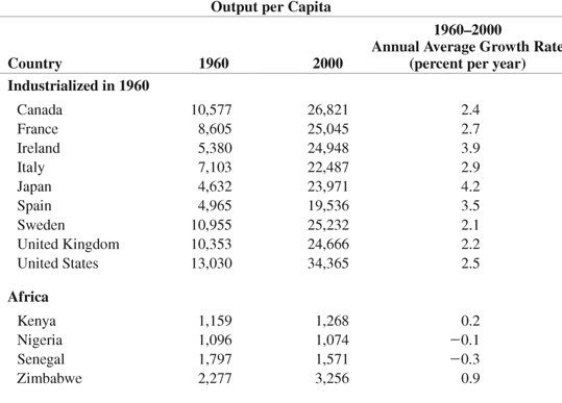
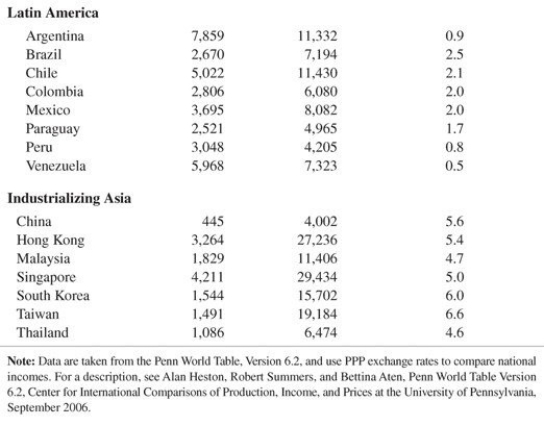 Assuming constant Annual Average Growth Rate in the future, calculate the output per capita for the United States and South Korea for the year 2040.
 (Essay)
4.8/5 (87)
(87) Which theory best explains the wealth inequalities amongst nations?
(Multiple Choice)
4.8/5 (89)
(89) Since 1960, South Korea and Singapore enjoyed average per-capita growth rates ________ the average industrialized world.
(Multiple Choice)
4.7/5 (89)
(89) When one compares per-capital output growth rates among countries
(Multiple Choice)
4.8/5 (82)
(82) Since 1960, countries in Africa have grown at rates ________ those of the main industrial countries.
(Multiple Choice)
4.7/5 (77)
(77) During 1991, Argentina's monetary law had a currency board. Explain and give an example.
(Essay)
4.7/5 (75)
(75) Which of the following are characteristic of a developing country?
(Multiple Choice)
4.8/5 (78)
(78) When a government defaults on its obligations, the event is called a
(Multiple Choice)
4.8/5 (78)
(78) During the time period of 1981-1983 what dramatic world issue happened?
(Multiple Choice)
4.7/5 (75)
(75) In 1981-1983, the world economy suffered a steep recession. Naturally, the fall in industrial countries' aggregate demand had a direct negative impact on the developing countries. What other mechanism was an even more important contributor to this event?
(Multiple Choice)
4.9/5 (78)
(78) Describe the Asian financial crisis as it unfolds beginning with the devaluation of the Thai currency in July 1997, followed by the Malaysian, Indonesian and South Korean crises. As part of your answer, elaborate on the Malaysian response to the crisis versus its troubled neighbors' responses.
(Essay)
4.8/5 (89)
(89) Which of the following economic lessons should we take from developing country crises in Latin America (and elsewhere)?
(Multiple Choice)
4.9/5 (98)
(98) The term Original Sin by two economists Barry Eichengreen and Ricardo Hausmann is used to describe what?
(Multiple Choice)
4.8/5 (82)
(82) Explain what the four main categories of world economies are and give examples?
(Essay)
4.9/5 (71)
(71) 
Filters
- Essay(0)
- Multiple Choice(0)
- Short Answer(0)
- True False(0)
- Matching(0)