



 Chat with AI
Exam 20: Financial Globalization: Opportunity and Crisis

Exam 1: Introduction37 Questions
Exam 2: World Trade: an Overview18 Questions
Exam 3: Labor Productivity and Comparative Advantage: the Ricardian Model47 Questions
Exam 4: Specific Factors and Income Distribution62 Questions
Exam 5: Resources and Trade: the Heckscher-Ohlin Model66 Questions
Exam 6: The Standard Trade Model45 Questions
Exam 7: External Economies of Scale and the International Location of Production37 Questions
Exam 8: Firms in the Global Economy: Export Decisions, Outsourcing, and Multinational Enterprises69 Questions
Exam 9: The Instruments of Trade Policy71 Questions
Exam 10: The Political Economy of Trade Policy57 Questions
Exam 11: Trade Policy in Developing Countries33 Questions
Exam 12: Controversies in Trade Policy46 Questions
Exam 13: National Income Accounting and the Balance of Payments72 Questions
Exam 14: Exchange Rates and the Foreign Exchange Market: an Asset Approach73 Questions
Exam 15: Money, Interest Rates, and Exchange Rates64 Questions
Exam 16: Price Levels and the Exchange Rate in the Long Run74 Questions
Exam 17: Output and the Exchange Rate in the Short Run114 Questions
Exam 18: Fixed Exchange Rates and Foreign Exchange Intervention72 Questions
Exam 19: International Monetary Systems: an Historical Overview153 Questions
Exam 20: Financial Globalization: Opportunity and Crisis113 Questions
Exam 21: Optimum Currency Areas and the Euro100 Questions
Exam 22: Developing Countries: Growth, Crisis, and Reform112 Questions
Select questions type


Describe the role of offshore banking and of offshore currency (eurocurrencies) trading.

Free
(Essay)
4.8/5  (76)
(76) Correct Answer: Verified
Both have mushroomed due to increased international trade, increased multinational corporations and globalization. Students should also emphasize banks' desire to escape domestic government regulations and taxes on financial activities and political concerns from holding deposits in the country that issued them, which increases default concerns on the part of the foreign investors, etc.
Describe the extensive "safety net" that has been set up in the United States in order to reduce the risk of bank failure.
Free
(Essay)
4.9/5 (70)
(70) Correct Answer:Verified
Verified(1) Deposit insurance
(2) Reserve requirements
(3) Capital requirements and asset restrictions
(4) Bank examination
(5) Lender of last resort facilities
How well has the international capital market performed?
Free
(Essay)
4.8/5 (86)
(86) Correct Answer:Verified
VerifiedInternational portfolio diversification has increased.
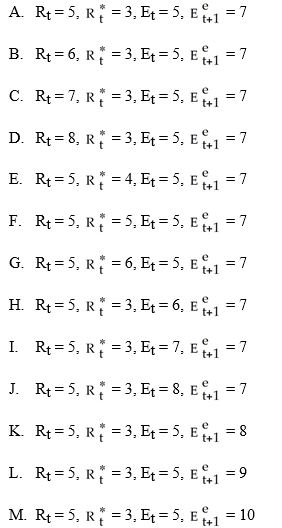
Does the interest rate parity hold in each of the following cases?
In case it does not hold, calculate the risk premium.
(Essay)
4.8/5 (86)
(86) "Bank failure may not be limited to banks that have mismanaged their assets." Explain why?
(Essay)
4.8/5 (60)
(60) In the Interest Parity Condition, R*t - Rt = (  - Et)/Et + xt, where Rt - Rt is the interest rate differential and (
 - Et)/Et is the expected change in the exchange rate, what does xt stand for if it potentially is a market efficient difference between the two?
- Et)/Et + xt, where Rt - Rt is the interest rate differential and ( - Et)/Et is the expected change in the exchange rate, what does xt stand for if it potentially is a market efficient difference between the two? (Multiple Choice)
4.8/5 (77)
(77) Many observers believe that the largely unregulated nature of global banking activity leaves the world financial system vulnerable to bank failure on a massive scale. Is this a real threat?
If so, what measures have governments taken to reduce it?
(Essay)
4.7/5 (74)
(74) For the following questions assume the following facts:
(1)Balance of Payments = 0 prior to the transactions.
(2)Person A (who lives in the United States) purchases an airplane from British Airways for $150,000.
(3)Person A pays with a check from his account at First Union Bank in the United States.
(4)British airways, since it will need dollars in 1 month, deposits the check at the Bank of England.
(5)Bank of England deposits the $150,000 at Commonwealth bank, which is located in the United States.
Due to the transactions above, what are the effects on the reserve at the Fed?
(Multiple Choice)
4.8/5 (80)
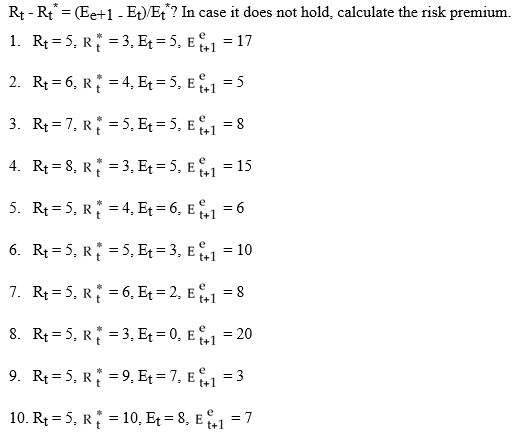
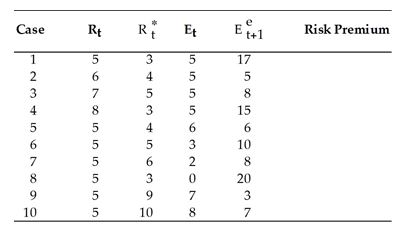
(80) Does the interest rate parity hold in each of the following cases by using the formula
(Essay)
4.7/5 (82)
(82) In the U.S., the following agencies have the right to examine the bank's books:
(Multiple Choice)
4.9/5 (75)
(75) The following simple two-country question illustrates how countries are made better off by trade in assets. Imagine that there are two countries, Home and Foreign, and that residents of each own only one asset, domestic land yielding an annual harvest of kiwi fruit. Assume that the yield on the land is uncertain. Half the time, Home's land yields a harvest of 100 tons of kiwi fruit at the same time as Foreign's land yields a harvest of 50 tons. The other half of the time the outcomes are reversed. The Foreign's harvest is 100 tons, but the Home harvest is only 50.
-Suppose the two countries can trade shares in the ownership of their perspective assets. Further, assume that a Home owner owns a 10 percent share in Foreign land. He will receive 10 percent share in Foreign land, and thus receives 10 percent of the annual Foreign kiwi fruit harvest. Further assume that a Foreign owner of a 10 percent share in Home land is permitted. In this case, a Foreigner is entitled to 10 percent of the Home harvest. Calculate the expected value of kiwi fruit for each investor. Is the investor better off?
(Essay)
4.9/5 (79)
(79) Imagine that there are two countries, Home and Far Far Away, and that residents of each own only one asset, domestic land yielding an annual harvest of mangoes. Assume that the yield on the land is uncertain. Half the time, Home's land yields a harvest of 5,000 tons of mangoes at the same time as Far Far Away's land yields a harvest of 2,500 tons. The other half of the time the outcomes are reversed. The average for each country mango harvest is
(Multiple Choice)
4.8/5 (80)
(80) 
Filters
- Essay(0)
- Multiple Choice(0)
- Short Answer(0)
- True False(0)
- Matching(0)