



 Chat with AI
Exam 20: Financial Globalization: Opportunity and Crisis

Exam 1: Introduction37 Questions
Exam 2: World Trade: an Overview18 Questions
Exam 3: Labor Productivity and Comparative Advantage: the Ricardian Model47 Questions
Exam 4: Specific Factors and Income Distribution62 Questions
Exam 5: Resources and Trade: the Heckscher-Ohlin Model66 Questions
Exam 6: The Standard Trade Model45 Questions
Exam 7: External Economies of Scale and the International Location of Production37 Questions
Exam 8: Firms in the Global Economy: Export Decisions, Outsourcing, and Multinational Enterprises69 Questions
Exam 9: The Instruments of Trade Policy71 Questions
Exam 10: The Political Economy of Trade Policy57 Questions
Exam 11: Trade Policy in Developing Countries33 Questions
Exam 12: Controversies in Trade Policy46 Questions
Exam 13: National Income Accounting and the Balance of Payments72 Questions
Exam 14: Exchange Rates and the Foreign Exchange Market: an Asset Approach73 Questions
Exam 15: Money, Interest Rates, and Exchange Rates64 Questions
Exam 16: Price Levels and the Exchange Rate in the Long Run74 Questions
Exam 17: Output and the Exchange Rate in the Short Run114 Questions
Exam 18: Fixed Exchange Rates and Foreign Exchange Intervention72 Questions
Exam 19: International Monetary Systems: an Historical Overview153 Questions
Exam 20: Financial Globalization: Opportunity and Crisis113 Questions
Exam 21: Optimum Currency Areas and the Euro100 Questions
Exam 22: Developing Countries: Growth, Crisis, and Reform112 Questions
Select questions type


The difference between an agency office located abroad and a subsidiary bank located abroad is
(Multiple Choice)
4.9/5  (88)
(88) Suppose you are offered a gamble in which you win $1,000 half the time but lose $1,000 half the time. If you are risk averter will you take the gamble?
(Essay)
4.9/5 (72)
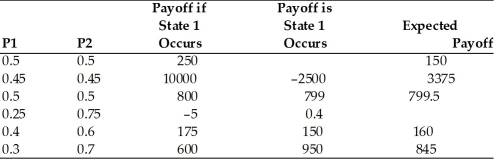
(72) Complete the following table with the formula (P1) * (payoff if state 1) + (P2)* (payoff if state 2), where P1 and P2 are the probabilities of state 1 and 2, respectively.
(Essay)
4.8/5 (83)
(83) What is the difference between equity instruments and debt instruments?
(Essay)
4.8/5 (69)
(69) What would best describe the international capital markets?
(Multiple Choice)
4.8/5 (84)
(84) Which type of main institution in the international capital market most often is involved in foreign exchange intervention?
(Multiple Choice)
4.7/5 (89)
(89) Suppose one is offered a gamble in which you win $1,000 half the time but lose $1,000 half the time. Since in this case one is as likely to win as to lose the $1,000, the average payoff on this gamble-its expected value-is:
0)5 ∗ $1,000 + 0.5 ∗ (-$1,000) = 0.
Under such circumstances:
(Multiple Choice)
4.8/5 (84)
(84) The following simple two-country question illustrates how countries are made better off by trade in assets. Imagine that there are two countries, Home and Foreign, and that residents of each own only one asset, domestic land yielding an annual harvest of kiwi fruit. Assume that the yield on the land is uncertain. Half the time, Home's land yields a harvest of 100 tons of kiwi fruit at the same time as Foreign's land yields a harvest of 50 tons. The other half of the time the outcomes are reversed. The Foreign's harvest is 100 tons, but the Home harvest is only 50.
-Suppose that trade in asset is not allowed but the two countries sign a treaty that guarantees the sending of 25 tons of kiwi in good time by the high output country in that season. What will the outcome be of such a treaty?
Explain why.
(Essay)
4.8/5 (82)
(82) The following simple two-country question illustrates how countries are made better off by trade in assets. Imagine that there are two countries, Home and Foreign, and that residents of each own only one asset, domestic land yielding an annual harvest of kiwi fruit. Assume that the yield on the land is uncertain. Half the time, Home's land yields a harvest of 100 tons of kiwi fruit at the same time as Foreign's land yields a harvest of 50 tons. The other half of the time the outcomes are reversed. The Foreign's harvest is 100 tons, but the Home harvest is only 50.
-Suppose the two countries can trade shares in the ownership of their perspective assets. Further assume that a Home owner owns a 25 percent share in Foreign land. He will receive 25 percent share in Foreign land and thus receives 25 percent of the annual Foreign kiwi fruit harvest. Further assume also that a Foreign owner of a 25 percent share in Home land is permitted. In this case, a Foreigner is entitled to 25 percent of the Home harvest. Calculate the expected value of kiwi fruit for each investor.
(Essay)
4.9/5 (89)
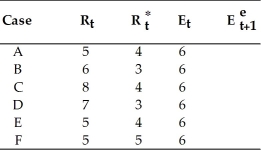
(89) Assume interest parity holds. Calculate for each of the following cases.
(Essay)
4.7/5 (76)
(76) Calculate the expected payoff for the following cases, where q1 and q2 are the probabilities of state 1 and 2, respectively.

(Essay)
4.8/5 (69)
(69) 
Filters
- Essay(0)
- Multiple Choice(0)
- Short Answer(0)
- True False(0)
- Matching(0)