



 Chat with AI
Exam 20: Financial Globalization: Opportunity and Crisis

Exam 1: Introduction37 Questions
Exam 2: World Trade: an Overview18 Questions
Exam 3: Labor Productivity and Comparative Advantage: the Ricardian Model47 Questions
Exam 4: Specific Factors and Income Distribution62 Questions
Exam 5: Resources and Trade: the Heckscher-Ohlin Model66 Questions
Exam 6: The Standard Trade Model45 Questions
Exam 7: External Economies of Scale and the International Location of Production37 Questions
Exam 8: Firms in the Global Economy: Export Decisions, Outsourcing, and Multinational Enterprises69 Questions
Exam 9: The Instruments of Trade Policy71 Questions
Exam 10: The Political Economy of Trade Policy57 Questions
Exam 11: Trade Policy in Developing Countries33 Questions
Exam 12: Controversies in Trade Policy46 Questions
Exam 13: National Income Accounting and the Balance of Payments72 Questions
Exam 14: Exchange Rates and the Foreign Exchange Market: an Asset Approach73 Questions
Exam 15: Money, Interest Rates, and Exchange Rates64 Questions
Exam 16: Price Levels and the Exchange Rate in the Long Run74 Questions
Exam 17: Output and the Exchange Rate in the Short Run114 Questions
Exam 18: Fixed Exchange Rates and Foreign Exchange Intervention72 Questions
Exam 19: International Monetary Systems: an Historical Overview153 Questions
Exam 20: Financial Globalization: Opportunity and Crisis113 Questions
Exam 21: Optimum Currency Areas and the Euro100 Questions
Exam 22: Developing Countries: Growth, Crisis, and Reform112 Questions
Select questions type


How can international trade in assets make both countries better off?
(Essay)
4.9/5  (77)
(77) For the following question assume the following facts:
(1)Balance of Payments = 0 prior to the transactions.
(2)Person A (who lives in the United States) purchases an airplane from British Airways for $150,000.
(3)Person A pays with a check from his account at First Union Bank in the United States.
(4)British airways, since it will need dollars in 1 month, deposits the check at the Bank of England.
(5)Bank of England deposits the $150,000 at Commonwealth bank, which is located in the United States.
Due to the transactions above, what are the effects on the balance of payments?
(Multiple Choice)
4.9/5 (75)
(75) Does the interest rate parity hold in each of the following cases?
In case it does not hold, calculate the risk premium.
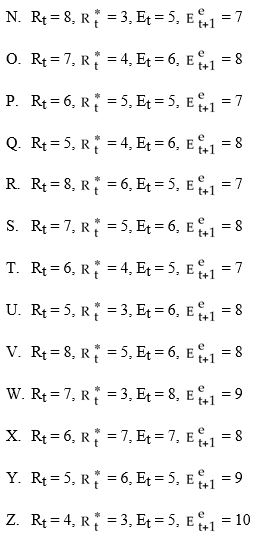
(Essay)
4.9/5 (82)
(82) In the United States, which of the following safety precautions has the government NOT taken to reduce Bank failures?
(Multiple Choice)
4.8/5 (88)
(88) What are the types of institution banks used to conduct foreign business?
(Multiple Choice)
4.8/5 (82)
(82) As a country begins to liberalize its capital account, what would you expect to happen to the difference between the interest rates for similar assets in this country and another country with open capital markets?
(Multiple Choice)
5.0/5 (83)
(83) Explain why, according to Feldstein and Horioka, one should expect that domestic investment rates diverge widely from saving rates.
(Essay)
4.7/5 (76)
(76) Calculate the expected payoff for the following cases, where q1 and q2 are the probabilities of state 1 and 2, respectively.

(Essay)
5.0/5 (78)
(78) The case where people purposely act in a careless way, for example, driving recklessly because they are insured, is called
(Multiple Choice)
4.7/5 (69)
(69) Who is the Basel Committee?
Discuss both their involvement in the Concordat as well as the role of the Concordat in international banking.
(Essay)
4.9/5 (84)
(84) 
Filters
- Essay(0)
- Multiple Choice(0)
- Short Answer(0)
- True False(0)
- Matching(0)