



 Chat with AI
Exam 6: The Standard Trade Model

Exam 1: Introduction37 Questions
Exam 2: World Trade: an Overview18 Questions
Exam 3: Labor Productivity and Comparative Advantage: the Ricardian Model47 Questions
Exam 4: Specific Factors and Income Distribution62 Questions
Exam 5: Resources and Trade: the Heckscher-Ohlin Model66 Questions
Exam 6: The Standard Trade Model45 Questions
Exam 7: External Economies of Scale and the International Location of Production37 Questions
Exam 8: Firms in the Global Economy: Export Decisions, Outsourcing, and Multinational Enterprises69 Questions
Exam 9: The Instruments of Trade Policy71 Questions
Exam 10: The Political Economy of Trade Policy57 Questions
Exam 11: Trade Policy in Developing Countries33 Questions
Exam 12: Controversies in Trade Policy46 Questions
Exam 13: National Income Accounting and the Balance of Payments72 Questions
Exam 14: Exchange Rates and the Foreign Exchange Market: an Asset Approach73 Questions
Exam 15: Money, Interest Rates, and Exchange Rates64 Questions
Exam 16: Price Levels and the Exchange Rate in the Long Run74 Questions
Exam 17: Output and the Exchange Rate in the Short Run114 Questions
Exam 18: Fixed Exchange Rates and Foreign Exchange Intervention72 Questions
Exam 19: International Monetary Systems: an Historical Overview153 Questions
Exam 20: Financial Globalization: Opportunity and Crisis113 Questions
Exam 21: Optimum Currency Areas and the Euro100 Questions
Exam 22: Developing Countries: Growth, Crisis, and Reform112 Questions
Select questions type


An export subsidy has the opposite effect on terms of trade to the effect of an import tariff. Domestically a tariff will raise the price of the import good, deteriorating the domestic terms of trade. A production subsidy for the export product will lower the local price of the export good, lowering the domestic terms of trade for the country. Hence the export subsidy and the import tariff have the same effect. This analysis seems to contradict the first sentence in this paragraph. Discuss this paradox.

Free
(Essay)
4.8/5  (82)
(82) Correct Answer: Verified
While this (Lerner) equivalence may well occur domestically, internationally the tariff will improve a country's terms of trade. An export subsidy on the other hand will in fact lower the international price of the (now readily available) export good, hence hurting a country's terms of trade.
If the ratio of price of cloth (PC) divided by the price of food (PF) increases in the international marketplace, then
Free
(Multiple Choice)
4.9/5 (75)
(75) Correct Answer:Verified
VerifiedE
The intertemporal tradeoff between present and future consumption is measured by the
Free
(Multiple Choice)
4.7/5 (82)
(82) Correct Answer:Verified
VerifiedB
Other things being equal, a rise in a country's terms of trade increases its welfare. What would happen if we relax the ceteris paribus assumption, and allow for the law of demand to operate internationally?
(Essay)
4.9/5 (83)
(83) If Slovenia were a large country in world trade, then if it imposes a large set of tariffs on its imports, this must
(Multiple Choice)
4.7/5 (97)
(97) If one observes that Japan was traditionally a net foreign lender, one could conclude that relative to its international trade and financial partners
(Multiple Choice)
4.9/5 (93)
(93) 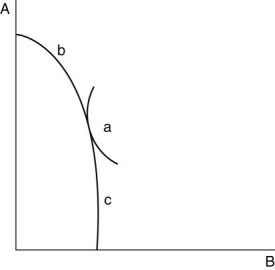 -Refer to above figure. Albania refused to engage in international trade for ideological reasons. To maximize its economic welfare it would choose to produce at which point in the diagram above?
Suppose the PA/PB at point a was equal to 1. Given this information, in which good (A or
B) does Albania enjoy a comparative advantage?
Now that the Cold War is over, Albania is interested in obtaining economic welfare gains from trade. The relevant international relative price is PA/PB = 2. Albania would therefore choose to produce at which point (a, b, or c)? Given this additional information, in which good does Albania enjoy a comparative advantage?
-Refer to above figure. Albania refused to engage in international trade for ideological reasons. To maximize its economic welfare it would choose to produce at which point in the diagram above?
Suppose the PA/PB at point a was equal to 1. Given this information, in which good (A or
B) does Albania enjoy a comparative advantage?
Now that the Cold War is over, Albania is interested in obtaining economic welfare gains from trade. The relevant international relative price is PA/PB = 2. Albania would therefore choose to produce at which point (a, b, or c)? Given this additional information, in which good does Albania enjoy a comparative advantage? (Essay)
4.7/5 (92)
(92) An increase in a country's net commodity terms of trade will
(Multiple Choice)
4.9/5 (76)
(76)
-Refer to above figure. Now, suppose that the relative price of A is actually not higher than Albania's autarkic level of 1, but quite the opposite (e.g., PA/PB = 0.5). Would Albania still be able to gain from trade?
If so, where would be its production point?
Given the information in this question, where is Albania's comparative advantage?
-Refer to above figure. Now, suppose that the relative price of A is actually not higher than Albania's autarkic level of 1, but quite the opposite (e.g., PA/PB = 0.5). Would Albania still be able to gain from trade?
If so, where would be its production point?
Given the information in this question, where is Albania's comparative advantage? (Essay)
4.9/5 (78)
(78) It may be argued that theoretically, international capital movements
(Multiple Choice)
4.8/5 (72)
(72) 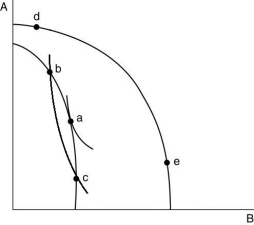 -Suppose that a country experiences growth strongly biased toward its export, cloth,
 (Multiple Choice)
4.8/5 (63)
(63) 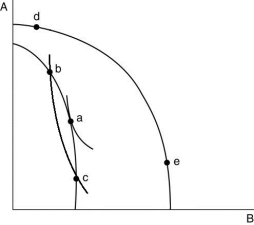 -Refer to the figure above, which shows a country's possible production possibility frontiers and indifference curves. If the country is producing at ________, then moving to ________ will cause utility to ________.
 (Multiple Choice)
4.8/5 (81)
(81) If the U.S. (a large country) imposes a tariff on its imported good, this will tend to
(Multiple Choice)
4.8/5 (91)
(91)
-Refer to the figure above, which shows a country's possible production possibility frontiers and indifference curves. If the country is producing at ________, then moving to ________ will cause utility to ________.
-Refer to the figure above, which shows a country's possible production possibility frontiers and indifference curves. If the country is producing at ________, then moving to ________ will cause utility to ________. (Multiple Choice)
4.8/5 (82)
(82) A fall in the real interest rate, all other things held constant, will cause a country's ________ to ________.
(Multiple Choice)
4.7/5 (71)
(71) Rapidly growing developing countries tend to be borrowers on the international capital markets. From this information we may surmise that they have a comparative advantage in
(Multiple Choice)
4.8/5 (68)
(68) An increase in the real interest rate, all other things held constant, will cause a country's ________ to ________.
(Multiple Choice)
4.9/5 (83)
(83) 
Filters
- Essay(0)
- Multiple Choice(0)
- Short Answer(0)
- True False(0)
- Matching(0)