



 Chat with AI
Exam 19: International Monetary Systems: an Historical Overview

Exam 1: Introduction37 Questions
Exam 2: World Trade: an Overview18 Questions
Exam 3: Labor Productivity and Comparative Advantage: the Ricardian Model47 Questions
Exam 4: Specific Factors and Income Distribution62 Questions
Exam 5: Resources and Trade: the Heckscher-Ohlin Model66 Questions
Exam 6: The Standard Trade Model45 Questions
Exam 7: External Economies of Scale and the International Location of Production37 Questions
Exam 8: Firms in the Global Economy: Export Decisions, Outsourcing, and Multinational Enterprises69 Questions
Exam 9: The Instruments of Trade Policy71 Questions
Exam 10: The Political Economy of Trade Policy57 Questions
Exam 11: Trade Policy in Developing Countries33 Questions
Exam 12: Controversies in Trade Policy46 Questions
Exam 13: National Income Accounting and the Balance of Payments72 Questions
Exam 14: Exchange Rates and the Foreign Exchange Market: an Asset Approach73 Questions
Exam 15: Money, Interest Rates, and Exchange Rates64 Questions
Exam 16: Price Levels and the Exchange Rate in the Long Run74 Questions
Exam 17: Output and the Exchange Rate in the Short Run114 Questions
Exam 18: Fixed Exchange Rates and Foreign Exchange Intervention72 Questions
Exam 19: International Monetary Systems: an Historical Overview153 Questions
Exam 20: Financial Globalization: Opportunity and Crisis113 Questions
Exam 21: Optimum Currency Areas and the Euro100 Questions
Exam 22: Developing Countries: Growth, Crisis, and Reform112 Questions
Select questions type


Under flexible exchange rate regime, a money-induced

Free
(Multiple Choice)
5.0/5  (81)
(81) Correct Answer: Verified
B
The costs of inflation have been most apparent in the post-war period in countries like
(Multiple Choice)
4.9/5 (80)
(80) "Even under flexible exchange rate regime, governments could not be indifferent to the behavior of exchange rates and inevitably surrendered some of their policy autonomy in other areas to prevent exchange rate movements they viewed as harmful to their economies." Discuss.
(Essay)
4.7/5 (88)
(88) Governments prefer to avoid excessive current account surpluses because
(Multiple Choice)
4.8/5 (86)
(86) The case of New Zealand, described in the text, asks what question about the country's international debt position?
(Essay)
4.8/5 (75)
(75) Advocates of floating rate suggested it is favorable for economies for all of the following reasons EXCEPT
(Multiple Choice)
4.9/5 (75)
(75) Why do governments prefer to avoid excessive current account surpluses?
Or, why are growing domestic claims to foreign wealth ever a problem?
(Essay)
4.9/5 (77)
(77) A convertible currency is a currency that may be freely exchanged for
(Multiple Choice)
4.8/5 (80)
(80) Which of the two features of the IMF Articles of Agreement helped promote flexibility in external adjustment?
(Multiple Choice)
4.8/5 (73)
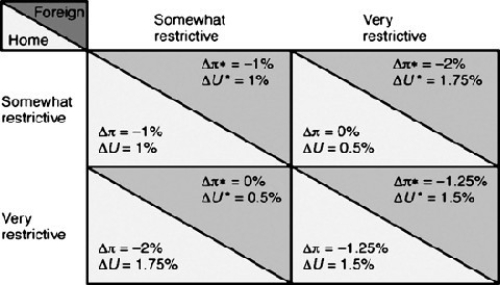
(73) Use the following table to illustrate the importance of macroeconomic policy coordination. Show that the two governments would have been happier if the two of them had adopted looser monetary policies, but given the policies that the other government did adopt, it is not in the interest of any individual government to change its course. Assume that each country wishes to get the biggest reduction in inflation rate at the lowest cost in terms of unemployment. This means that each country maximizes-ΔΠ/ΔU, the inflation reduction per point of increased unemployment.
(Essay)
4.9/5 (88)
(88) "The line distinguishing external from internal goals can be fuzzy." Discuss.
(Essay)
4.7/5 (78)
(78) The case of New Zealand, as described in the text, draws what simple conclusion regarding the country's international debt position?
(Essay)
4.8/5 (96)
(96) The "rules of the game" under the gold standard can best be described as which of the following:
(Multiple Choice)
4.8/5 (78)
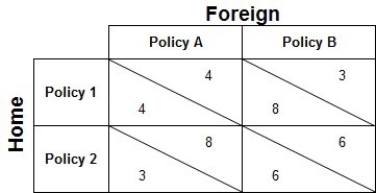
(78) Refer to the payoff matrix below, which ________ a prisoner's dilemma. If both countries go it alone, Home will choose Policy ________ and Foreign will choose Policy ________.
(Multiple Choice)
4.8/5 (90)
(90) 
Filters
- Essay(0)
- Multiple Choice(0)
- Short Answer(0)
- True False(0)
- Matching(0)