



 Chat with AI
Exam 15: Money, Interest Rates, and Exchange Rates

Exam 1: Introduction37 Questions
Exam 2: World Trade: an Overview18 Questions
Exam 3: Labor Productivity and Comparative Advantage: the Ricardian Model47 Questions
Exam 4: Specific Factors and Income Distribution62 Questions
Exam 5: Resources and Trade: the Heckscher-Ohlin Model66 Questions
Exam 6: The Standard Trade Model45 Questions
Exam 7: External Economies of Scale and the International Location of Production37 Questions
Exam 8: Firms in the Global Economy: Export Decisions, Outsourcing, and Multinational Enterprises69 Questions
Exam 9: The Instruments of Trade Policy71 Questions
Exam 10: The Political Economy of Trade Policy57 Questions
Exam 11: Trade Policy in Developing Countries33 Questions
Exam 12: Controversies in Trade Policy46 Questions
Exam 13: National Income Accounting and the Balance of Payments72 Questions
Exam 14: Exchange Rates and the Foreign Exchange Market: an Asset Approach73 Questions
Exam 15: Money, Interest Rates, and Exchange Rates64 Questions
Exam 16: Price Levels and the Exchange Rate in the Long Run74 Questions
Exam 17: Output and the Exchange Rate in the Short Run114 Questions
Exam 18: Fixed Exchange Rates and Foreign Exchange Intervention72 Questions
Exam 19: International Monetary Systems: an Historical Overview153 Questions
Exam 20: Financial Globalization: Opportunity and Crisis113 Questions
Exam 21: Optimum Currency Areas and the Euro100 Questions
Exam 22: Developing Countries: Growth, Crisis, and Reform112 Questions
Select questions type


Which one of the following statements is the MOST accurate?

Free
(Multiple Choice)
4.9/5  (73)
(73) Correct Answer: Verified
C
Which one of the following statements is the MOST accurate?
Free
(Multiple Choice)
4.9/5 (63)
(63) Correct Answer:Verified
VerifiedD
A reduction in a country's money supply causes
Free
(Multiple Choice)
5.0/5 (72)
(72) Correct Answer:Verified
VerifiedB
Combine a graph showing the interest parity condition and one showing money demand and supply to demonstrate simultaneous equilibrium in the money market and the foreign exchange market.
How would an increase in the U.S. money supply affect the dollar/euro exchange rate and the U.S. interest rate?
Illustrate your answer graphically and explain.
(Essay)
4.9/5 (77)
(77) Using a figure describing both the U.S. money market and the foreign exchange market, analyze the effects of an increase in the U.S. money supply on the dollar/euro exchange rate.
(Essay)
4.9/5 (68)
(68) Using 4 different figures, plot the time paths showing the effects of a permanent increase in the United States money supply on:
(a)U.S. Money supply
(b)The dollar interest rate.
(c)The U.S. price level
(d)The dollar/euro exchange rate
(Essay)
4.8/5 (77)
(77) Which one of the following statements is the MOST accurate?
(Multiple Choice)
4.9/5 (90)
(90) In a world where the price level could adjust immediately to its new long-run level after a money supply increase
(Multiple Choice)
4.8/5 (91)
(91) What are the factors that determine the amount of money an individual desires to hold?
(Essay)
4.8/5 (71)
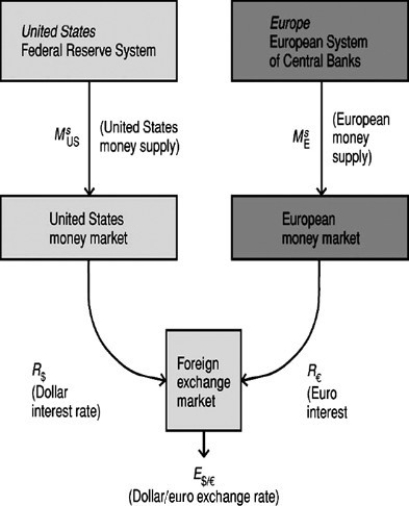
(71) Explain how the money markets of two countries are linked through the foreign exchange market.
(Essay)
4.8/5 (83)
(83) In the United States at the end of 2012, the total money supply, M1, amounted to approximately
(Multiple Choice)
4.8/5 (75)
(75) 

Filters
- Essay(0)
- Multiple Choice(0)
- Short Answer(0)
- True False(0)
- Matching(0)