



 Chat with AI
Exam 20: Financial Globalization: Opportunity and Crisis

Exam 1: Introduction37 Questions
Exam 2: World Trade: an Overview18 Questions
Exam 3: Labor Productivity and Comparative Advantage: the Ricardian Model47 Questions
Exam 4: Specific Factors and Income Distribution62 Questions
Exam 5: Resources and Trade: the Heckscher-Ohlin Model66 Questions
Exam 6: The Standard Trade Model45 Questions
Exam 7: External Economies of Scale and the International Location of Production37 Questions
Exam 8: Firms in the Global Economy: Export Decisions, Outsourcing, and Multinational Enterprises69 Questions
Exam 9: The Instruments of Trade Policy71 Questions
Exam 10: The Political Economy of Trade Policy57 Questions
Exam 11: Trade Policy in Developing Countries33 Questions
Exam 12: Controversies in Trade Policy46 Questions
Exam 13: National Income Accounting and the Balance of Payments72 Questions
Exam 14: Exchange Rates and the Foreign Exchange Market: an Asset Approach73 Questions
Exam 15: Money, Interest Rates, and Exchange Rates64 Questions
Exam 16: Price Levels and the Exchange Rate in the Long Run74 Questions
Exam 17: Output and the Exchange Rate in the Short Run114 Questions
Exam 18: Fixed Exchange Rates and Foreign Exchange Intervention72 Questions
Exam 19: International Monetary Systems: an Historical Overview153 Questions
Exam 20: Financial Globalization: Opportunity and Crisis113 Questions
Exam 21: Optimum Currency Areas and the Euro100 Questions
Exam 22: Developing Countries: Growth, Crisis, and Reform112 Questions
Select questions type


Asset trades that deal with debt instruments are best described as
(Multiple Choice)
4.8/5  (77)
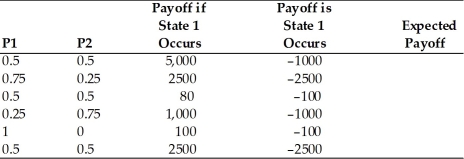
(77) Calculate the expected payoff for the following cases with the formula: (P1) * (payoff if state 1) + (P2) * (payoff if state 2), where P1 and P2 are the probabilities of state 1 and 2, respectively.
(Essay)
4.8/5 (78)
(78) Why is it useful to make a distinction between debt and equity instruments?
(Essay)
4.9/5 (87)
(87) What is a difficulty encountered in regulating international banking?
(Multiple Choice)
4.9/5 (78)
(78) A random walk model can more accurately predict exchange rates as compared to a sophisticated forecast
(Multiple Choice)
4.8/5 (77)
(77) Explain why large interest rate differences would be strong evidence of unrealized gains from trade.
(Essay)
4.7/5 (79)
(79) "It is in the interest of each depositor to withdraw her money from a bank if all other depositors are doing the same, even when the bank's assets are sound." Discuss. As part of your answer clearly state whether the statement is true or false.
(Essay)
5.0/5 (79)
(79) Capital markets of poor developing countries that liberalized their financial systems to allow private asset trade with foreigners are called
(Multiple Choice)
4.8/5 (88)
(88) Besides world trade growth, what can explain the growth of international banking since the 1960s?
(Multiple Choice)
4.9/5 (83)
(83) The following simple two-country question illustrates how countries are made better off by trade in assets. Imagine that there are two countries, Home and Foreign, and that residents of each own only one asset, domestic land yielding an annual harvest of kiwi fruit. Assume that the yield on the land is uncertain. Half the time, Home's land yields a harvest of 100 tons of kiwi fruit at the same time as Foreign's land yields a harvest of 50 tons. The other half of the time the outcomes are reversed. The Foreign's harvest is 100 tons, but the Home harvest is only 50.
-Calculate the average, for each country of kiwi harvest.
(Essay)
4.9/5 (72)
(72) Explain why the FDIC is following a "too-big-to-fail" policy of fully protecting all depositors at the largest banks.
(Essay)
4.8/5 (81)
(81) 
Filters
- Essay(0)
- Multiple Choice(0)
- Short Answer(0)
- True False(0)
- Matching(0)