



 Chat with AI
Exam 22: Developing Countries: Growth, Crisis, and Reform

Exam 1: Introduction37 Questions
Exam 2: World Trade: an Overview18 Questions
Exam 3: Labor Productivity and Comparative Advantage: the Ricardian Model47 Questions
Exam 4: Specific Factors and Income Distribution62 Questions
Exam 5: Resources and Trade: the Heckscher-Ohlin Model66 Questions
Exam 6: The Standard Trade Model45 Questions
Exam 7: External Economies of Scale and the International Location of Production37 Questions
Exam 8: Firms in the Global Economy: Export Decisions, Outsourcing, and Multinational Enterprises69 Questions
Exam 9: The Instruments of Trade Policy71 Questions
Exam 10: The Political Economy of Trade Policy57 Questions
Exam 11: Trade Policy in Developing Countries33 Questions
Exam 12: Controversies in Trade Policy46 Questions
Exam 13: National Income Accounting and the Balance of Payments72 Questions
Exam 14: Exchange Rates and the Foreign Exchange Market: an Asset Approach73 Questions
Exam 15: Money, Interest Rates, and Exchange Rates64 Questions
Exam 16: Price Levels and the Exchange Rate in the Long Run74 Questions
Exam 17: Output and the Exchange Rate in the Short Run114 Questions
Exam 18: Fixed Exchange Rates and Foreign Exchange Intervention72 Questions
Exam 19: International Monetary Systems: an Historical Overview153 Questions
Exam 20: Financial Globalization: Opportunity and Crisis113 Questions
Exam 21: Optimum Currency Areas and the Euro100 Questions
Exam 22: Developing Countries: Growth, Crisis, and Reform112 Questions
Select questions type


Does it appear that currency boards make low-inflation policies credible?
(Essay)
4.9/5  (87)
(87) A trend that has been reinforced by many developing countries is privatization. Privatization refers to
(Multiple Choice)
4.8/5 (86)
(86) Over the period 1960-2014, the United States economy grew at roughly
(Multiple Choice)
4.9/5 (75)
(75) In the instances where a loan has been issued under certain terms and has to be repaid, what happens when the borrower does not uphold these stipulations?
(Multiple Choice)
4.8/5 (85)
(85) The 1980s are considered as the "lost decade" of Latin American growth. Explain why?
(Essay)
4.9/5 (81)
(81) A considerable advantage that richer countries have over poorer ones is exemplified by the fact that
(Multiple Choice)
4.7/5 (74)
(74) Discuss the role of more "transparency" in reducing the risk of financial crisis.
(Essay)
4.7/5 (75)
(75) Describe alternative forms of capital inflow to finance external deficits and explain why these methods were used in different times?
(Essay)
4.9/5 (71)
(71) If a developing country institutes a currency board, it relinquishes control over having
(Multiple Choice)
4.9/5 (72)
(72) There are many ways developing countries finance their external deficits EXCEPT
(Multiple Choice)
4.8/5 (70)
(70) One should expect ________ relationship between annual per-capita GDP and an inverse index of corruption.
(Multiple Choice)
4.9/5 (79)
(79) Please consider Table 22-2 below.
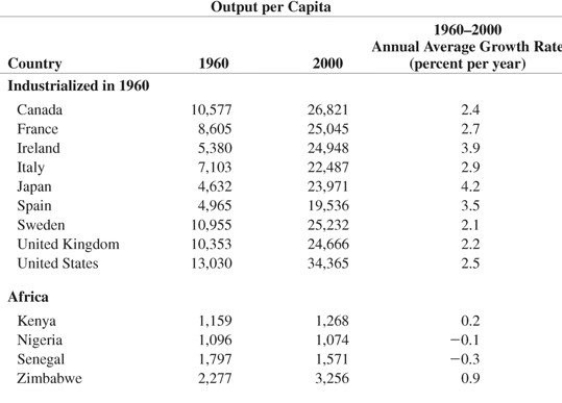
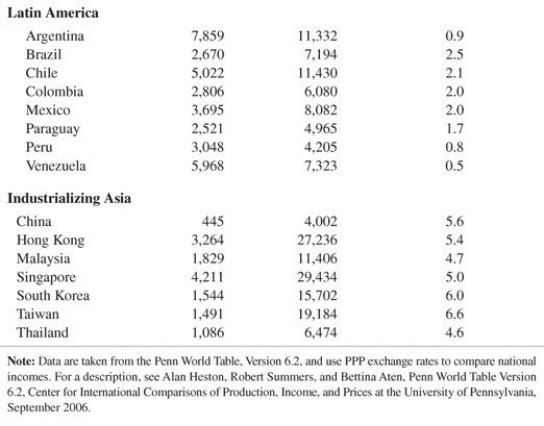 Assuming constant Annual Average Growth Rate in the future, determine the year in which the United States will have the same output per capita as South Korea?
 (Essay)
4.8/5 (69)
(69) Explain why East Asian countries have done so well relative to South American countries.
(Essay)
4.8/5 (70)
(70) Why may equity finance be preferred to debt finance for developing countries?
(Multiple Choice)
4.9/5 (64)
(64) List and explain 3 major channels through which developing countries have financed their external deficits.
(Essay)
4.9/5 (85)
(85) In general, one would expect that life expectancies reflect international differences in income levels. Do the data support such a claim?
(Multiple Choice)
4.8/5 (90)
(90) What are the main lessons economists learned from the developing country crisis?
(Essay)
4.8/5 (83)
(83) Compare the macroeconomic performances in the 1990s of the following countries under the following exchange-rate regimes: floating exchange rates, Mexico and Brazil; capital control, China and Malaysia; and currency boards, Estonia and Hong Kong; dollarization, Argentina.
(Essay)
4.9/5 (63)
(63) The main factors that discourage investment in capital and skills in developing countries are
(Multiple Choice)
4.8/5 (64)
(64) 
Filters
- Essay(0)
- Multiple Choice(0)
- Short Answer(0)
- True False(0)
- Matching(0)