



 Chat with AI
Exam 3: Project Management

Exam 1: Operations and Productivity126 Questions
Exam 2: Operations Strategy in a Global Environment135 Questions
Exam 3: Project Management123 Questions
Exam 4: Forecasting144 Questions
Exam 5: Design of Goods and Services137 Questions
Exam 6: Managing Quality130 Questions
Exam 7: Statistical Process Control154 Questions
Exam 8: Process Strategy131 Questions
Exam9: Capacity and Constraint Management107 Questions
Exam 10: Location Strategies140 Questions
Exam 11: Layout Strategies161 Questions
Exam 12: Human Resources, Job Design, and Work Measurement191 Questions
Exam 13: Supply-Chain Management145 Questions
Exam 14: Outsourcing as a Supply-Chain Strategy73 Questions
Exam 15: Inventory Management155 Questions
Exam 16: Aggregate Planning134 Questions
Exam 17: Material Requirements Planning MRP and ERP169 Questions
Exam 18: Short-Term Scheduling139 Questions
Exam 19: Just-In-Time and Lean Options137 Questions
Exam 20: Maintenance and Reliability130 Questions
Exam 21: Decision-Making Tools97 Questions
Exam 22: Linear Programming100 Questions
Exam 23: Transportation Models94 Questions
Exam 24: Waiting-Line Models135 Questions
Exam 25: Learning Curves111 Questions
Exam 26: Simulation93 Questions
Select questions type


The network analysis method that allows activity times to vary is __________.
(Short Answer)
4.9/5  (80)
(80) In PERT analysis, the identification of the critical path can be incorrect if a noncritical activity takes substantially more than its expected time.
(True/False)
4.8/5 (93)
(93) What was the name of the construction project to rebuild the Pentagon after the terrorist attacks on Sept. 11, 2001?
(Multiple Choice)
4.9/5 (81)
(81) Which of the following statements regarding PERT times is true?
(Multiple Choice)
5.0/5 (74)
(74) The __________ has established a code of ethics especially for project managers.
(Short Answer)
4.9/5 (84)
(84) Which of the following statements concerning CPM activities is False?
(Multiple Choice)
4.7/5 (73)
(73) A project organization that becomes permanent is often referred to as a __________.
(Multiple Choice)
4.8/5 (70)
(70) Activity D on a CPM network has predecessors B and C, and has successor F. D has duration 6. B's earliest finish is 18, while C's is 20. F's late start is 26. Which of the following is definitely true?
(Multiple Choice)
4.9/5 (78)
(78) An activity on a PERT network has these time estimates: optimistic = 2, most likely = 3, and pessimistic = 8. Its expected time and variance (if it is a critical activity) are
(Multiple Choice)
4.8/5 (90)
(90) A contractor's project being analyzed by PERT has an estimated time for the critical path of 120 days. The sum of all activity variances is 81; the sum of variances along the critical path is 64. The probability that the project will take 130 or more days to complete is
(Multiple Choice)
5.0/5 (70)
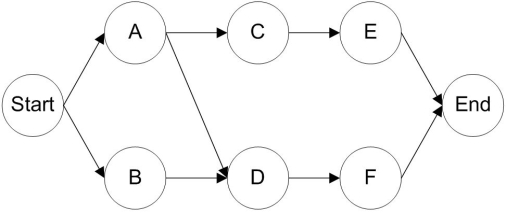
(70) Consider the network pictured below.
a. Enumerate all paths through this network.
b. Calculate the critical path for the network.
c. What is the minimum duration of the project?
d. How much slack exists at each activity?
(Essay)
4.8/5 (84)
(84) Identify and describe briefly each of the purposes of project scheduling.
(Essay)
4.9/5 (73)
(73) In project management, crashing an activity must consider the impact on all paths in the network.
(True/False)
4.8/5 (76)
(76) Two critical path activities are candidates for crashing on a CPM network. Activity details are in the table below. To cut one day from the project's duration, activity _________ should be crashed first, adding _________ to project cost. Activity Normal Time Normal Cost Crash Time Crash Cost B 4 days \ 6,000 3 days \ 8,000 C 6 days \ 4,000 4 days \ 6,000
(Multiple Choice)
4.8/5 (77)
(77) Given the critical path below, calculate the following
a. The crash cost per unit time savings for each activity.
b. The maximum total crash time savings and cost.
c. The maximum total time-savings with a $3000 budget.
Activity Normal Time Normal Cost Crash Duration Crash Cost A 8 days \ 8,000 7 days \ 12,000 B 5 days \ 2,000 3 days \ 10,000 C 10 days \ 9,000 9 days \ 12,000
(Essay)
4.9/5 (90)
(90) Briefly discuss what is meant by critical path analysis. What are critical path activities and why are they important?
(Essay)
4.8/5 (80)
(80) Which of the following statements regarding Bechtel is true?
(Multiple Choice)
4.8/5 (71)
(71) __________ is the amount of time an individual activity in a network can be delayed without delaying the entire project.
(Short Answer)
4.8/5 (75)
(75) 
Filters
- Essay(0)
- Multiple Choice(0)
- Short Answer(0)
- True False(0)
- Matching(0)