



 Chat with AI
Exam 20: Maintenance and Reliability

Exam 1: Operations and Productivity126 Questions
Exam 2: Operations Strategy in a Global Environment135 Questions
Exam 3: Project Management123 Questions
Exam 4: Forecasting144 Questions
Exam 5: Design of Goods and Services137 Questions
Exam 6: Managing Quality130 Questions
Exam 7: Statistical Process Control154 Questions
Exam 8: Process Strategy131 Questions
Exam9: Capacity and Constraint Management107 Questions
Exam 10: Location Strategies140 Questions
Exam 11: Layout Strategies161 Questions
Exam 12: Human Resources, Job Design, and Work Measurement191 Questions
Exam 13: Supply-Chain Management145 Questions
Exam 14: Outsourcing as a Supply-Chain Strategy73 Questions
Exam 15: Inventory Management155 Questions
Exam 16: Aggregate Planning134 Questions
Exam 17: Material Requirements Planning MRP and ERP169 Questions
Exam 18: Short-Term Scheduling139 Questions
Exam 19: Just-In-Time and Lean Options137 Questions
Exam 20: Maintenance and Reliability130 Questions
Exam 21: Decision-Making Tools97 Questions
Exam 22: Linear Programming100 Questions
Exam 23: Transportation Models94 Questions
Exam 24: Waiting-Line Models135 Questions
Exam 25: Learning Curves111 Questions
Exam 26: Simulation93 Questions
Select questions type


Simulation models and expert systems are useful tools for enhancing maintenance.

Free
(True/False)
4.8/5  (85)
(85) Correct Answer: Verified
True
Increasing the number of parts or components in a product tends to reduce its reliability. Why is this true only when adding components in series?
Free
(Essay)
4.8/5 (86)
(86) Correct Answer:Verified
VerifiedAdding parts in series involves an additional multiplication by a value less than one, so that reliability must fall. Adding parts in parallel (the redundancy concept) increases reliability because only one part of the parallel system must function.
A redundant part decreases reliability if the reliability of the redundant part is lower than that of the part it is backing up.
Free
(True/False)
4.8/5 (82)
(82) Correct Answer:Verified
VerifiedFalse
TPM (total productive maintenance) is an application of TQM (total quality management) principles to the area of maintenance.
(True/False)
4.8/5 (83)
(83) Suppose that a three stage process in a nuclear reactor had reliability ratings of .98 at each station and that only one stage needed to be successful for the process to work. If the plant wants to establish 6-sigma standards, what % reliable redundant controls need to be added to each station.
(Essay)
4.9/5 (84)
(84) Consider a product that is "settled in." Its MTBF distribution has been found to be normal with a mean of 10,000 hours and a standard deviation of 100 hours. What is the probability of a breakdown before 8,000 hours?
Before 9,000 hours?
Would you prefer a policy of preventive maintenance, or a policy of breakdown maintenance, on this product?
Explain your choice.
(Essay)
4.8/5 (93)
(93) The probability that a product will function properly for a specified time under stated conditions is
(Multiple Choice)
4.9/5 (74)
(74) How do many electronic firms deal with infant mortality in their products?
(Essay)
4.7/5 (99)
(99) General Grant must send orders to General Butler. Carrier pigeons are the medium of choice. A single pigeon has a .7 probability of arriving at the proper destination in a timely fashion. How many pigeons, each carrying an identical set of orders, must Grant send in order for him to have 98% confidence that the orders reached General Butler?
(Essay)
4.8/5 (74)
(74) __________ is the probability that a machine part or product will function properly for a specified time under stated conditions.
(Short Answer)
4.8/5 (75)
(75) The reliability of a system in which each individual component must function in order for the entire system to function, and in which each component has its own unique reliability, independent of other components, is the product of the probabilities of each of those components.
(True/False)
4.8/5 (86)
(86) 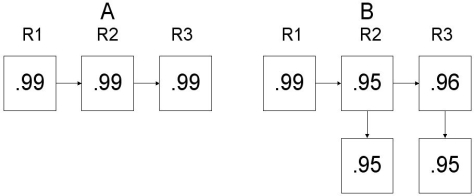
The process that involves repair on an emergency or priority basis is known as
(Multiple Choice)
4.9/5 (77)
(77) What is the reliability of the three components connected in series shown below?

(Multiple Choice)
4.8/5 (76)
(76) Ten high-technology batteries are tested for 200 hours each. One failed at 20 hours; all others completed the test. FR(%) is __________ and MTBF is __________.
(Multiple Choice)
4.9/5 (72)
(72) The Everstart is a battery with an intended design life of 72 months. Stephanie Bradley recently put five of these batteries through accelerated testing (the company couldn't wait six years) to simulate failure patterns. The test results had one failure at 26 months, one failure at 32 months, one failure at 50 months, and one failure at 62 months. Calculate FR(%), FR(N), and MTBF.
(Essay)
4.8/5 (97)
(97) The product failure rate is the percentage of failures among the total number of products tested.
(True/False)
4.8/5 (83)
(83) A two-component process has an 81% success rate in series and a 99% success rate in parallel. If each component has the same reliability, what is the reliability of an individual component?
(Multiple Choice)
4.9/5 (96)
(96) The objective of maintenance and reliability is to maintain the capability of the system.
(True/False)
5.0/5 (78)
(78) 
Filters
- Essay(0)
- Multiple Choice(0)
- Short Answer(0)
- True False(0)
- Matching(0)