



 Chat with AI
Exam 2: The Economic Problem

Exam 1: What Is Economics212 Questions
Exam 2: The Economic Problem159 Questions
Exam 3: Demand and Supply197 Questions
Exam 4: Elasticity186 Questions
Exam 5: Efficiency and Equity119 Questions
Exam 6: Governments Actions in Markets130 Questions
Exam 7: Global Markets in Action138 Questions
Exam 8: Utility and Demand120 Questions
Exam 9: Possibilities, Preferences, and Choices124 Questions
Exam 10: Organizing Production111 Questions
Exam 11: Output and Costs142 Questions
Exam 12: Perfect Competition117 Questions
Exam 13: Monopoly118 Questions
Exam 14: Monopolistic Competition122 Questions
Exam 15: Oligopoly106 Questions
Exam 16: Externalities116 Questions
Exam 17: Public Goods and Common Resources98 Questions
Exam 18: Markets for Factors of Production128 Questions
Exam 19: Economic Inequality124 Questions
Exam 20: Measuring Gdp and Economic Growth133 Questions
Exam 21: Monitoring Jobs and Inflation121 Questions
Exam 22: Economic Growth98 Questions
Exam 23: Finance, Saving, and Investment141 Questions
Exam 24: Money, the Price Level, and Inflation126 Questions
Exam 25: The Exchange Rate and the Balance of Payments126 Questions
Exam 26: Aggregate Supply and Aggregate Demand136 Questions
Exam 27: Expenditure Multipliers171 Questions
Exam 28: The Business Cycle, Inflation, and Deflation110 Questions
Exam 29: Fiscal Policy97 Questions
Exam 30: Monetary Policy97 Questions
Exam 31: Macro Only: International Trade Policy126 Questions
Select questions type


Which of the following quotations illustrates economic growth?
(Multiple Choice)
4.8/5  (83)
(83) Consider a PPF that measures the production of quilts on the y-axis and the production of pillows on the x-axis. As the firm moves along this PPF, the quantities of
(Multiple Choice)
4.8/5 (82)
(82) Trade is organized using the social institutions of all of the following except
(Multiple Choice)
4.8/5 (76)
(76) Table 2.1.1
The following table gives points on the production possibilities frontier for goods X and Y.
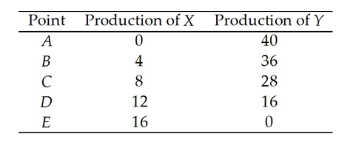 -Refer to Table 2.1.1. As we increase the production of X,
 (Multiple Choice)
4.8/5 (77)
(77) As production of food increases, marginal benefit from food
(Multiple Choice)
4.9/5 (67)
(67) Use the figure below to answer the following questions.
 Figure 2.1.2
-Consider the production possibilities frontier in Figure 2.1.2. Which of the following statements is false?
Figure 2.1.2
-Consider the production possibilities frontier in Figure 2.1.2. Which of the following statements is false? (Multiple Choice)
4.8/5 (77)
(77) Use the figure below to answer the following questions.
 Figure 2.1.3
-Refer to the production possibilities frontier in Figure 2.1.3. The opportunity cost of moving from C to B will be
Figure 2.1.3
-Refer to the production possibilities frontier in Figure 2.1.3. The opportunity cost of moving from C to B will be (Multiple Choice)
4.8/5 (77)
(77) Which one of the following concepts is not illustrated by a production possibilities frontier?
(Multiple Choice)
4.9/5 (80)
(80) Use the information below to answer the following questions.
Fact 2.4.2
Agnes can produce either 1 unit of X or 1 unit of Y in an hour, while Brenda can produce either 2 units of X or 4 units of Y in an hour.
-Complete the following sentence. Given Fact 2.4.2,
(Multiple Choice)
4.8/5 (77)
(77) Use the figure below to answer the following questions.
 Figure 2.2.1
-In Figure 2.2.1, when 4,000 bicycles are produced each month,
Figure 2.2.1
-In Figure 2.2.1, when 4,000 bicycles are produced each month, (Multiple Choice)
4.9/5 (85)
(85) Use the table below to answer the following questions.
Table 2.4.2
Production for one week by Sheila and Bruce
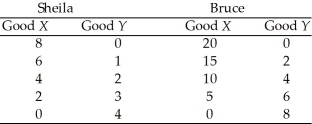 -Given the information in Table 2.4.2, can Sheila and Bruce gain by specialization?
 (Multiple Choice)
4.9/5 (79)
(79) A production possibilities frontier will shift outward FOR ALL OF THE FOLLOWING REASONS EXCEPT
(Multiple Choice)
4.8/5 (81)
(81) Use the table below to answer the following question.
Table 2.1.4
Consider the following production possibilities for a student for the typical week:
 -Refer to Table 2.1.4. Complete the following sentence. The production possibilities frontier in the table shows
 (Multiple Choice)
4.9/5 (68)
(68) Use the table below to answer the following questions.
Table 2.1.2
Production Possibilities
 -Refer to Table 2.1.2. In moving from combination B to combination C, the opportunity cost of producing one additional unit of guns is
 (Multiple Choice)
4.8/5 (76)
(76) Use the figure below to answer the following questions.
Figure 2.1.3
-Figure 2.1.3 illustrates Mary's production possibilities frontier. If Mary wants to move from point B to point C,
Figure 2.1.3
-Figure 2.1.3 illustrates Mary's production possibilities frontier. If Mary wants to move from point B to point C, (Multiple Choice)
4.7/5 (75)
(75) Use the figure below to answer the following questions.
Figure 2.2.1
-In Figure 2.2.1, when 2,000 bicycles are produced each month,
Figure 2.2.1
-In Figure 2.2.1, when 2,000 bicycles are produced each month, (Multiple Choice)
4.9/5 (82)
(82) On a graph of a production possibilities frontier, opportunity cost is represented by
(Multiple Choice)
4.8/5 (81)
(81) A situation in which resources are either unused or misallocated or both is represented in a production possibilities frontier diagram by
(Multiple Choice)
4.9/5 (71)
(71) 
Filters
- Essay(0)
- Multiple Choice(0)
- Short Answer(0)
- True False(0)
- Matching(0)