



 Chat with AI
Exam 13: Monopoly

Exam 1: What Is Economics212 Questions
Exam 2: The Economic Problem159 Questions
Exam 3: Demand and Supply197 Questions
Exam 4: Elasticity186 Questions
Exam 5: Efficiency and Equity119 Questions
Exam 6: Governments Actions in Markets130 Questions
Exam 7: Global Markets in Action138 Questions
Exam 8: Utility and Demand120 Questions
Exam 9: Possibilities, Preferences, and Choices124 Questions
Exam 10: Organizing Production111 Questions
Exam 11: Output and Costs142 Questions
Exam 12: Perfect Competition117 Questions
Exam 13: Monopoly118 Questions
Exam 14: Monopolistic Competition122 Questions
Exam 15: Oligopoly106 Questions
Exam 16: Externalities116 Questions
Exam 17: Public Goods and Common Resources98 Questions
Exam 18: Markets for Factors of Production128 Questions
Exam 19: Economic Inequality124 Questions
Exam 20: Measuring Gdp and Economic Growth133 Questions
Exam 21: Monitoring Jobs and Inflation121 Questions
Exam 22: Economic Growth98 Questions
Exam 23: Finance, Saving, and Investment141 Questions
Exam 24: Money, the Price Level, and Inflation126 Questions
Exam 25: The Exchange Rate and the Balance of Payments126 Questions
Exam 26: Aggregate Supply and Aggregate Demand136 Questions
Exam 27: Expenditure Multipliers171 Questions
Exam 28: The Business Cycle, Inflation, and Deflation110 Questions
Exam 29: Fiscal Policy97 Questions
Exam 30: Monetary Policy97 Questions
Exam 31: Macro Only: International Trade Policy126 Questions
Select questions type


A monopoly arises for two key reasons, which are

Free
(Multiple Choice)
5.0/5  (67)
(67) Correct Answer: Verified
A
To prevent monopoly from arising, there must be
Free
(Multiple Choice)
4.8/5 (81)
(81) Correct Answer:Verified
VerifiedD
If a firm practises perfect price discrimination,
Free
(Multiple Choice)
4.9/5 (97)
(97) Correct Answer:Verified
VerifiedE
Use the figure below to answer the following questions.
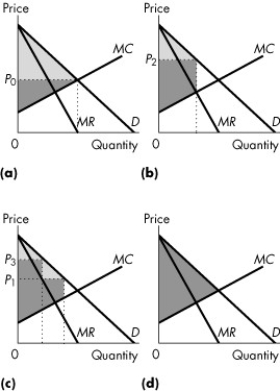 Figure 13.3.2
-Consider Figure 13.3.2. Consider a single-price monopoly. If the light grey area shows the consumer surplus, and the dark grey area shows the producer surplus, which graph correctly represents this firm?
Figure 13.3.2
-Consider Figure 13.3.2. Consider a single-price monopoly. If the light grey area shows the consumer surplus, and the dark grey area shows the producer surplus, which graph correctly represents this firm? (Multiple Choice)
4.8/5 (74)
(74) The capture theory holds that regulations are supplied to maximize
(Multiple Choice)
4.8/5 (86)
(86) To increase sales from 7 units to 8 units, a single-price monopolist must drop the price from $7 per unit to $6 per unit. What is marginal revenue in this range?
(Multiple Choice)
4.8/5 (79)
(79) For a single-price monopoly, marginal revenue is less than price because
(Multiple Choice)
4.8/5 (73)
(73) Use the figure below to answer the following questions.
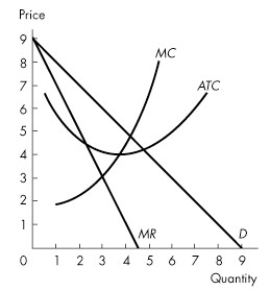 Figure 13.2.2
-For the single-price monopoly shown in Figure 13.2.2, when profit is maximized, quantity is
Figure 13.2.2
-For the single-price monopoly shown in Figure 13.2.2, when profit is maximized, quantity is (Multiple Choice)
4.9/5 (88)
(88) Use the table below to answer the following questions.
Table 13.4.1
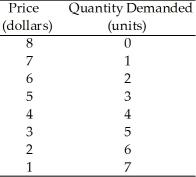 -Table 13.4.1 shows the demand schedule faced by a perfect price-discriminating monopoly. If 3 units are sold, total revenue is
 (Multiple Choice)
4.8/5 (76)
(76) Use the figure below to answer the following questions.
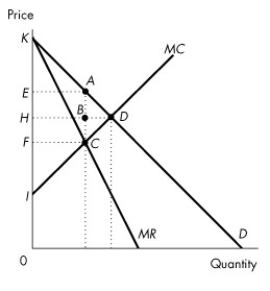 Figure 13.3.3
-Consider the revenue and cost curves in Figure 13.3.3. If this is a single-price monopoly, what is consumer surplus?
Figure 13.3.3
-Consider the revenue and cost curves in Figure 13.3.3. If this is a single-price monopoly, what is consumer surplus? (Multiple Choice)
4.8/5 (80)
(80) Use the figure below to answer the following questions.
Figure 13.3.3
-Consider the market demand curve in Figure 13.3.3. If the market is perfectly competitive, which area indicates producer surplus?
Figure 13.3.3
-Consider the market demand curve in Figure 13.3.3. If the market is perfectly competitive, which area indicates producer surplus? (Multiple Choice)
4.7/5 (74)
(74) Use the figure below to answer the following questions.
 Figure 13.5.2
-Consider the natural monopoly depicted in Figure 13.5.2. What area in the graph represents the deadweight loss arising from an average cost pricing rule?
Figure 13.5.2
-Consider the natural monopoly depicted in Figure 13.5.2. What area in the graph represents the deadweight loss arising from an average cost pricing rule? (Multiple Choice)
4.9/5 (78)
(78) Use the figure below to answer the following questions.
 Figure 13.4.6
-Prime Pharmaceuticals has developed a new asthma inhaler, for which it has a patent. An inhaler can be produced at a constant marginal cost of $2 per inhaler. The demand curve, marginal revenue curve, and marginal cost curve for this new asthma inhaler are shown in Figure 13.4.6. The patent gives Prime Pharmaceuticals a monopoly for its new inhaler. If prime Pharmaceuticals can perfectly price discriminate, producer surplus is
Figure 13.4.6
-Prime Pharmaceuticals has developed a new asthma inhaler, for which it has a patent. An inhaler can be produced at a constant marginal cost of $2 per inhaler. The demand curve, marginal revenue curve, and marginal cost curve for this new asthma inhaler are shown in Figure 13.4.6. The patent gives Prime Pharmaceuticals a monopoly for its new inhaler. If prime Pharmaceuticals can perfectly price discriminate, producer surplus is (Multiple Choice)
4.9/5 (81)
(81) Use the figure below to answer the following questions.
Figure 13.4.6
-Prime Pharmaceuticals has developed a new asthma medicine, for which it has a patent. An inhaler can be produced at a constant marginal cost of $2 per inhaler. The demand curve, marginal revenue curve, and marginal cost curve for this new asthma inhaler are shown in Figure 13.4.6. The patent gives Prime Pharmaceuticals a monopoly for its new inhaler. If Prime Pharmaceuticals can perfectly price discriminate, then consumer surplus is
Figure 13.4.6
-Prime Pharmaceuticals has developed a new asthma medicine, for which it has a patent. An inhaler can be produced at a constant marginal cost of $2 per inhaler. The demand curve, marginal revenue curve, and marginal cost curve for this new asthma inhaler are shown in Figure 13.4.6. The patent gives Prime Pharmaceuticals a monopoly for its new inhaler. If Prime Pharmaceuticals can perfectly price discriminate, then consumer surplus is (Multiple Choice)
5.0/5 (84)
(84) For a monopoly able to practice perfect price discrimination, the market
(Multiple Choice)
4.9/5 (77)
(77) Under a marginal cost pricing rule, a regulated natural monopoly
(Multiple Choice)
4.8/5 (90)
(90) 
Filters
- Essay(0)
- Multiple Choice(0)
- Short Answer(0)
- True False(0)
- Matching(0)