



 Chat with AI
Exam 13: Monopoly

Exam 1: What Is Economics212 Questions
Exam 2: The Economic Problem159 Questions
Exam 3: Demand and Supply197 Questions
Exam 4: Elasticity186 Questions
Exam 5: Efficiency and Equity119 Questions
Exam 6: Governments Actions in Markets130 Questions
Exam 7: Global Markets in Action138 Questions
Exam 8: Utility and Demand120 Questions
Exam 9: Possibilities, Preferences, and Choices124 Questions
Exam 10: Organizing Production111 Questions
Exam 11: Output and Costs142 Questions
Exam 12: Perfect Competition117 Questions
Exam 13: Monopoly118 Questions
Exam 14: Monopolistic Competition122 Questions
Exam 15: Oligopoly106 Questions
Exam 16: Externalities116 Questions
Exam 17: Public Goods and Common Resources98 Questions
Exam 18: Markets for Factors of Production128 Questions
Exam 19: Economic Inequality124 Questions
Exam 20: Measuring Gdp and Economic Growth133 Questions
Exam 21: Monitoring Jobs and Inflation121 Questions
Exam 22: Economic Growth98 Questions
Exam 23: Finance, Saving, and Investment141 Questions
Exam 24: Money, the Price Level, and Inflation126 Questions
Exam 25: The Exchange Rate and the Balance of Payments126 Questions
Exam 26: Aggregate Supply and Aggregate Demand136 Questions
Exam 27: Expenditure Multipliers171 Questions
Exam 28: The Business Cycle, Inflation, and Deflation110 Questions
Exam 29: Fiscal Policy97 Questions
Exam 30: Monetary Policy97 Questions
Exam 31: Macro Only: International Trade Policy126 Questions
Select questions type


Which one of the following is an example of a natural barrier to entry of new firms into an industry?
(Multiple Choice)
4.9/5  (80)
(80) Use the figure below to answer the following questions.
 Figure 13.3.3
-Consider the cost and revenue curves in Figure 13.3.3. Which area indicates the deadweight loss from a single-price monopoly?
Figure 13.3.3
-Consider the cost and revenue curves in Figure 13.3.3. Which area indicates the deadweight loss from a single-price monopoly? (Multiple Choice)
4.9/5 (74)
(74) Firms that can price discriminate between customers do so to
(Multiple Choice)
4.8/5 (76)
(76) Use the figure below to answer the following question.
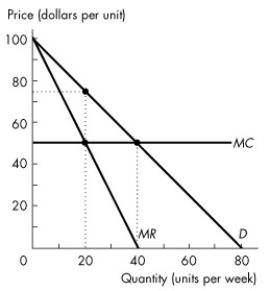 Figure 13.4.3
-Refer to Figure 13.4.3. The outcome is efficient if
Figure 13.4.3
-Refer to Figure 13.4.3. The outcome is efficient if (Multiple Choice)
4.9/5 (85)
(85) Use the figure below to answer the following questions.
 Figure 13.5.2
-Consider the natural monopoly depicted in Figure 13.5.2. If a regulatory agency sets a price just sufficient for the firm to make zero economic profit, and if the firm inflates its costs as much as possible, the regulated price will be
Figure 13.5.2
-Consider the natural monopoly depicted in Figure 13.5.2. If a regulatory agency sets a price just sufficient for the firm to make zero economic profit, and if the firm inflates its costs as much as possible, the regulated price will be (Multiple Choice)
4.7/5 (87)
(87) Use the figure below to answer the following question.
 Figure 13.1.1
-Refer to Figure 13.1.1. The quantity demanded by the market is 8 million cubic metres a month. This market is
Figure 13.1.1
-Refer to Figure 13.1.1. The quantity demanded by the market is 8 million cubic metres a month. This market is (Multiple Choice)
4.9/5 (73)
(73) Taking competitive rent seeking activity into account, the social cost of monopoly is equal to the
(Multiple Choice)
4.8/5 (84)
(84) An exclusive right granted to a firm to supply a good or service is
(Multiple Choice)
4.9/5 (67)
(67) Canada Post has a monopoly on residential mail delivery. Pfizer Inc. makes LIPITOR, a prescription drug that lowers cholesterol. Rogers Communications is the sole provider of cable television service in some parts of Ontario. The monopolies which profit from price discrimination are
(Multiple Choice)
4.8/5 (70)
(70) When Dominant Pizza is willing to sell a pizza to a student who lives on-campus at a lower price than it sells the identical pizza to a student who lives a block away from the campus, the pizza firm is
(Multiple Choice)
4.8/5 (75)
(75) An average cost pricing rule sets ________ equal to average total cost. An average cost pricing rule is not an efficient way of regulating monopoly because at the quantity produced, ________.
(Multiple Choice)
4.9/5 (72)
(72) Use the table below to answer the following questions.
Table 13.4.1
 -Table 13.4.1 shows the demand schedule faced by a monopoly. If the monopoly is a perfect price-discriminating monopoly the marginal revenue from the sale of the 3rd unit of output is
 (Multiple Choice)
4.9/5 (71)
(71) Sue's Surfboards is the sole renter of surfboards on Big Wave Island. Sue does not price discriminate. For Sue's Surfboards, the change in total revenue from each additional surfboard rented is her
(Multiple Choice)
4.8/5 (72)
(72) A price cap is a price ________. A price cap might be a more effective way of regulating monopoly than rate of return regulation because under rate of return regulation, ________.
(Multiple Choice)
4.8/5 (82)
(82) Use the figure below to answer the following questions.
 Figure 13.4.2
-Refer to Figure 13.4.2. Assume this monopolist practises perfect price discrimination. How many tickets are sold?
Figure 13.4.2
-Refer to Figure 13.4.2. Assume this monopolist practises perfect price discrimination. How many tickets are sold? (Multiple Choice)
4.8/5 (73)
(73) 
Filters
- Essay(0)
- Multiple Choice(0)
- Short Answer(0)
- True False(0)
- Matching(0)