



 Chat with AI
Exam 13: Monopoly

Exam 1: What Is Economics212 Questions
Exam 2: The Economic Problem159 Questions
Exam 3: Demand and Supply197 Questions
Exam 4: Elasticity186 Questions
Exam 5: Efficiency and Equity119 Questions
Exam 6: Governments Actions in Markets130 Questions
Exam 7: Global Markets in Action138 Questions
Exam 8: Utility and Demand120 Questions
Exam 9: Possibilities, Preferences, and Choices124 Questions
Exam 10: Organizing Production111 Questions
Exam 11: Output and Costs142 Questions
Exam 12: Perfect Competition117 Questions
Exam 13: Monopoly118 Questions
Exam 14: Monopolistic Competition122 Questions
Exam 15: Oligopoly106 Questions
Exam 16: Externalities116 Questions
Exam 17: Public Goods and Common Resources98 Questions
Exam 18: Markets for Factors of Production128 Questions
Exam 19: Economic Inequality124 Questions
Exam 20: Measuring Gdp and Economic Growth133 Questions
Exam 21: Monitoring Jobs and Inflation121 Questions
Exam 22: Economic Growth98 Questions
Exam 23: Finance, Saving, and Investment141 Questions
Exam 24: Money, the Price Level, and Inflation126 Questions
Exam 25: The Exchange Rate and the Balance of Payments126 Questions
Exam 26: Aggregate Supply and Aggregate Demand136 Questions
Exam 27: Expenditure Multipliers171 Questions
Exam 28: The Business Cycle, Inflation, and Deflation110 Questions
Exam 29: Fiscal Policy97 Questions
Exam 30: Monetary Policy97 Questions
Exam 31: Macro Only: International Trade Policy126 Questions
Select questions type


Use the information below to answer the following questions.
Fact 13.3.1 What the Apple-Samsung Verdict Means for Your Smartphone
A California jury found Samsung guilty of violating the majority of the patents in question, including software features like double-tap zooming and scrolling. It recommended that Apple be awarded more than $1 billion in damages. This verdict could significantly affect both smartphone users and producers.
Source: CNN Money, August 26, 2012
-Refer to Fact 13.3.1. Suppose Apple becomes a monopoly in the smartphone market. Choose the statement that is incorrect.
(Multiple Choice)
4.8/5  (63)
(63) Suppose in an industry a firm realizes economies of scale over the entire length of its LRAC curve. In this situation, the firm is
(Multiple Choice)
4.8/5 (81)
(81) Use the information below to answer the following questions.
Fact 13.1.1
The following statements give some information about seven markets.
1. Coca-Cola cuts its price below that of Pepsi-Cola in an attempt to increase its market share.
2. A single firm, protected by a barrier to entry, produces a personal service that has no close substitutes.
3. A barrier to entry exists, but the good has some close substitutes.
4. A firm offers discounts to students and seniors.
5. A firm can sell any quantity it chooses at the going price.
6. The government issues Nike an exclusive licence to produce golf balls.
7. A firm experiences economies of scale even when it produces the quantity that meets the entire market demand.
-Refer to Fact 13.1.1. A monopoly might arise in the market described in
(Multiple Choice)
4.8/5 (81)
(81) Use the information below to answer the following questions.
Fact 13.1.1
The following statements give some information about seven markets.
1. Coca-Cola cuts its price below that of Pepsi-Cola in an attempt to increase its market share.
2. A single firm, protected by a barrier to entry, produces a personal service that has no close substitutes.
3. A barrier to entry exists, but the good has some close substitutes.
4. A firm offers discounts to students and seniors.
5. A firm can sell any quantity it chooses at the going price.
6. The government issues Nike an exclusive licence to produce golf balls.
7. A firm experiences economies of scale even when it produces the quantity that meets the entire market demand.
-Refer to Fact 13.1.1. The firm described in statement ________ is a natural monopoly. The firm described in statement ________ is a legal monopoly.
(Multiple Choice)
4.8/5 (75)
(75) Use the figure below to answer the following questions.
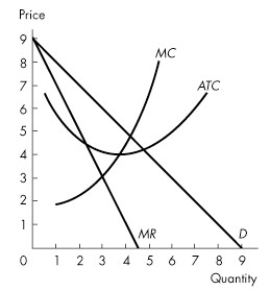 Figure 13.2.2
-Refer to Figure 13.2.2. If the single-price monopoly shown in Figure 13.2.2 is maximizing profit, what is total economic profit?
Figure 13.2.2
-Refer to Figure 13.2.2. If the single-price monopoly shown in Figure 13.2.2 is maximizing profit, what is total economic profit? (Multiple Choice)
4.8/5 (86)
(86) If the demand for its good or service is elastic, a monopoly's
(Multiple Choice)
4.8/5 (86)
(86) A monopoly ________ make positive economic profit in the long run because ________.
(Multiple Choice)
4.9/5 (79)
(79) Use the information below to answer the following questions.
Fact 13.5.1
Cascade Springs Inc. is a natural monopoly that bottles water from a spring high in the Rocky Mountains. The total fixed cost it incurs is $80,000, and its marginal cost is 10 cents a bottle. The demand curve for Cascade Springs bottled water is shown in the following figure:
 Figure 13.5.1
-Refer to Figure 13.5.1. Suppose the firm is regulated by the government that imposes marginal cost pricing. The price of a bottle of water is
Figure 13.5.1
-Refer to Figure 13.5.1. Suppose the firm is regulated by the government that imposes marginal cost pricing. The price of a bottle of water is (Multiple Choice)
4.9/5 (97)
(97) Use the table below to answer the following question.
Table 13.2.1
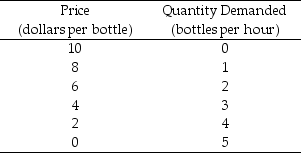 -Refer to Table 13.2.1. Minnie's Mineral Springs, a single-price monopoly, faces the market demand schedule given in the table. Minnie will not produce a quantity at which the market demand for water is inelastic because when demand is inelastic she can ________ the quantity produced, which ________.
 (Multiple Choice)
4.8/5 (79)
(79) Use the figure below to answer the following questions.
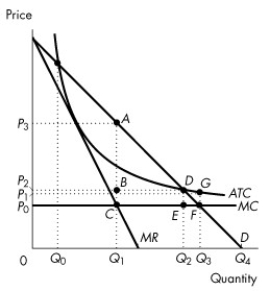 Figure 13.3.4
-Consider the natural monopoly depicted in Figure 13.3.4. What area in the graph represents the deadweight loss arising from an unregulated monopoly?
Figure 13.3.4
-Consider the natural monopoly depicted in Figure 13.3.4. What area in the graph represents the deadweight loss arising from an unregulated monopoly? (Multiple Choice)
4.9/5 (74)
(74) Which of the following is true for a perfect price-discriminating monopoly?
(Multiple Choice)
4.8/5 (81)
(81) Donna owns the only dog grooming salon on Lonely Island. If Donna can price discriminate between dog owners who are seniors and those who are not, her economic profit will be ________ than if she does not price discriminate and the number of dog groomings will be ________ if she does not price discriminate.
(Multiple Choice)
4.9/5 (76)
(76) Use the figure below to answer the following questions.
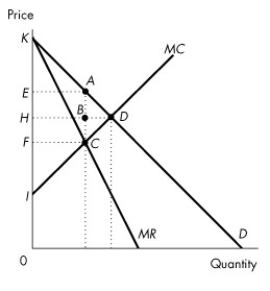 Figure 13.3.3
-Consider the revenue and cost curves in Figure 13.3.3. If this is a single-price monopoly, what area is producer surplus?
Figure 13.3.3
-Consider the revenue and cost curves in Figure 13.3.3. If this is a single-price monopoly, what area is producer surplus? (Multiple Choice)
4.7/5 (77)
(77) Use the figure below to answer the following questions.
Figure 13.3.4
-Consider the natural monopoly depicted in Figure 13.3.4. Total surplus is at a maximum when quantity is
Figure 13.3.4
-Consider the natural monopoly depicted in Figure 13.3.4. Total surplus is at a maximum when quantity is (Multiple Choice)
4.7/5 (78)
(78) If a profit-maximizing monopoly is producing an output at which marginal cost exceeds marginal revenue, it
(Multiple Choice)
4.9/5 (81)
(81) Use the information below to answer the following questions.
Fact 13.5.1
Cascade Springs Inc. is a natural monopoly that bottles water from a spring high in the Rocky Mountains. The total fixed cost it incurs is $80,000, and its marginal cost is 10 cents a bottle. The demand curve for Cascade Springs bottled water is shown in the following figure:
Figure 13.5.1
-Refer to Figure 13.5.1. Suppose the government regulates the firm with average cost pricing. What is the price?
Figure 13.5.1
-Refer to Figure 13.5.1. Suppose the government regulates the firm with average cost pricing. What is the price? (Multiple Choice)
4.8/5 (72)
(72) A single-price monopoly is a firm that ________ each unit of its output ________. A ________ monopoly sells different units of a good or service for different prices.
(Multiple Choice)
4.8/5 (89)
(89) 
Filters
- Essay(0)
- Multiple Choice(0)
- Short Answer(0)
- True False(0)
- Matching(0)