



 Chat with AI
Exam 26: Aggregate Supply and Aggregate Demand

Exam 1: What Is Economics212 Questions
Exam 2: The Economic Problem159 Questions
Exam 3: Demand and Supply197 Questions
Exam 4: Elasticity186 Questions
Exam 5: Efficiency and Equity119 Questions
Exam 6: Governments Actions in Markets130 Questions
Exam 7: Global Markets in Action138 Questions
Exam 8: Utility and Demand120 Questions
Exam 9: Possibilities, Preferences, and Choices124 Questions
Exam 10: Organizing Production111 Questions
Exam 11: Output and Costs142 Questions
Exam 12: Perfect Competition117 Questions
Exam 13: Monopoly118 Questions
Exam 14: Monopolistic Competition122 Questions
Exam 15: Oligopoly106 Questions
Exam 16: Externalities116 Questions
Exam 17: Public Goods and Common Resources98 Questions
Exam 18: Markets for Factors of Production128 Questions
Exam 19: Economic Inequality124 Questions
Exam 20: Measuring Gdp and Economic Growth133 Questions
Exam 21: Monitoring Jobs and Inflation121 Questions
Exam 22: Economic Growth98 Questions
Exam 23: Finance, Saving, and Investment141 Questions
Exam 24: Money, the Price Level, and Inflation126 Questions
Exam 25: The Exchange Rate and the Balance of Payments126 Questions
Exam 26: Aggregate Supply and Aggregate Demand136 Questions
Exam 27: Expenditure Multipliers171 Questions
Exam 28: The Business Cycle, Inflation, and Deflation110 Questions
Exam 29: Fiscal Policy97 Questions
Exam 30: Monetary Policy97 Questions
Exam 31: Macro Only: International Trade Policy126 Questions
Select questions type


Use the figure below to answer the following question.
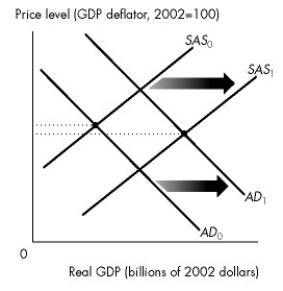 Figure 26.3.4
-Refer to Figure 26.3.4. The changes represented
Figure 26.3.4
-Refer to Figure 26.3.4. The changes represented
Free
(Multiple Choice)
4.8/5  (83)
(83) Correct Answer: Verified
E
Full-employment equilibrium occurs when
Free
(Multiple Choice)
4.9/5 (85)
(85) Correct Answer:Verified
VerifiedC
Use the table below to answer the following questions.
Table 26.3.1
 -Refer to Table 26.3.1. As this economy moves to long-run equilibrium, the
Free
(Multiple Choice)
4.7/5 (85)
(85) Correct Answer:Verified
VerifiedB
The Canadian government increases its expenditure on goods and services in a time of war or increased international tension. Starting from a position of long-run equilibrium, what effect does this event have on Canada's economy in the short run?
(Multiple Choice)
4.9/5 (85)
(85) Use the figure below to answer the following questions.
 Figure 26.2.1
-Refer to Figure 26.2.1. Which graph illustrates what happens when government expenditure increases?
Figure 26.2.1
-Refer to Figure 26.2.1. Which graph illustrates what happens when government expenditure increases? (Multiple Choice)
4.8/5 (75)
(75) Canadian businesses expect future profits to rise. Starting from a position of long-run equilibrium, what effect does this event have on Canada's economy in the short run?
(Multiple Choice)
5.0/5 (79)
(79) Use the figure below to answer the following questions.
 Figure 26.3.2
-Refer to Figure 26.3.2. When the economy of Mythlo is in short-run macroeconomic equilibrium, the price level is
Figure 26.3.2
-Refer to Figure 26.3.2. When the economy of Mythlo is in short-run macroeconomic equilibrium, the price level is (Multiple Choice)
4.8/5 (79)
(79) Beginning at a long-run equilibrium, an increase in aggregate demand
(Multiple Choice)
4.9/5 (71)
(71) Use the figure below to answer the following questions.
Figure 26.2.1
-Refer to Figure 26.2.1. Which graph illustrates what happens when the quantity of money decreases?
Figure 26.2.1
-Refer to Figure 26.2.1. Which graph illustrates what happens when the quantity of money decreases? (Multiple Choice)
4.8/5 (88)
(88) Use the figure below to answer the following questions.
 Figure 26.3.1
-Refer to Figure 26.3.1. Econoworld is at its short-run macroeconomic equilibrium. There is a difference between ________ real GDP and potential GDP of $________ billion.
Figure 26.3.1
-Refer to Figure 26.3.1. Econoworld is at its short-run macroeconomic equilibrium. There is a difference between ________ real GDP and potential GDP of $________ billion. (Multiple Choice)
4.8/5 (75)
(75) Use the figure below to answer the following questions.
Figure 26.3.1
-Refer to Figure 26.3.1. If Econoworld automatically adjusts to a long-run equilibrium, then in the long-run macroeconomic equilibrium,
Figure 26.3.1
-Refer to Figure 26.3.1. If Econoworld automatically adjusts to a long-run equilibrium, then in the long-run macroeconomic equilibrium, (Multiple Choice)
4.8/5 (80)
(80) Which one of the following shifts the aggregate demand curve leftward?
(Multiple Choice)
4.9/5 (88)
(88) Which one of the following newspaper quotations describes a movement along an SAS curve?
(Multiple Choice)
4.7/5 (83)
(83) Which of the following news quotes best describes a new classical view of a recession?
(Multiple Choice)
4.7/5 (89)
(89) Which one of the following factors will not shift the aggregate demand curve?
(Multiple Choice)
4.9/5 (86)
(86) Use the figure below to answer the following questions.
Figure 26.3.2
-Refer to Figure 26.3.2. In Mythlo there is a difference between the ________ equilibrium real GDP and potential GDP of ________ billion.
Figure 26.3.2
-Refer to Figure 26.3.2. In Mythlo there is a difference between the ________ equilibrium real GDP and potential GDP of ________ billion. (Multiple Choice)
4.8/5 (85)
(85) We observe a decrease in the price level and a decrease in real GDP. Which of the following is a possible explanation?
(Multiple Choice)
4.8/5 (78)
(78) 
Filters
- Essay(0)
- Multiple Choice(0)
- Short Answer(0)
- True False(0)
- Matching(0)