



 Chat with AI
Exam 26: Aggregate Supply and Aggregate Demand

Exam 1: What Is Economics212 Questions
Exam 2: The Economic Problem159 Questions
Exam 3: Demand and Supply197 Questions
Exam 4: Elasticity186 Questions
Exam 5: Efficiency and Equity119 Questions
Exam 6: Governments Actions in Markets130 Questions
Exam 7: Global Markets in Action138 Questions
Exam 8: Utility and Demand120 Questions
Exam 9: Possibilities, Preferences, and Choices124 Questions
Exam 10: Organizing Production111 Questions
Exam 11: Output and Costs142 Questions
Exam 12: Perfect Competition117 Questions
Exam 13: Monopoly118 Questions
Exam 14: Monopolistic Competition122 Questions
Exam 15: Oligopoly106 Questions
Exam 16: Externalities116 Questions
Exam 17: Public Goods and Common Resources98 Questions
Exam 18: Markets for Factors of Production128 Questions
Exam 19: Economic Inequality124 Questions
Exam 20: Measuring Gdp and Economic Growth133 Questions
Exam 21: Monitoring Jobs and Inflation121 Questions
Exam 22: Economic Growth98 Questions
Exam 23: Finance, Saving, and Investment141 Questions
Exam 24: Money, the Price Level, and Inflation126 Questions
Exam 25: The Exchange Rate and the Balance of Payments126 Questions
Exam 26: Aggregate Supply and Aggregate Demand136 Questions
Exam 27: Expenditure Multipliers171 Questions
Exam 28: The Business Cycle, Inflation, and Deflation110 Questions
Exam 29: Fiscal Policy97 Questions
Exam 30: Monetary Policy97 Questions
Exam 31: Macro Only: International Trade Policy126 Questions
Select questions type


Consider an economy starting from a position of full employment. Which one of the following changes does not occur as a result of a decrease in aggregate demand?
(Multiple Choice)
4.9/5  (77)
(77) Which one of the following newspaper quotations describes a leftward shift of the LAS curve?
(Multiple Choice)
4.8/5 (93)
(93) Everything else remaining the same, an increase in the expected inflation rate
(Multiple Choice)
4.8/5 (73)
(73) Autoworkers agree to a cut in the nominal wage rate. This event ________ short-run aggregate supply and ________ long-run aggregate supply.
(Multiple Choice)
4.9/5 (70)
(70) Suppose that the E.U. economy goes into an expansion. Canadian real GDP ________ and Canadian unemployment ________ in the short run.
(Multiple Choice)
4.8/5 (83)
(83) Use the figure below to answer the following questions.
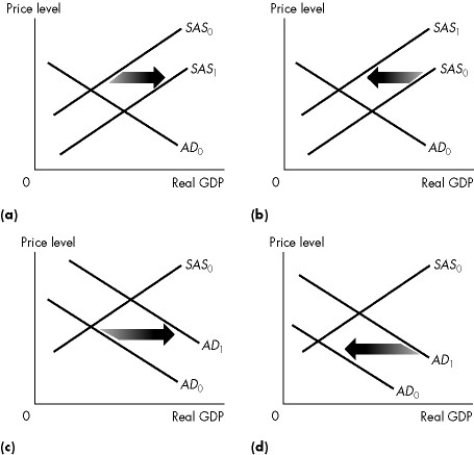 Figure 26.2.1
-Refer to Figure 26.2.1. Which graph illustrates what happens when expected future income increases?
Figure 26.2.1
-Refer to Figure 26.2.1. Which graph illustrates what happens when expected future income increases? (Multiple Choice)
4.8/5 (88)
(88) Use the figure below to answer the following questions.
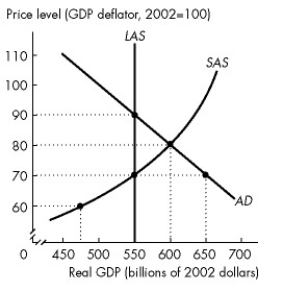 Figure 26.3.2
-Refer to Figure 26.3.2. Currently in Mythlo
Figure 26.3.2
-Refer to Figure 26.3.2. Currently in Mythlo (Multiple Choice)
4.8/5 (77)
(77) The world goes into an expansion. Starting from a position of long-run equilibrium, what effect does this event have on Canada's economy in the short run?
(Multiple Choice)
4.9/5 (74)
(74) If real GDP is greater than potential GDP, we would expect
(Multiple Choice)
4.9/5 (83)
(83) Which of the following statements about the Keynesian view of the macroeconomy is incorrect?
(Multiple Choice)
4.7/5 (86)
(86) Use the figure below to answer the following questions.
Figure 26.3.2
-Refer to Figure 26.3.2. If the economy of Mythlo automatically adjusts to long-run equilibrium, then
Figure 26.3.2
-Refer to Figure 26.3.2. If the economy of Mythlo automatically adjusts to long-run equilibrium, then (Multiple Choice)
4.7/5 (85)
(85) The quantity of real GDP demanded does not depend on decisions made by
(Multiple Choice)
4.9/5 (86)
(86) Use the figure below to answer the following questions.
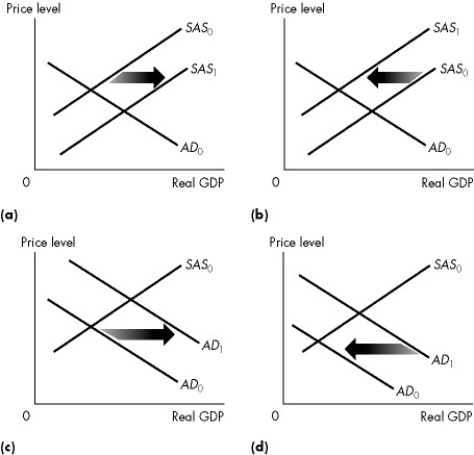 Figure 26.1.1
-Refer to Figure 26.1.1. Which graph illustrates what happens when factor prices decrease?
Figure 26.1.1
-Refer to Figure 26.1.1. Which graph illustrates what happens when factor prices decrease? (Multiple Choice)
4.9/5 (88)
(88) Which one, if any, of the following events shift the short-run aggregate supply curve but not the long-run aggregate supply curve?
(Multiple Choice)
4.7/5 (85)
(85) 
Filters
- Essay(0)
- Multiple Choice(0)
- Short Answer(0)
- True False(0)
- Matching(0)