



 Chat with AI
Exam 13: Monopoly

Exam 1: What Is Economics212 Questions
Exam 2: The Economic Problem159 Questions
Exam 3: Demand and Supply197 Questions
Exam 4: Elasticity186 Questions
Exam 5: Efficiency and Equity119 Questions
Exam 6: Governments Actions in Markets130 Questions
Exam 7: Global Markets in Action138 Questions
Exam 8: Utility and Demand120 Questions
Exam 9: Possibilities, Preferences, and Choices124 Questions
Exam 10: Organizing Production111 Questions
Exam 11: Output and Costs142 Questions
Exam 12: Perfect Competition117 Questions
Exam 13: Monopoly118 Questions
Exam 14: Monopolistic Competition122 Questions
Exam 15: Oligopoly106 Questions
Exam 16: Externalities116 Questions
Exam 17: Public Goods and Common Resources98 Questions
Exam 18: Markets for Factors of Production128 Questions
Exam 19: Economic Inequality124 Questions
Exam 20: Measuring Gdp and Economic Growth133 Questions
Exam 21: Monitoring Jobs and Inflation121 Questions
Exam 22: Economic Growth98 Questions
Exam 23: Finance, Saving, and Investment141 Questions
Exam 24: Money, the Price Level, and Inflation126 Questions
Exam 25: The Exchange Rate and the Balance of Payments126 Questions
Exam 26: Aggregate Supply and Aggregate Demand136 Questions
Exam 27: Expenditure Multipliers171 Questions
Exam 28: The Business Cycle, Inflation, and Deflation110 Questions
Exam 29: Fiscal Policy97 Questions
Exam 30: Monetary Policy97 Questions
Exam 31: Macro Only: International Trade Policy126 Questions
Select questions type


Use the figure below to answer the following questions.
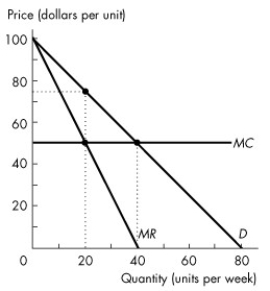 Figure 13.3.1
-Refer to Figure 13.3.1. The efficient quantity is
Figure 13.3.1
-Refer to Figure 13.3.1. The efficient quantity is (Multiple Choice)
4.9/5  (98)
(98) Methods of rent seeking include which of the following?
I. Buying a monopoly
II. Creating a monopoly
III. Price discrimination
(Multiple Choice)
4.8/5 (92)
(92) A monopolist under marginal cost pricing has an incentive to
(Multiple Choice)
4.8/5 (85)
(85) Use the figure below to answer the following questions.
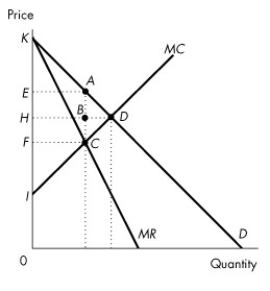 Figure 13.3.3
-Consider the market demand curve in Figure 13.3.3. If the market is perfectly competitive, which area indicates consumer surplus?
Figure 13.3.3
-Consider the market demand curve in Figure 13.3.3. If the market is perfectly competitive, which area indicates consumer surplus? (Multiple Choice)
4.9/5 (69)
(69) One difference between perfectly competitive markets and a single-price monopoly is that
(Multiple Choice)
4.8/5 (56)
(56) Use the figure below to answer the following questions.
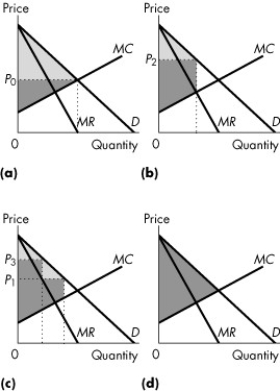 Figure 13.3.2
-Consider Figure 13.3.2. Consider a perfectly competitive market. If the light grey area shows the consumer surplus, and the dark grey area shows the producer surplus, which graph correctly represents this market?
Figure 13.3.2
-Consider Figure 13.3.2. Consider a perfectly competitive market. If the light grey area shows the consumer surplus, and the dark grey area shows the producer surplus, which graph correctly represents this market? (Multiple Choice)
4.8/5 (71)
(71) Use the figure below to answer the following questions.
 Figure 13.5.2
-Consider the natural monopoly depicted in Figure 13.5.2. If a regulatory agency sets a price just sufficient for the firm to make zero economic profit, what output will it produce?
Figure 13.5.2
-Consider the natural monopoly depicted in Figure 13.5.2. If a regulatory agency sets a price just sufficient for the firm to make zero economic profit, what output will it produce? (Multiple Choice)
4.7/5 (80)
(80) Use the figure below to answer the following questions.
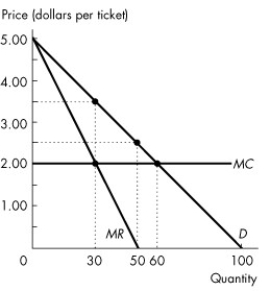 Figure 13.4.2
-Refer to Figure 13.4.2. Assume this monopolist practises perfect price discrimination. What is total revenue?
Figure 13.4.2
-Refer to Figure 13.4.2. Assume this monopolist practises perfect price discrimination. What is total revenue? (Multiple Choice)
4.8/5 (77)
(77) Use the figure below to answer the following questions.
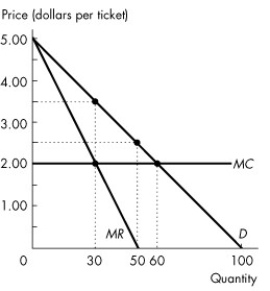 Figure 13.2.3
-Refer to Figure 13.2.3. Assume this firm is a single-price monopoly. What is the profit-maximizing price to charge for the tickets?
Figure 13.2.3
-Refer to Figure 13.2.3. Assume this firm is a single-price monopoly. What is the profit-maximizing price to charge for the tickets? (Multiple Choice)
4.8/5 (89)
(89) Which of the following markets will have the largest deadweight loss?
(Multiple Choice)
4.9/5 (87)
(87) If marginal revenue equals zero, then demand at this level of output is
(Multiple Choice)
4.8/5 (81)
(81) For the regulated natural monopoly, an average cost pricing rule sets price equal to
(Multiple Choice)
4.9/5 (91)
(91) 
Filters
- Essay(0)
- Multiple Choice(0)
- Short Answer(0)
- True False(0)
- Matching(0)