



 Chat with AI
Exam 13: Monopoly

Exam 1: What Is Economics212 Questions
Exam 2: The Economic Problem159 Questions
Exam 3: Demand and Supply197 Questions
Exam 4: Elasticity186 Questions
Exam 5: Efficiency and Equity119 Questions
Exam 6: Governments Actions in Markets130 Questions
Exam 7: Global Markets in Action138 Questions
Exam 8: Utility and Demand120 Questions
Exam 9: Possibilities, Preferences, and Choices124 Questions
Exam 10: Organizing Production111 Questions
Exam 11: Output and Costs142 Questions
Exam 12: Perfect Competition117 Questions
Exam 13: Monopoly118 Questions
Exam 14: Monopolistic Competition122 Questions
Exam 15: Oligopoly106 Questions
Exam 16: Externalities116 Questions
Exam 17: Public Goods and Common Resources98 Questions
Exam 18: Markets for Factors of Production128 Questions
Exam 19: Economic Inequality124 Questions
Exam 20: Measuring Gdp and Economic Growth133 Questions
Exam 21: Monitoring Jobs and Inflation121 Questions
Exam 22: Economic Growth98 Questions
Exam 23: Finance, Saving, and Investment141 Questions
Exam 24: Money, the Price Level, and Inflation126 Questions
Exam 25: The Exchange Rate and the Balance of Payments126 Questions
Exam 26: Aggregate Supply and Aggregate Demand136 Questions
Exam 27: Expenditure Multipliers171 Questions
Exam 28: The Business Cycle, Inflation, and Deflation110 Questions
Exam 29: Fiscal Policy97 Questions
Exam 30: Monetary Policy97 Questions
Exam 31: Macro Only: International Trade Policy126 Questions
Select questions type


Use the table below to answer the following questions.
Table 13.4.1
 -Refer to Table 13.4.1. If a perfect price-discriminating monopoly faces the demand schedule shown in Table 13.4.1 and if marginal cost is constant at $3, output is
 (Multiple Choice)
4.9/5  (80)
(80) Use the figure below to answer the following questions.
 Figure 13.3.3
-Consider the revenue and cost curves in Figure 13.3.3. What is the difference in consumer surplus between a single-price monopoly and a perfectly competitive market?
Figure 13.3.3
-Consider the revenue and cost curves in Figure 13.3.3. What is the difference in consumer surplus between a single-price monopoly and a perfectly competitive market? (Multiple Choice)
4.8/5 (79)
(79) Use the figure below to answer the following questions.
Figure 13.3.3
-Consider the revenue and cost curves in Figure 13.3.3. What is the difference in producer surplus between a single-price monopoly and a perfectly competitive market?
Figure 13.3.3
-Consider the revenue and cost curves in Figure 13.3.3. What is the difference in producer surplus between a single-price monopoly and a perfectly competitive market? (Multiple Choice)
4.7/5 (75)
(75) Which of the following quotes by a store manager describes price discrimination in action?
(Multiple Choice)
5.0/5 (77)
(77) When perfect price discrimination occurs, which one of the following statements is false?
(Multiple Choice)
4.8/5 (86)
(86) Use the figure below to answer the following questions.
Figure 13.3.3
-Refer to Figure 13.3.3. What is the redistribution of surplus from consumers to the producer with a single-price monopoly, as compared to a perfectly competitive market?
Figure 13.3.3
-Refer to Figure 13.3.3. What is the redistribution of surplus from consumers to the producer with a single-price monopoly, as compared to a perfectly competitive market? (Multiple Choice)
4.9/5 (81)
(81) Use the figure below to answer the following questions.
 Figure 13.4.6
-Prime Pharmaceuticals has developed a new asthma medicine, for which it has a patent. An inhaler can be produced at a constant marginal cost of $2 per inhaler. The demand curve, marginal revenue curve, and marginal cost curve for this new asthma inhaler are shown in Figure 13.4.6. The patent gives Prime Pharmaceuticals a monopoly for its new inhaler. If Prime Pharmaceuticals can perfectly price discriminate, then it
Figure 13.4.6
-Prime Pharmaceuticals has developed a new asthma medicine, for which it has a patent. An inhaler can be produced at a constant marginal cost of $2 per inhaler. The demand curve, marginal revenue curve, and marginal cost curve for this new asthma inhaler are shown in Figure 13.4.6. The patent gives Prime Pharmaceuticals a monopoly for its new inhaler. If Prime Pharmaceuticals can perfectly price discriminate, then it (Multiple Choice)
4.9/5 (80)
(80) Canada Post has a monopoly on residential mail delivery. Pfizer Inc. makes LIPITOR, a prescription drug that lowers cholesterol. Rogers Communications is the sole provider of cable television service in some parts of Ontario. The monopolies which are legal monopolies are
(Multiple Choice)
4.7/5 (88)
(88) Use the figure below to answer the following questions.
 Figure 13.2.3
-Refer to Figure 13.2.3. Assume this firm is a single-price monopoly. How many tickets does this monopolist sell to maximize economic profit?
Figure 13.2.3
-Refer to Figure 13.2.3. Assume this firm is a single-price monopoly. How many tickets does this monopolist sell to maximize economic profit? (Multiple Choice)
4.8/5 (94)
(94) Which one of the following is most likely to be a natural monopoly?
(Multiple Choice)
5.0/5 (82)
(82) Use the figure below to answer the following questions.
Figure 13.3.3
-Consider the market demand curve in Figure 13.3.3. If the market is perfectly competitive, which area indicates the deadweight loss?
Figure 13.3.3
-Consider the market demand curve in Figure 13.3.3. If the market is perfectly competitive, which area indicates the deadweight loss? (Multiple Choice)
4.9/5 (82)
(82) Use the figure below to answer the following questions.
 Figure 13.5.2
-Consider the natural monopoly depicted in Figure 13.5.2. If a regulator uses a marginal cost pricing rule to set price, what is the quantity produced?
Figure 13.5.2
-Consider the natural monopoly depicted in Figure 13.5.2. If a regulator uses a marginal cost pricing rule to set price, what is the quantity produced? (Multiple Choice)
4.9/5 (75)
(75) The output of a (not perfect)price-discriminating monopoly is
(Multiple Choice)
4.8/5 (76)
(76) Use the figure below to answer the following questions.
 Figure 13.3.1
-Refer to Figure 13.3.1. If this market is a single-price monopoly, then
Figure 13.3.1
-Refer to Figure 13.3.1. If this market is a single-price monopoly, then (Multiple Choice)
4.9/5 (77)
(77) Use the figure below to answer the following question.
 Figure 13.4.1
-Which area in Figure 13.4.1 indicates the deadweight loss from a perfect price-discriminating monopoly?
Figure 13.4.1
-Which area in Figure 13.4.1 indicates the deadweight loss from a perfect price-discriminating monopoly? (Multiple Choice)
4.9/5 (72)
(72) Use the figure below to answer the following questions.
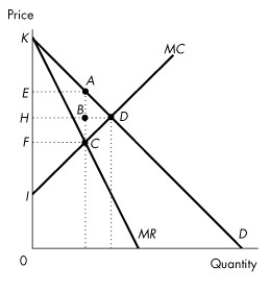 Figure 13.4.5
-Consider the cost and revenue curves in Figure 13.4.5. If this is a perfect price-discriminating monopoly, what is consumer surplus?
Figure 13.4.5
-Consider the cost and revenue curves in Figure 13.4.5. If this is a perfect price-discriminating monopoly, what is consumer surplus? (Multiple Choice)
4.8/5 (73)
(73) Which of the following occurs with both perfectly price-discriminating and single-price monopolies?
(Multiple Choice)
4.9/5 (71)
(71) 
Filters
- Essay(0)
- Multiple Choice(0)
- Short Answer(0)
- True False(0)
- Matching(0)