



 Chat with AI
Exam 2: The Economic Problem

Exam 1: What Is Economics212 Questions
Exam 2: The Economic Problem159 Questions
Exam 3: Demand and Supply197 Questions
Exam 4: Elasticity186 Questions
Exam 5: Efficiency and Equity119 Questions
Exam 6: Governments Actions in Markets130 Questions
Exam 7: Global Markets in Action138 Questions
Exam 8: Utility and Demand120 Questions
Exam 9: Possibilities, Preferences, and Choices124 Questions
Exam 10: Organizing Production111 Questions
Exam 11: Output and Costs142 Questions
Exam 12: Perfect Competition117 Questions
Exam 13: Monopoly118 Questions
Exam 14: Monopolistic Competition122 Questions
Exam 15: Oligopoly106 Questions
Exam 16: Externalities116 Questions
Exam 17: Public Goods and Common Resources98 Questions
Exam 18: Markets for Factors of Production128 Questions
Exam 19: Economic Inequality124 Questions
Exam 20: Measuring Gdp and Economic Growth133 Questions
Exam 21: Monitoring Jobs and Inflation121 Questions
Exam 22: Economic Growth98 Questions
Exam 23: Finance, Saving, and Investment141 Questions
Exam 24: Money, the Price Level, and Inflation126 Questions
Exam 25: The Exchange Rate and the Balance of Payments126 Questions
Exam 26: Aggregate Supply and Aggregate Demand136 Questions
Exam 27: Expenditure Multipliers171 Questions
Exam 28: The Business Cycle, Inflation, and Deflation110 Questions
Exam 29: Fiscal Policy97 Questions
Exam 30: Monetary Policy97 Questions
Exam 31: Macro Only: International Trade Policy126 Questions
Select questions type


In 1963, the production possibilities per person in Canada were ________ than those in Hong Kong. Between 1963 and 2013, Hong Kong's production possibilities have ________ Canada's production possibilities.
(Multiple Choice)
4.8/5  (65)
(65) The depletion of fish stocks in Eastern Canada, with its accompanying unemployment, will lead to a
(Multiple Choice)
4.8/5 (83)
(83) A person who has an absolute advantage in the production of all goods will
(Multiple Choice)
4.7/5 (91)
(91) Suppose the production possibilities frontier for skirts and pants is a straight line. As the production of skirts increases, the marginal benefit from skirts
(Multiple Choice)
4.8/5 (75)
(75) Use the information below to answer the following questions.
Fact 2.4.1
In one hour, Sue can produce 50 caps or 10 jackets, and Tessa can produce 70 caps or 7 jackets.
-Refer to Fact 2.4.1. Sue's opportunity cost of producing a cap is ________ jackets and Tessa's opportunity cost of producing a cap is ________ jackets.
(Multiple Choice)
4.8/5 (84)
(84) Consider the following household. In 5 hours, Bob can cook 5 meals or clean 6 rooms. In 5 hours, Mary can cook 30 meals or clean 10 rooms. Select the best statement.
(Multiple Choice)
4.9/5 (65)
(65) Use the figure below to answer the following questions.
 Figure 2.1.1
-Refer to the production possibilities frontier in Figure 2.1.1. Which one of the following is true about point C?
Figure 2.1.1
-Refer to the production possibilities frontier in Figure 2.1.1. Which one of the following is true about point C? (Multiple Choice)
4.7/5 (73)
(73) Use the table below to answer the following questions.
Table 2.1.1
The following table gives points on the production possibilities frontier for goods X and Y.
 -Refer to Table 2.1.1. What does point C mean?
 (Multiple Choice)
4.9/5 (76)
(76) Use the table below to answer the following question.
Table 2.1.3
Production possibilities for a society that produces only two
goods - hockey sticks and maple leaves
 -Refer to Table 2.1.3. In moving from combination C to combination B, the opportunity cost of producing one additional hockey stick is
 (Multiple Choice)
4.8/5 (79)
(79) Use the table below to answer the following question.
Table 2.2.1
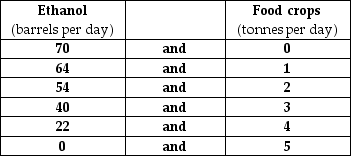 -Refer to Table 2.2.1. Marginal benefit from food crops
 (Multiple Choice)
4.8/5 (96)
(96) Use the information below to answer the following questions.
Fact 2.4.1
In one hour, Sue can produce 50 caps or 10 jackets, and Tessa can produce 70 caps or 7 jackets.
-Refer to Fact 2.4.1. ________ has a comparative advantage in producing caps. If Sue and Tessa each specialize in producing the good in which they have a comparative advantage and trade 1 jacket for 7 caps, ________.
(Multiple Choice)
4.8/5 (74)
(74) Individuals A and B can both produce goods X and Y. Individual A has a comparative advantage in the production of X if
(Multiple Choice)
4.8/5 (86)
(86) Consider a country that has two industries. In the north, they grow wild rice, which requires a lot of rainfall. In the south, they grow wheat, which requires just a moderate amount of rainfall (too much rainfall is bad for wheat production). One year, there is a record rainfall. This will result in
(Multiple Choice)
4.8/5 (88)
(88) 
Filters
- Essay(0)
- Multiple Choice(0)
- Short Answer(0)
- True False(0)
- Matching(0)