



 Chat with AI
Exam 2: The Economic Problem

Exam 1: What Is Economics212 Questions
Exam 2: The Economic Problem159 Questions
Exam 3: Demand and Supply197 Questions
Exam 4: Elasticity186 Questions
Exam 5: Efficiency and Equity119 Questions
Exam 6: Governments Actions in Markets130 Questions
Exam 7: Global Markets in Action138 Questions
Exam 8: Utility and Demand120 Questions
Exam 9: Possibilities, Preferences, and Choices124 Questions
Exam 10: Organizing Production111 Questions
Exam 11: Output and Costs142 Questions
Exam 12: Perfect Competition117 Questions
Exam 13: Monopoly118 Questions
Exam 14: Monopolistic Competition122 Questions
Exam 15: Oligopoly106 Questions
Exam 16: Externalities116 Questions
Exam 17: Public Goods and Common Resources98 Questions
Exam 18: Markets for Factors of Production128 Questions
Exam 19: Economic Inequality124 Questions
Exam 20: Measuring Gdp and Economic Growth133 Questions
Exam 21: Monitoring Jobs and Inflation121 Questions
Exam 22: Economic Growth98 Questions
Exam 23: Finance, Saving, and Investment141 Questions
Exam 24: Money, the Price Level, and Inflation126 Questions
Exam 25: The Exchange Rate and the Balance of Payments126 Questions
Exam 26: Aggregate Supply and Aggregate Demand136 Questions
Exam 27: Expenditure Multipliers171 Questions
Exam 28: The Business Cycle, Inflation, and Deflation110 Questions
Exam 29: Fiscal Policy97 Questions
Exam 30: Monetary Policy97 Questions
Exam 31: Macro Only: International Trade Policy126 Questions
Select questions type


Use the figure below to answer the following questions.
Table 2.4.1
The planets of Vulcan and Romulus each produce goods X and Y.
The following table gives points on their production possibilities frontiers.
 -Refer to Table 2.4.1. For Romulus, the opportunity cost of producing an additional unit of X is
 (Multiple Choice)
4.9/5  (90)
(90) The kitchen manager at an Italian restaurant is deciding what assignments he should give to his two cooks, John and David. John can make 25 pizzas or 40 servings of pasta per hour and David can make 20 pizzas or 30 servings of pasta per hour. Which is the manager's best choice?
(Multiple Choice)
4.9/5 (88)
(88) Use the figure below to answer the following questions.
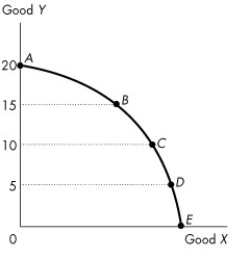 Figure 2.1.3
-Figure 2.1.3 illustrates Mary's production possibilities frontier. If Mary wants to move from point D to point C,
Figure 2.1.3
-Figure 2.1.3 illustrates Mary's production possibilities frontier. If Mary wants to move from point D to point C, (Multiple Choice)
4.7/5 (78)
(78) Use the information below to answer the following questions.
Fact 2.4.2
Agnes can produce either 1 unit of X or 1 unit of Y in an hour, while Brenda can produce either 2 units of X or 4 units of Y in an hour.
-Refer to Fact 2.4.2. Which one of the following statements is true?
(Multiple Choice)
4.9/5 (83)
(83) All points on the PPF are points of ________ efficiency. When we produce at the point on the PPF that we prefer above all other points we achieve ________ efficiency.
(Multiple Choice)
4.8/5 (85)
(85) The growth of capital resources, including human capital is
(Multiple Choice)
4.9/5 (91)
(91) Which of the following is true regarding marginal benefit?
I. The marginal benefit curve shows the benefit firms receive by producing another unit of a good.
II. Marginal benefit increases as more and more of a good is consumed.
III. Marginal benefit is the maximum amount a person is willing to pay to obtain one more unit of a good.
(Multiple Choice)
4.8/5 (73)
(73) Use the table below to answer the following questions.
Table 2.1.1
The following table gives points on the production possibilities frontier for goods X and Y.
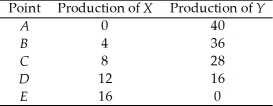 -Refer to Table 2.1.1. The opportunity cost of increasing the production of Y from 16 to 36 units is
 (Multiple Choice)
4.8/5 (68)
(68) Consider a production possibilities frontier with corn production measured on the vertical axis and car production measured on the horizontal axis. Unusually good weather for growing corn shifts
(Multiple Choice)
4.9/5 (81)
(81) Use the information below to answer the following questions.
Fact 2.4.2
Agnes can produce either 1 unit of X or 1 unit of Y in an hour, while Brenda can produce either 2 units of X or 4 units of Y in an hour.
-Given Fact 2.4.2, the opportunity cost of producing a unit of Y is
(Multiple Choice)
4.8/5 (81)
(81) Use the information below to answer the following questions.
Fact 2.4.1
In an eight-hour day, Andy can produce either 24 loaves of bread or 8 kilograms of butter. In an eight-hour day, Rolfe can produce either 8 loaves of bread or 8 kilograms of butter.
-Given Fact 2.4.1, Andy and Rolfe
(Multiple Choice)
4.8/5 (82)
(82) In an economy lacking property rights, it would be ________ to realize the gains from trade, and there would be ________ specialization compared to an economy with property rights.
(Multiple Choice)
4.8/5 (86)
(86) Use the figure below to answer the following questions.
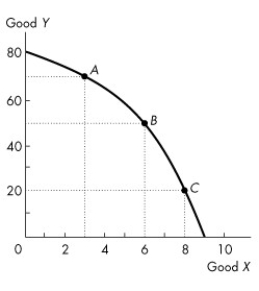 Figure 2.1.2
-Refer to the production possibilities frontier in Figure 2.1.2. If 6 units of X are currently being produced, then
Figure 2.1.2
-Refer to the production possibilities frontier in Figure 2.1.2. If 6 units of X are currently being produced, then (Multiple Choice)
4.8/5 (86)
(86) A medical clinic has 10 workers. Each worker can produce a maximum of either 2 units of medical services or 5 units of secretarial services a day. The opportunity cost of one more unit of medical services is
(Multiple Choice)
4.8/5 (82)
(82) Which of the following quotations best illustrates a tradeoff?
(Multiple Choice)
4.7/5 (85)
(85) Use the figure below to answer the following questions.
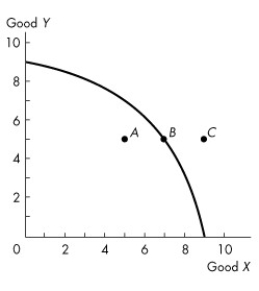 Figure 2.1.1
-Refer to the production possibilities frontier in Figure 2.1.1. Which one of the following is true about point A?
Figure 2.1.1
-Refer to the production possibilities frontier in Figure 2.1.1. Which one of the following is true about point A? (Multiple Choice)
4.8/5 (81)
(81) Use the figure below to answer the following questions.
Figure 2.1.2
-Refer to the production possibilities frontier in Figure 2.1.2. At point C, what is the opportunity cost of increasing the production of Y from 20 to 50 units?
Figure 2.1.2
-Refer to the production possibilities frontier in Figure 2.1.2. At point C, what is the opportunity cost of increasing the production of Y from 20 to 50 units? (Multiple Choice)
4.9/5 (70)
(70) Marginal benefit from a good or service is the benefit received from consuming ________. It is measured by the most that people are willing to pay for ________.
(Multiple Choice)
4.9/5 (84)
(84) If opportunity costs are increasing, then the production possibilities frontier
(Multiple Choice)
4.7/5 (65)
(65) 
Filters
- Essay(0)
- Multiple Choice(0)
- Short Answer(0)
- True False(0)
- Matching(0)