



 Chat with AI
Exam 2: The Economic Problem

Exam 1: What Is Economics212 Questions
Exam 2: The Economic Problem159 Questions
Exam 3: Demand and Supply197 Questions
Exam 4: Elasticity186 Questions
Exam 5: Efficiency and Equity119 Questions
Exam 6: Governments Actions in Markets130 Questions
Exam 7: Global Markets in Action138 Questions
Exam 8: Utility and Demand120 Questions
Exam 9: Possibilities, Preferences, and Choices124 Questions
Exam 10: Organizing Production111 Questions
Exam 11: Output and Costs142 Questions
Exam 12: Perfect Competition117 Questions
Exam 13: Monopoly118 Questions
Exam 14: Monopolistic Competition122 Questions
Exam 15: Oligopoly106 Questions
Exam 16: Externalities116 Questions
Exam 17: Public Goods and Common Resources98 Questions
Exam 18: Markets for Factors of Production128 Questions
Exam 19: Economic Inequality124 Questions
Exam 20: Measuring Gdp and Economic Growth133 Questions
Exam 21: Monitoring Jobs and Inflation121 Questions
Exam 22: Economic Growth98 Questions
Exam 23: Finance, Saving, and Investment141 Questions
Exam 24: Money, the Price Level, and Inflation126 Questions
Exam 25: The Exchange Rate and the Balance of Payments126 Questions
Exam 26: Aggregate Supply and Aggregate Demand136 Questions
Exam 27: Expenditure Multipliers171 Questions
Exam 28: The Business Cycle, Inflation, and Deflation110 Questions
Exam 29: Fiscal Policy97 Questions
Exam 30: Monetary Policy97 Questions
Exam 31: Macro Only: International Trade Policy126 Questions
Select questions type


Microsoft's marginal cost of the 100th copy of Microsoft Windows 8 is
(Multiple Choice)
5.0/5  (70)
(70) Table 2.1.1
The following table gives points on the production possibilities frontier for goods X and Y.
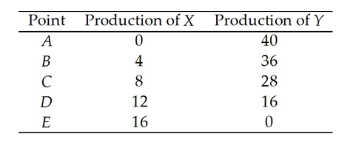 -From the data in Table 2.1.1 we can infer that
 (Multiple Choice)
4.9/5 (97)
(97) To gain from comparative advantage, countries must not only trade, they must also
(Multiple Choice)
4.8/5 (76)
(76) The opportunity cost of pushing the production possibilities frontier outward is
(Multiple Choice)
4.7/5 (79)
(79) In Portugal, the opportunity cost of a bale of wool is 3 bottles of wine. In England, the opportunity cost of 1 bottle of wine is 3 bales of wool. Given this information,
(Multiple Choice)
4.9/5 (85)
(85) Debra has an absolute advantage in producing a good when she
(Multiple Choice)
4.9/5 (83)
(83) The development of new goods and better ways of producing goods and services is
(Multiple Choice)
4.8/5 (80)
(80) Table 2.1.1
The following table gives points on the production possibilities frontier for goods X and Y.
-The diagram of the production possibilities frontier corresponding to the data in Table 2.1.1 would be
-The diagram of the production possibilities frontier corresponding to the data in Table 2.1.1 would be (Multiple Choice)
4.7/5 (74)
(74) Tom takes 20 minutes to cook an egg and 5 minutes to make a sandwich. Jerry takes 15 minutes to cook an egg and 3 minutes to make a sandwich. If Tom and Jerry specialize and trade eggs and sandwiches with each other,
(Multiple Choice)
4.8/5 (76)
(76) Use the figure below to answer the following questions.
 Figure 2.1.3
-Refer to the production possibilities frontier in Figure 2.1.3. The fact that less of X must be given up when moving from D to C than when moving from B to A indicates
Figure 2.1.3
-Refer to the production possibilities frontier in Figure 2.1.3. The fact that less of X must be given up when moving from D to C than when moving from B to A indicates (Multiple Choice)
4.7/5 (76)
(76) The principle of decreasing marginal benefit implies that the
(Multiple Choice)
4.8/5 (70)
(70) Jane produces only corn and cloth. If her preferences for corn and cloth change, then
(Multiple Choice)
5.0/5 (88)
(88) Which one of the following concepts is illustrated by a production possibilities frontier?
(Multiple Choice)
4.8/5 (83)
(83) Use the figure below to answer the following question.
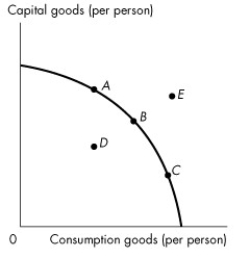 Figure 2.3.1
-Refer to the production possibilities frontier in Figure 2.3.1. The production possibilities frontier will shift rightward most rapidly if current production is at
Figure 2.3.1
-Refer to the production possibilities frontier in Figure 2.3.1. The production possibilities frontier will shift rightward most rapidly if current production is at (Multiple Choice)
4.8/5 (60)
(60) If Sam is producing at a point inside his production possibilities frontier, then he
(Multiple Choice)
4.8/5 (64)
(64) 
Filters
- Essay(0)
- Multiple Choice(0)
- Short Answer(0)
- True False(0)
- Matching(0)