



 Chat with AI
Exam 2: The Economic Problem

Exam 1: What Is Economics212 Questions
Exam 2: The Economic Problem159 Questions
Exam 3: Demand and Supply197 Questions
Exam 4: Elasticity186 Questions
Exam 5: Efficiency and Equity119 Questions
Exam 6: Governments Actions in Markets130 Questions
Exam 7: Global Markets in Action138 Questions
Exam 8: Utility and Demand120 Questions
Exam 9: Possibilities, Preferences, and Choices124 Questions
Exam 10: Organizing Production111 Questions
Exam 11: Output and Costs142 Questions
Exam 12: Perfect Competition117 Questions
Exam 13: Monopoly118 Questions
Exam 14: Monopolistic Competition122 Questions
Exam 15: Oligopoly106 Questions
Exam 16: Externalities116 Questions
Exam 17: Public Goods and Common Resources98 Questions
Exam 18: Markets for Factors of Production128 Questions
Exam 19: Economic Inequality124 Questions
Exam 20: Measuring Gdp and Economic Growth133 Questions
Exam 21: Monitoring Jobs and Inflation121 Questions
Exam 22: Economic Growth98 Questions
Exam 23: Finance, Saving, and Investment141 Questions
Exam 24: Money, the Price Level, and Inflation126 Questions
Exam 25: The Exchange Rate and the Balance of Payments126 Questions
Exam 26: Aggregate Supply and Aggregate Demand136 Questions
Exam 27: Expenditure Multipliers171 Questions
Exam 28: The Business Cycle, Inflation, and Deflation110 Questions
Exam 29: Fiscal Policy97 Questions
Exam 30: Monetary Policy97 Questions
Exam 31: Macro Only: International Trade Policy126 Questions
Select questions type


Choose the correct statements. 1. Opportunity cost of a good is the increase in the quantity produced of one good divided by the decrease in the quantity produced of another good as we move along the PPF.
2. The opportunity cost of an action is the highest-valued alternative forgone.
3. Opportunity cost is a ratio.
4. There is no relationship between the opportunity cost of producing an additional good measured on the x-axis and the opportunity cost of producing an additional good measured on the y-axis.
(Multiple Choice)
5.0/5  (92)
(92) If Harold must decrease production of some other good to increase production of good X, then Harold
(Multiple Choice)
4.9/5 (77)
(77) A medical clinic has 10 workers. Each worker can produce a maximum of either 2 units of medical services or 5 units of secretarial services a day. One day, the firm decides it would like to produce 10 units of medical services and 30 units of secretarial services. This output level is
(Multiple Choice)
4.9/5 (71)
(71) The fact that resources are not equally productive in all activities
(Multiple Choice)
4.7/5 (85)
(85) In general, if country A is accumulating capital at a faster rate than country B, then country A
(Multiple Choice)
4.8/5 (76)
(76) Use the table below to answer the following questions.
Table 2.1.2
Production Possibilities
 -Refer to Table 2.1.2. According to this production possibilities frontier,
 (Multiple Choice)
4.7/5 (84)
(84) If Harold can increase production of good X without decreasing production of any other good, then Harold
(Multiple Choice)
4.8/5 (84)
(84) As we move down the bowed-out production possibilities frontier, opportunity cost
(Multiple Choice)
4.9/5 (69)
(69) Ted chooses to study for his economics exam instead of going to the concert. The concert he will miss is Ted's ________ of studying for the exam.
(Multiple Choice)
4.9/5 (83)
(83) Use the figure below to answer the following questions.
 Figure 2.1.2
-Refer to the production possibilities frontier in Figure 2.1.2. At point A, the opportunity cost of increasing production of Y to 80 units is
Figure 2.1.2
-Refer to the production possibilities frontier in Figure 2.1.2. At point A, the opportunity cost of increasing production of Y to 80 units is (Multiple Choice)
4.8/5 (69)
(69) Tom and Don have different opportunity costs of producing two goods. If Tom and Don specialize in producing the goods in which each has a comparative advantage and they exchange goods, then
(Multiple Choice)
4.9/5 (85)
(85) Use the figure below to answer the following questions.
Figure 2.1.2
-Refer to the production possibilities frontier in Figure 2.1.2. At point C, the opportunity cost of producing one more unit of X is
Figure 2.1.2
-Refer to the production possibilities frontier in Figure 2.1.2. At point C, the opportunity cost of producing one more unit of X is (Multiple Choice)
4.7/5 (78)
(78) Table 2.1.1
The following table gives points on the production possibilities frontier for goods X and Y.
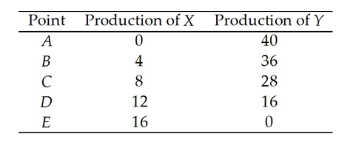 -From the data in Table 2.1.1, the production of 10 units of X and 28 units of Y is
 (Multiple Choice)
4.8/5 (79)
(79) Complete the following sentence. As you consume more and more of a good,
(Multiple Choice)
4.7/5 (74)
(74) A medical clinic has 10 workers. Each worker can produce a maximum of either 2 units of medical services or 5 units of secretarial services a day. One day, the firm decides it would like to produce 16 units of medical services and 5 units of secretarial services. This output level is
(Multiple Choice)
4.8/5 (76)
(76) A production possibilities frontier is negatively sloped because
(Multiple Choice)
4.8/5 (74)
(74) Consider Toyota's PPF, which measures cars on the x-axis and new skills and new technology on the y-axis. Toyota's opportunity cost of upgrading workers' skills and creating new technology is
(Multiple Choice)
4.9/5 (87)
(87) 
Filters
- Essay(0)
- Multiple Choice(0)
- Short Answer(0)
- True False(0)
- Matching(0)