



 Chat with AI
Exam 36: The International Monetary System: Order or Disorder

Exam 1: What Is Economics232 Questions
Exam 2: The Economy: Myth and Reality155 Questions
Exam 3: The Fundamental Economic Problem: Scarcity and Choice255 Questions
Exam 4: Supply and Demand: an Initial Look313 Questions
Exam 5: Consumer Choice: Individual and Market Demand206 Questions
Exam 6: Demand and Elasticity214 Questions
Exam 7: Production, Inputs, and Cost: Building Blocks for Supply Analysis221 Questions
Exam 8: Output, Price, and Profit: the Importance of Marginal Analysis194 Questions
Exam 9: Securities: Business Finance and the Economy: the Tail That Wags the Dog203 Questions
Exam 10: The Firm and the Industry Under Perfect Competition212 Questions
Exam 11: Monopoly208 Questions
Exam 12: Between Competition and Monopoly230 Questions
Exam 13: Limiting Market Power: Regulation and Antitrust155 Questions
Exam 14: The Case for Free Markets: the Price System225 Questions
Exam 15: The Shortcomings of Free Markets219 Questions
Exam 16: Externalities, the Environment, and Natural Resources222 Questions
Exam 17: Taxation and Resource Allocation221 Questions
Exam 18: Pricing the Factors of Production233 Questions
Exam 19: Labor and Entrepreneurship: the Human Inputs271 Questions
Exam 20: Poverty, Inequality, and Discrimination172 Questions
Exam 21: Is Useconomic Leadership Threatened75 Questions
Exam 22: An Introduction to Macroeconomics216 Questions
Exam 23: The Goals of Macroeconomic Policy212 Questions
Exam 24: Economic Growth: Theory and Policy228 Questions
Exam 25: Aggregate Demand and the Powerful Consumer219 Questions
Exam 26: Demand-Side Equilibrium: Unemployment or Inflation216 Questions
Exam 27: Bringing in the Supply Side: Unemployment and Inflation228 Questions
Exam 28: Managing Aggregate Demand: Fiscal Policy210 Questions
Exam 29: Money and the Banking System224 Questions
Exam 30: Monetary Policy: Conventional and Unconventional210 Questions
Exam 31: He Financial Crisis and the Great Recession66 Questions
Exam 32: The Debate Over Monetary and Fiscal Policy219 Questions
Exam 33: Budget Deficits in the Short and Long Run215 Questions
Exam 34: The Trade-Off Between Inflation and Unemployment219 Questions
Exam 35: International Trade and Comparative Advantage223 Questions
Exam 36: The International Monetary System: Order or Disorder218 Questions
Exam 37: Exchange Rates and the Macroeconomy219 Questions
Select questions type


Which of the following countries has gone so far as to adopt the U.S.dollar as its domestic currency?
(Multiple Choice)
4.9/5  (79)
(79) When a government influences the exchange rate of its currency, it is said to be practicing "dirty floating."
(True/False)
4.9/5 (86)
(86) The gold standard prevented a nation from controlling its domestic economy through monetary policy.
(True/False)
4.7/5 (76)
(76) Figure 19-3
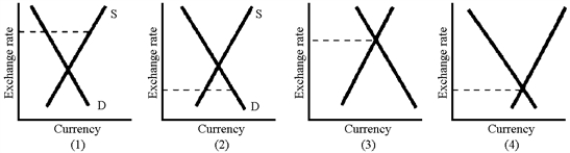 -Of the graphs in Figure 19-3, where the dotted line shows the actual exchange rate, which one shows a country with an overvalued currency and a balance of trade deficit?
 (Multiple Choice)
4.9/5 (84)
(84) The dollar appreciates against the euro when U.S.demand for European goods increases.
(True/False)
4.9/5 (79)
(79) If Japanese tourists visit Yellowstone Park, what is the effect in the foreign exchange market?
(Multiple Choice)
4.8/5 (83)
(83) On May 12, 2011, the U.S.dollar was worth 0.61 British pounds.How many dollars did it take to buy one British pound?
(Multiple Choice)
4.8/5 (67)
(67)  -Assume that the information in Table 19-1 applies to the cost per ton of coal in 1998.Assume that also over a 10-year period prices rise 100 percent in Great Britain and 200 percent in the United States.According to the purchasing power parity theory, the exchange rate between the dollar and the pound in the year 2008 will be
 (Multiple Choice)
4.9/5 (81)
(81) The current exchange rate system for most currencies is described most accurately as one of
(Multiple Choice)
4.8/5 (89)
(89) An area in which the United States has had a sizable surplus in its balance of payments is sales of ____ to foreigners.
(Multiple Choice)
4.9/5 (63)
(63) A deficit country, like Argentina in 2001, must follow restrictive monetary and fiscal policy in order to maintain a fixed exchange rate.
(True/False)
4.8/5 (84)
(84) The rate at which one currency is traded for another is called a(n)
(Multiple Choice)
4.9/5 (82)
(82) One method for a deficit country to correct the situation under a fixed exchange rate system is to
(Multiple Choice)
4.7/5 (79)
(79) The International Monetary Fund was established to manage the Bretton Woods System.
(True/False)
4.9/5 (87)
(87) If a currency decreases in value as a result of government decree rather than market forces, the process is known as
(Multiple Choice)
4.8/5 (74)
(74) A fixed exchange rate can be maintained by a government as long as it has sufficient
(Multiple Choice)
4.8/5 (84)
(84) Figure 19-2
 -Of the graphs in Figure 19-2, where the broken line represents the fixed exchange rates, which one shows how a balance of payments deficit could be reduced through a recession in Japan?
 (Multiple Choice)
4.9/5 (74)
(74) 
Filters
- Essay(0)
- Multiple Choice(0)
- Short Answer(0)
- True False(0)
- Matching(0)