



 Chat with AI
Exam 36: The International Monetary System: Order or Disorder

Exam 1: What Is Economics232 Questions
Exam 2: The Economy: Myth and Reality155 Questions
Exam 3: The Fundamental Economic Problem: Scarcity and Choice255 Questions
Exam 4: Supply and Demand: an Initial Look313 Questions
Exam 5: Consumer Choice: Individual and Market Demand206 Questions
Exam 6: Demand and Elasticity214 Questions
Exam 7: Production, Inputs, and Cost: Building Blocks for Supply Analysis221 Questions
Exam 8: Output, Price, and Profit: the Importance of Marginal Analysis194 Questions
Exam 9: Securities: Business Finance and the Economy: the Tail That Wags the Dog203 Questions
Exam 10: The Firm and the Industry Under Perfect Competition212 Questions
Exam 11: Monopoly208 Questions
Exam 12: Between Competition and Monopoly230 Questions
Exam 13: Limiting Market Power: Regulation and Antitrust155 Questions
Exam 14: The Case for Free Markets: the Price System225 Questions
Exam 15: The Shortcomings of Free Markets219 Questions
Exam 16: Externalities, the Environment, and Natural Resources222 Questions
Exam 17: Taxation and Resource Allocation221 Questions
Exam 18: Pricing the Factors of Production233 Questions
Exam 19: Labor and Entrepreneurship: the Human Inputs271 Questions
Exam 20: Poverty, Inequality, and Discrimination172 Questions
Exam 21: Is Useconomic Leadership Threatened75 Questions
Exam 22: An Introduction to Macroeconomics216 Questions
Exam 23: The Goals of Macroeconomic Policy212 Questions
Exam 24: Economic Growth: Theory and Policy228 Questions
Exam 25: Aggregate Demand and the Powerful Consumer219 Questions
Exam 26: Demand-Side Equilibrium: Unemployment or Inflation216 Questions
Exam 27: Bringing in the Supply Side: Unemployment and Inflation228 Questions
Exam 28: Managing Aggregate Demand: Fiscal Policy210 Questions
Exam 29: Money and the Banking System224 Questions
Exam 30: Monetary Policy: Conventional and Unconventional210 Questions
Exam 31: He Financial Crisis and the Great Recession66 Questions
Exam 32: The Debate Over Monetary and Fiscal Policy219 Questions
Exam 33: Budget Deficits in the Short and Long Run215 Questions
Exam 34: The Trade-Off Between Inflation and Unemployment219 Questions
Exam 35: International Trade and Comparative Advantage223 Questions
Exam 36: The International Monetary System: Order or Disorder218 Questions
Exam 37: Exchange Rates and the Macroeconomy219 Questions
Select questions type


Lately, the Chinese authorities seem to be backing away from ____ and the Yuan has ____ relative to the dollar.
(Multiple Choice)
4.9/5  (86)
(86) For developing countries, one of the dangers inherent in the inflows of capital that finance investment is
(Multiple Choice)
4.8/5 (88)
(88) Inflation plays a major role in determining whether a currency is appreciating or depreciating.
(True/False)
4.7/5 (71)
(71) Figure 19-1
 -Of the graphs in Figure 19-1, which one shows the effects of an increase in interest rates in Japan and a depreciation of the dollar?
 (Multiple Choice)
4.8/5 (82)
(82) Under a gold standard, a balance of payments surplus automatically
(Multiple Choice)
4.8/5 (94)
(94) When a government intentionally lowers the value of its currency, that is called depreciation.
(True/False)
4.9/5 (86)
(86) On June 3, 2005, it cost 1.22 U.S.dollars to buy one euro.How many euros did it take to buy one U.S.dollar?
(Multiple Choice)
4.9/5 (74)
(74) Define the following terms and explain their importance to the study of macroeconomics:a.exchange rateb.depreciationc.devaluationd.fixed exchange rates
(Essay)
5.0/5 (80)
(80)  -From Table 19-1, what is the exchange rate between the dollar and the pound?
 (Multiple Choice)
4.8/5 (75)
(75) An economic boom in the United States will tend to cause booms in other countries because as U.S.GDP rises, U.S.
(Multiple Choice)
4.9/5 (73)
(73) Can the U.S.dollar and the European euro both appreciate relative to each other?
(Multiple Choice)
4.8/5 (92)
(92) On May 12, 2011, it cost U.S.$.04 to buy one Russian ruble.How many Russian rubles would U.S.$1 buy?
(Multiple Choice)
4.9/5 (86)
(86) A fixed exchange rate system encourages speculators to attack weaker currencies.
(True/False)
4.9/5 (73)
(73) Figure 19-3
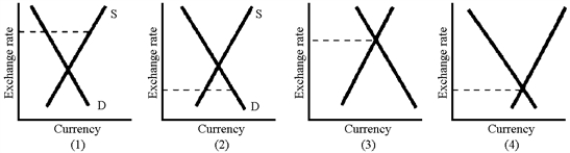 -Of the graphs in Figure 19-3, where the dotted line shows the actual exchange rate, which one shows a country with an undervalued currency and a balance of trade surplus?
 (Multiple Choice)
4.9/5 (72)
(72) Figure 19-2
 -Of the graphs in Figure 19-2, which one shows the effects on the exchange rate of an expansion in Japan?
 (Multiple Choice)
4.8/5 (83)
(83) If the U.S.purchases oil from Venezuela, what is the effect in the foreign exchange market?
(Multiple Choice)
4.9/5 (73)
(73) Everything else being equal, one can expect the euro to appreciate relative to the dollar if
(Multiple Choice)
4.8/5 (77)
(77) Because central banks intervene in currency markets, the term ____ has been used to describe the system.
(Multiple Choice)
4.9/5 (62)
(62) If the price of the dollar changes from 100 Japanese yen to 120 Japanese yen, the dollar has depreciated.
(True/False)
4.9/5 (85)
(85) 
Filters
- Essay(0)
- Multiple Choice(0)
- Short Answer(0)
- True False(0)
- Matching(0)