



 Chat with AI
Exam 15: The Shortcomings of Free Markets

Exam 1: What Is Economics232 Questions
Exam 2: The Economy: Myth and Reality155 Questions
Exam 3: The Fundamental Economic Problem: Scarcity and Choice255 Questions
Exam 4: Supply and Demand: an Initial Look313 Questions
Exam 5: Consumer Choice: Individual and Market Demand206 Questions
Exam 6: Demand and Elasticity214 Questions
Exam 7: Production, Inputs, and Cost: Building Blocks for Supply Analysis221 Questions
Exam 8: Output, Price, and Profit: the Importance of Marginal Analysis194 Questions
Exam 9: Securities: Business Finance and the Economy: the Tail That Wags the Dog203 Questions
Exam 10: The Firm and the Industry Under Perfect Competition212 Questions
Exam 11: Monopoly208 Questions
Exam 12: Between Competition and Monopoly230 Questions
Exam 13: Limiting Market Power: Regulation and Antitrust155 Questions
Exam 14: The Case for Free Markets: the Price System225 Questions
Exam 15: The Shortcomings of Free Markets219 Questions
Exam 16: Externalities, the Environment, and Natural Resources222 Questions
Exam 17: Taxation and Resource Allocation221 Questions
Exam 18: Pricing the Factors of Production233 Questions
Exam 19: Labor and Entrepreneurship: the Human Inputs271 Questions
Exam 20: Poverty, Inequality, and Discrimination172 Questions
Exam 21: Is Useconomic Leadership Threatened75 Questions
Exam 22: An Introduction to Macroeconomics216 Questions
Exam 23: The Goals of Macroeconomic Policy212 Questions
Exam 24: Economic Growth: Theory and Policy228 Questions
Exam 25: Aggregate Demand and the Powerful Consumer219 Questions
Exam 26: Demand-Side Equilibrium: Unemployment or Inflation216 Questions
Exam 27: Bringing in the Supply Side: Unemployment and Inflation228 Questions
Exam 28: Managing Aggregate Demand: Fiscal Policy210 Questions
Exam 29: Money and the Banking System224 Questions
Exam 30: Monetary Policy: Conventional and Unconventional210 Questions
Exam 31: He Financial Crisis and the Great Recession66 Questions
Exam 32: The Debate Over Monetary and Fiscal Policy219 Questions
Exam 33: Budget Deficits in the Short and Long Run215 Questions
Exam 34: The Trade-Off Between Inflation and Unemployment219 Questions
Exam 35: International Trade and Comparative Advantage223 Questions
Exam 36: The International Monetary System: Order or Disorder218 Questions
Exam 37: Exchange Rates and the Macroeconomy219 Questions
Select questions type


Regarding government manipulation of the interest rate, all of these statements are correct, except:
(Multiple Choice)
4.8/5  (80)
(80) The City Symphony presents three open-air concerts in the city park pavilion during the spring and summer.Many who attend make donations for symphony expenses, but the donation is not required.Some who attend make no contributions.Economists would
(Multiple Choice)
4.7/5 (83)
(83) Figure 15-1
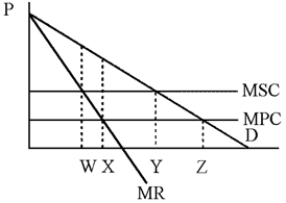 -Figure 15-1 describes conditions in the monopolized weezil industry.If the government replaces the monopolist with perfectly competitive firms and forces these firms to take account of all the costs and benefits they impose on society, the industry will produce an output equal to
 (Multiple Choice)
4.9/5 (77)
(77) The lure of ____ directs resources to optimally efficient activities and time periods.
(Multiple Choice)
4.8/5 (82)
(82) What rule must be followed to obtain an efficient allocation of resources?
(Multiple Choice)
4.8/5 (63)
(63) Private ownership of rivers and lakes will halt all water pollution.
(True/False)
4.9/5 (81)
(81) Figure 15-2
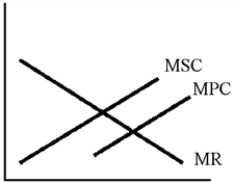 -The firm illustrated in Figure 15-2 is producing
 (Multiple Choice)
4.8/5 (78)
(78) Marginal social cost is made up of marginal private cost and incidental cost.
(True/False)
4.8/5 (78)
(78) The interest rate is the opportunity cost of transferring spending power between time periods.However, the market mechanism may fail to provide adequately for future economic growth.List the reasons why a market might fail.
(Essay)
4.8/5 (67)
(67) The pollution emitted by a power plant is an example of a detrimental externality.
(True/False)
4.8/5 (87)
(87) Public goods could effectively be provided by private markets, but we choose to provide them through government.
(True/False)
4.9/5 (92)
(92) The key explanation for the prevalence of waterway pollution is
(Multiple Choice)
4.9/5 (71)
(71) The most threatening and damaging detrimental externality at issue today is:
(Multiple Choice)
4.8/5 (78)
(78) The Rand Corporation estimates that the external costs imposed by alcohol consumption (for example, deaths caused by drunk drivers) to be 48 cents per ounce consumed.Taxes on alcohol amount to 23 cents per ounce consumed.This information suggests: (i) alcohol is overconsumed; (ii) alcohol taxes should be raised.Which of these statements is correct?
(Multiple Choice)
4.9/5 (77)
(77) The economic justification for public subsidies to university research is based on
(Multiple Choice)
4.8/5 (85)
(85) Which term refers to the share of an activity's marginal cost that is paid for by people other than those who carry out the activity?
(Multiple Choice)
4.7/5 (82)
(82) 
Filters
- Essay(0)
- Multiple Choice(0)
- Short Answer(0)
- True False(0)
- Matching(0)