



 Chat with AI
Exam 15: The Shortcomings of Free Markets

Exam 1: What Is Economics232 Questions
Exam 2: The Economy: Myth and Reality155 Questions
Exam 3: The Fundamental Economic Problem: Scarcity and Choice255 Questions
Exam 4: Supply and Demand: an Initial Look313 Questions
Exam 5: Consumer Choice: Individual and Market Demand206 Questions
Exam 6: Demand and Elasticity214 Questions
Exam 7: Production, Inputs, and Cost: Building Blocks for Supply Analysis221 Questions
Exam 8: Output, Price, and Profit: the Importance of Marginal Analysis194 Questions
Exam 9: Securities: Business Finance and the Economy: the Tail That Wags the Dog203 Questions
Exam 10: The Firm and the Industry Under Perfect Competition212 Questions
Exam 11: Monopoly208 Questions
Exam 12: Between Competition and Monopoly230 Questions
Exam 13: Limiting Market Power: Regulation and Antitrust155 Questions
Exam 14: The Case for Free Markets: the Price System225 Questions
Exam 15: The Shortcomings of Free Markets219 Questions
Exam 16: Externalities, the Environment, and Natural Resources222 Questions
Exam 17: Taxation and Resource Allocation221 Questions
Exam 18: Pricing the Factors of Production233 Questions
Exam 19: Labor and Entrepreneurship: the Human Inputs271 Questions
Exam 20: Poverty, Inequality, and Discrimination172 Questions
Exam 21: Is Useconomic Leadership Threatened75 Questions
Exam 22: An Introduction to Macroeconomics216 Questions
Exam 23: The Goals of Macroeconomic Policy212 Questions
Exam 24: Economic Growth: Theory and Policy228 Questions
Exam 25: Aggregate Demand and the Powerful Consumer219 Questions
Exam 26: Demand-Side Equilibrium: Unemployment or Inflation216 Questions
Exam 27: Bringing in the Supply Side: Unemployment and Inflation228 Questions
Exam 28: Managing Aggregate Demand: Fiscal Policy210 Questions
Exam 29: Money and the Banking System224 Questions
Exam 30: Monetary Policy: Conventional and Unconventional210 Questions
Exam 31: He Financial Crisis and the Great Recession66 Questions
Exam 32: The Debate Over Monetary and Fiscal Policy219 Questions
Exam 33: Budget Deficits in the Short and Long Run215 Questions
Exam 34: The Trade-Off Between Inflation and Unemployment219 Questions
Exam 35: International Trade and Comparative Advantage223 Questions
Exam 36: The International Monetary System: Order or Disorder218 Questions
Exam 37: Exchange Rates and the Macroeconomy219 Questions
Select questions type


The cost of trash removal goes up, in part at least, because labor productivity in auto manufacturing goes up.
(True/False)
4.8/5  (74)
(74) An efficient allocation of resources requires that a product's price equal its average cost.
(True/False)
4.8/5 (70)
(70) Give an appropriate remedy for correcting excessive pollution and note any difficulties in implementing it.
(Essay)
5.0/5 (92)
(92) A free rider is one who enjoys the benefits of a public good without paying for it.
(True/False)
4.8/5 (67)
(67) An economy produces only two goods, paper and scissors.Dyes from paper production pollute a nearby river.Use a production possibilities curve to illustrate your explanation of how the unfettered market would fail to provide the efficient mix of paper and scissors.
(Essay)
4.9/5 (79)
(79) Discuss the role of trust as a critical piece of any principal-agent situation.In particular, what role did trust play in the recent stock market scandals?
(Essay)
4.9/5 (89)
(89) Unscrupulous managers have learned ways to manipulate stock options and undermine their benefits to stockholders.Discuss some provisions that could be built into the process to curb such practices.
(Essay)
4.8/5 (74)
(74) As manufacturing becomes more efficient, services can be expected to become more costly.
(True/False)
4.7/5 (83)
(83) Figure 15-1
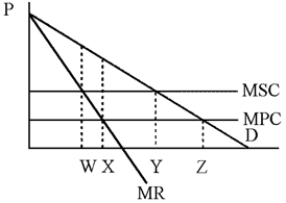 -Figure 15-1 describes conditions in the monopolized weezil industry.In the absence of government intervention, the monopolist will produce an output equal to
 (Multiple Choice)
4.9/5 (83)
(83) Government action can usually perfectly correct the market's shortcomings.
(True/False)
4.8/5 (73)
(73) A market economy provides solutions to almost all social ills such as poverty and environmental damage.
(True/False)
4.8/5 (85)
(85) Producers of computer software are plagued with the problem of "pirating", that is, many people copy software legally purchased by others.The industry estimates that for each legal copy of a program, there are two pirated copies in use.The industry wants strict laws for the enforcement of its "intellectual property rights," but enforcement is obviously very difficult.Economists call this problem
(Multiple Choice)
4.8/5 (60)
(60) Explain whether the market produces too little, too much, or the right amount: (a) of goods with detrimental externalities; (b) of goods with public good characteristics.
(Essay)
4.9/5 (72)
(72) If interest rates fall, the opportunity cost of spending money today rather than tomorrow
(Multiple Choice)
4.8/5 (70)
(70) An increase in wages in the public sector is always accompanied by an increase in labor productivity.
(True/False)
4.9/5 (83)
(83) Suppose that deposit insurance were reduced to a maximum of $50,000 per account (instead of $250,000).This would address the specific market imperfection of
(Multiple Choice)
4.9/5 (76)
(76) There is much world concern over the deteriorating condition of the Pyramids and other historical structures in Egypt.While people of all nations enjoy visiting these structures, there has been little financial support for preservation coming from within Egypt or from elsewhere.Economists would describe this as an example of
(Multiple Choice)
4.8/5 (68)
(68) Electric utilities have trumpeted nuclear power for years, advocating it as lower in production costs than other alternatives.Yet, society has resisted heavy reliance on nuclear power.Explain the source of the disagreement and suggest which side (utilities or society) is correct.
(Essay)
4.8/5 (73)
(73) What is the meaning of "a defective telescopic faculty," as described by A.C.Pigou?
(Multiple Choice)
4.8/5 (74)
(74) 
Filters
- Essay(0)
- Multiple Choice(0)
- Short Answer(0)
- True False(0)
- Matching(0)