



 Chat with AI
Exam 2: Trade-Offs, comparative Advantage, and the Market System

Exam 1: Economics: Foundations and Models444 Questions
Exam 2: Trade-Offs, comparative Advantage, and the Market System498 Questions
Exam 3: Where Prices Come From: the Interaction of Demand and Supply475 Questions
Exam 4: Market Efficiency and Market Failure465 Questions
Exam 5: The Economics of Health Care334 Questions
Exam 6: Firms, the Stock Market, and Corporate Governance250 Questions
Exam 7: Consumer Choice and Elasticity380 Questions
Exam 8: Technology, production, and Costs276 Questions
Exam 9: Firms in Perfectly Competitive Markets297 Questions
Exam 10: Monopoly and Antitrust Policy271 Questions
Exam 11: Monopolistic Competition and Oligopoly414 Questions
Exam 12: Gdp: Measuring Total Production and Income266 Questions
Exam 13: Unemployment and Inflation292 Questions
Exam 14: Economic Growth, the Financial System, and Business Cycles257 Questions
Exam 15: Aggregate Demand and Aggregate Supply Analysis284 Questions
Exam 16: Money, banks, and the Federal Reserve System279 Questions
Exam 17: Monetary Policy277 Questions
Exam 18: Fiscal Policy282 Questions
Exam 19: Comparative Advantage, international Trade, and Exchange Rates446 Questions
Select questions type


Figure 2-7
 Mercedes Benz recently decided to introduce its B-class automobile in the U.S.market, an electric car that is has designed and developed in a partnership with Tesla Motors.Assume Mercedes Benz chooses to produce both electric-engine vehicles and gasoline-engine vehicles.Figure 2-7 shows changes to its production possibilities frontier in response to new developments and different strategic production decisions.
-Refer to Figure 2-7.Assume that in response to changing consumer demands,Mercedes cuts back on the production of electric vehicles and increased its production of gasoline-powered vehicles.This strategy is best represented by the
Mercedes Benz recently decided to introduce its B-class automobile in the U.S.market, an electric car that is has designed and developed in a partnership with Tesla Motors.Assume Mercedes Benz chooses to produce both electric-engine vehicles and gasoline-engine vehicles.Figure 2-7 shows changes to its production possibilities frontier in response to new developments and different strategic production decisions.
-Refer to Figure 2-7.Assume that in response to changing consumer demands,Mercedes cuts back on the production of electric vehicles and increased its production of gasoline-powered vehicles.This strategy is best represented by the (Multiple Choice)
4.9/5  (70)
(70) Is it possible for a firm to have an absolute advantage in producing something without having a comparative advantage? Why or why not?
(Essay)
4.8/5 (76)
(76) On a diagram of a production possibility frontier,opportunity cost is represented by the production possibility frontier shifting outward.
(True/False)
5.0/5 (81)
(81) Table 2-13
Tammi Horace Dogs Groomed 20 12 Cats Bathed 10 8
Table 2-13 shows the output per day of two pet groomers, Tammi and Horace.They can either devote their time to grooming dogs or bathing cats.
-Refer to Table 2-13.Which of the following statements is true?
(Multiple Choice)
4.8/5 (76)
(76) Suppose in the United States,the opportunity cost of producing a motor engine is 4 auto bodies.In Canada,the opportunity cost of producing a motor engine is 2 auto bodies.
a.What is the opportunity cost of producing an auto body for the United States?
b.What is the opportunity cost of producing an auto body for Canada?
c.Which country has a comparative advantage in the production of auto bodies?
d.Which country has a comparative advantage in the production of motor engines?
(Essay)
5.0/5 (82)
(82) Figure 2-4
 Figure 2-4 shows various points on three different production possibilities frontiers for a nation.
-Refer to Figure 2-4.A movement from ________ is the result of advancements in plastic production technology.
Figure 2-4 shows various points on three different production possibilities frontiers for a nation.
-Refer to Figure 2-4.A movement from ________ is the result of advancements in plastic production technology. (Multiple Choice)
5.0/5 (74)
(74) If a country produces only two goods,it is possible to have an absolute advantage in the production of both those goods.
(True/False)
4.9/5 (89)
(89) Figure 2-4
Figure 2-4 shows various points on three different production possibilities frontiers for a nation.
-Refer to Figure 2-4.A movement from Y to Z
Figure 2-4 shows various points on three different production possibilities frontiers for a nation.
-Refer to Figure 2-4.A movement from Y to Z (Multiple Choice)
4.9/5 (89)
(89)  -Refer to Figure 2-1.Point C is
Table 2-1
Production choices for Tomaso's Trattoria
Choice Quantity of Pizzas Produced Quantity of Calzones Produced A 48 0 B 36 15 C 24 30 D 12 45 E 0 60
-Refer to Table 2-1.Assume Tomaso's Trattoria only produces pizzas and calzones.A combination of 24 pizzas and 15 calzones would appear
(Multiple Choice)
4.8/5 (68)
(68) Table 2-12
One canoe One Sailboat Guaternala 10 hours 60 hours Monduras 15 hours 75 hours
Table 2-12 shows the number of labor hours required to produce a canoe and a sailboat in Guatemala and Honduras.
-Refer to Table 2-12.Honduras has a comparative advantage in the production of
(Multiple Choice)
4.8/5 (77)
(77) Table 2-21
Digital Carner a Wheat (bushels) China 100 hours 5 hours South Korea 90 hours 3 hours
-Refer to Table 2-21.This table shows the number of labor hours required to produce a digital camera and a bushel of wheat in China and South Korea.
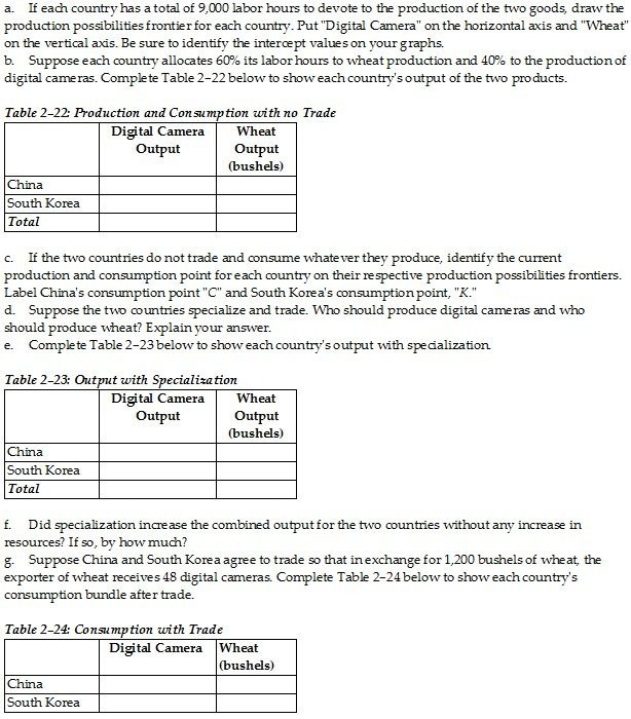 h.Show the consumption points after trade on each country's production possibilities frontier.Label these points "B" for China and "J" for South Korea.
i.Has trade made the two countries better off? Explain your answer.
h.Show the consumption points after trade on each country's production possibilities frontier.Label these points "B" for China and "J" for South Korea.
i.Has trade made the two countries better off? Explain your answer. (Essay)
4.8/5 (74)
(74) Table 2-19
Wilrn Betty Statues 12 14 Benches 4 7
Table 2-19 shows the output per month of two people, Wilma and Betty.They can either devote their time to making marble statues or making marble benches.
-Refer to Table 2-19.Which of the following statements is true?
(Multiple Choice)
4.8/5 (91)
(91) A decrease in the unemployment rate may be represented as a movement from a point inside the production possibilities frontier to a point on the frontier.
(True/False)
4.9/5 (73)
(73) ________ marginal opportunity cost implies that the more resources already devoted to any activity,the payoff from allocating yet more resources to that activity increases by progressively smaller amounts.
(Multiple Choice)
4.9/5 (81)
(81) Figure 2-13
 Figure 2-13 shows the production possibilities frontiers for Tahiti and Bora Bora. Each country produces two goods, milk and honey.
-Refer to Figure 2-13.What is the opportunity cost of producing one gallon of milk in Bora Bora?
Figure 2-13 shows the production possibilities frontiers for Tahiti and Bora Bora. Each country produces two goods, milk and honey.
-Refer to Figure 2-13.What is the opportunity cost of producing one gallon of milk in Bora Bora? (Multiple Choice)
4.7/5 (82)
(82) If Blake can pick more cherries in one hour than Cody,then Blake has a comparative advantage in cherry picking.
(True/False)
4.9/5 (75)
(75) An organization of producers that limits the amount of a good produced is known as a
(Multiple Choice)
4.8/5 (75)
(75) Figure 2-14
 Figure 2-14 shows the production possibilities frontiers for Costa Rica and Guatemala. Each country produces two goods, pineapples and coconuts.
-Refer to Figure 2-14.Which country has a comparative advantage in the production of pineapples?
Figure 2-14 shows the production possibilities frontiers for Costa Rica and Guatemala. Each country produces two goods, pineapples and coconuts.
-Refer to Figure 2-14.Which country has a comparative advantage in the production of pineapples? (Multiple Choice)
4.8/5 (90)
(90) 
Filters
- Essay(0)
- Multiple Choice(0)
- Short Answer(0)
- True False(0)
- Matching(0)