



 Chat with AI
Exam 2: Trade-Offs, comparative Advantage, and the Market System

Exam 1: Economics: Foundations and Models444 Questions
Exam 2: Trade-Offs, comparative Advantage, and the Market System498 Questions
Exam 3: Where Prices Come From: the Interaction of Demand and Supply475 Questions
Exam 4: Market Efficiency and Market Failure465 Questions
Exam 5: The Economics of Health Care334 Questions
Exam 6: Firms, the Stock Market, and Corporate Governance250 Questions
Exam 7: Consumer Choice and Elasticity380 Questions
Exam 8: Technology, production, and Costs276 Questions
Exam 9: Firms in Perfectly Competitive Markets297 Questions
Exam 10: Monopoly and Antitrust Policy271 Questions
Exam 11: Monopolistic Competition and Oligopoly414 Questions
Exam 12: Gdp: Measuring Total Production and Income266 Questions
Exam 13: Unemployment and Inflation292 Questions
Exam 14: Economic Growth, the Financial System, and Business Cycles257 Questions
Exam 15: Aggregate Demand and Aggregate Supply Analysis284 Questions
Exam 16: Money, banks, and the Federal Reserve System279 Questions
Exam 17: Monetary Policy277 Questions
Exam 18: Fiscal Policy282 Questions
Exam 19: Comparative Advantage, international Trade, and Exchange Rates446 Questions
Select questions type


For a person to have a comparative advantage in producing a product,he must be able to produce that product at a higher opportunity cost than his competitors.
(True/False)
4.8/5  (91)
(91) Table 2-16
One Cell Phone Lumber (per board foot) Estonia 40 hours 8 hours Finland 16 hours 4 hours
Table 2-16 shows the number of labor hours required to produce a cell phone and a board foot of lumber in Estonia and Finland.
-Refer to Table 2-16.If the two countries specialize and trade,who should export lumber?
(Multiple Choice)
4.9/5 (84)
(84) Figure 2-8
 Figure 2-8 above shows the production possibilities frontier for Vidalia, a nation that produces two goods, roses and orchids.
-Refer to Figure 2-8.If Vidalia chooses to produce 60 dozen orchids,how many roses can it produce to maximize production?
Figure 2-8 above shows the production possibilities frontier for Vidalia, a nation that produces two goods, roses and orchids.
-Refer to Figure 2-8.If Vidalia chooses to produce 60 dozen orchids,how many roses can it produce to maximize production? (Multiple Choice)
4.9/5 (80)
(80) Figure 2-8
Figure 2-8 above shows the production possibilities frontier for Vidalia, a nation that produces two goods, roses and orchids.
-Refer to Figure 2-8.Suppose Vidalia is currently producing 120 dozen roses per period.How many orchids is it also producing,assuming that resources are fully utilized?
Figure 2-8 above shows the production possibilities frontier for Vidalia, a nation that produces two goods, roses and orchids.
-Refer to Figure 2-8.Suppose Vidalia is currently producing 120 dozen roses per period.How many orchids is it also producing,assuming that resources are fully utilized? (Multiple Choice)
4.7/5 (90)
(90) Table 2-4
Production Choices for Dina's Diner
Choice Quantity of Sliders Produced Quantity of Hot Wings Produced A 80 0 B 60 25 C 40 50 D 20 75 E 0 100
-Refer to Table 2-4.Assume Dina's Diner only produces sliders and hot wings.A combination of 60 sliders and 50 hot wings would appear
(Multiple Choice)
4.9/5 (88)
(88) If Sanjaya can shuck more oysters in one hour than Tatiana,then Sanjaya has a comparative advantage in shucking oysters.
(True/False)
4.8/5 (63)
(63) Any output combination inside a production possibility frontier is associated with unused or underutilized resources.
(True/False)
4.8/5 (83)
(83) Individuals who have never been the best at doing anything
(Multiple Choice)
4.9/5 (81)
(81) In the desire to have a celebrity's image protected to prevent it from being used in ways he would not approve,a celebrity's estate
(Multiple Choice)
4.8/5 (82)
(82) Suppose there is some unemployment in the economy and society decides that it wants more of one good.Which of the following statements is true?
(Multiple Choice)
4.9/5 (90)
(90) Which of the following is a flow in the circular flow model?
(Multiple Choice)
4.8/5 (93)
(93) Table 2-11
One Digital Camera Wheat (per pound) China 100 hours 4 hours South Korea 60 hours 3 hours
Table 2-11 shows the number of labor hours required to produce a digital camera and a pound of wheat in China and South Korea.
-Refer to Table 2-11.South Korea has a comparative advantage in the production of
(Multiple Choice)
4.9/5 (82)
(82) Figure 2-6
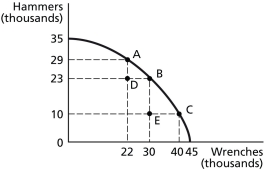 -Refer to Figure 2-6.If the economy is currently producing at point A,what is the opportunity cost of moving to point B?
 (Multiple Choice)
4.9/5 (72)
(72) Table 2-18
Minnie Mickey Hats 40 50 Urmbrellas 10 5
Table 2-18 shows the output per week of two people, Minnie and Mickey.They can either devote their time to making hats or making umbrellas.
-Refer to Table 2-18.Which of the following statements is true?
(Multiple Choice)
4.7/5 (81)
(81) In the circular flow model,households demand resources such as labor services in the product market.
(True/False)
4.9/5 (93)
(93) 
Filters
- Essay(0)
- Multiple Choice(0)
- Short Answer(0)
- True False(0)
- Matching(0)