



 Chat with AI
Exam 2: Trade-Offs, comparative Advantage, and the Market System

Exam 1: Economics: Foundations and Models444 Questions
Exam 2: Trade-Offs, comparative Advantage, and the Market System498 Questions
Exam 3: Where Prices Come From: the Interaction of Demand and Supply475 Questions
Exam 4: Market Efficiency and Market Failure465 Questions
Exam 5: The Economics of Health Care334 Questions
Exam 6: Firms, the Stock Market, and Corporate Governance250 Questions
Exam 7: Consumer Choice and Elasticity380 Questions
Exam 8: Technology, production, and Costs276 Questions
Exam 9: Firms in Perfectly Competitive Markets297 Questions
Exam 10: Monopoly and Antitrust Policy271 Questions
Exam 11: Monopolistic Competition and Oligopoly414 Questions
Exam 12: Gdp: Measuring Total Production and Income266 Questions
Exam 13: Unemployment and Inflation292 Questions
Exam 14: Economic Growth, the Financial System, and Business Cycles257 Questions
Exam 15: Aggregate Demand and Aggregate Supply Analysis284 Questions
Exam 16: Money, banks, and the Federal Reserve System279 Questions
Exam 17: Monetary Policy277 Questions
Exam 18: Fiscal Policy282 Questions
Exam 19: Comparative Advantage, international Trade, and Exchange Rates446 Questions
Select questions type


The payment received by suppliers of entrepreneurial skills is called rent.
(True/False)
4.9/5  (73)
(73) Table 2-11
One Digital Camera Wheat (per pound) China 100 hours 4 hours South Korea 60 hours 3 hours
Table 2-11 shows the number of labor hours required to produce a digital camera and a pound of wheat in China and South Korea.
-Refer to Table 2-11.What is China's opportunity cost of producing one pound of wheat?
(Multiple Choice)
4.8/5 (66)
(66) Figure 2-5
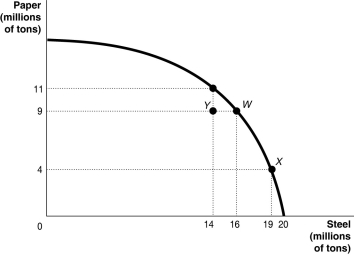 -Refer to Figure 2-5.If the economy is currently producing at point X,what is the opportunity cost of moving to point W?
 (Multiple Choice)
4.9/5 (66)
(66) Table 2-5
Production choices for Nadia's Neckware
Choice Quantity of Ascots Produced Quantity of Bowties Produced A 32 0 B 24 6 C 16 12 D 8 18 E 0 24
-Refer to Table 2-5.Assume Nadia's Neckware only produces ascots and bowties.A combination of 24 ascots and 12 bowties would appear
(Multiple Choice)
4.7/5 (94)
(94) Table 2-12
One canoe One Sailboat Guaternala 10 hours 60 hours Monduras 15 hours 75 hours
Table 2-12 shows the number of labor hours required to produce a canoe and a sailboat in Guatemala and Honduras.
-Refer to Table 2-12.What is Guatemala's opportunity cost of producing one sailboat?
(Multiple Choice)
4.8/5 (86)
(86) Which of the following countries does not come close to the free market benchmark?
(Multiple Choice)
5.0/5 (81)
(81) In the circular flow model,households supply resources such as labor services in the product market.
(True/False)
5.0/5 (82)
(82) The ________ demonstrates the roles played by households and firms in the market system.
(Multiple Choice)
4.8/5 (79)
(79) Suppose your expenses for this term are as follows: tuition: $12,000,room and board: $6,500,books and other educational supplies: $1,500.Further,during the term,you can only work part-time and earn $3,500 instead of your full-time salary of $14,000.What is the opportunity cost of going to college this term,assuming that your room and board expenses would be the same even if you did not go to college?
(Multiple Choice)
4.9/5 (80)
(80) Economic decline (negative growth)is represented on a production possibilities frontier model by the production possibility frontier
(Multiple Choice)
4.8/5 (91)
(91) The idea underlying Adam Smith's "invisible hand" is that people tend to behave in ways that go unnoticed in society.
(True/False)
4.9/5 (92)
(92) Figure 2-16
 -Refer to Figure 2-16.One segment of the circular flow diagram in the figure shows the flow of wages and salaries from market K to economic agents M.What is market K and who are economic agents M?
 (Multiple Choice)
4.9/5 (88)
(88) On a diagram of a production possibility frontier,economic decline (negative growth)is represented by the production possibility frontier shifting inward.
(True/False)
4.9/5 (87)
(87) Figure 2-4
 Figure 2-4 shows various points on three different production possibilities frontiers for a nation.
-Refer to Figure 2-4.Consider the following movements:
a.from point V to point W
b.from point W to point Y
c.from point Y to point Z
Which of the movements listed above represents advancements in technology with respect to only plastic production?
Figure 2-4 shows various points on three different production possibilities frontiers for a nation.
-Refer to Figure 2-4.Consider the following movements:
a.from point V to point W
b.from point W to point Y
c.from point Y to point Z
Which of the movements listed above represents advancements in technology with respect to only plastic production? (Multiple Choice)
4.8/5 (77)
(77) Figure 2-18
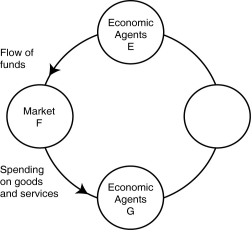 -Refer to Figure 2-18.One segment of the circular flow diagram in the figure shows the flow of funds from economic agents E to market F.Who are economic agents E and what is market F?
 (Multiple Choice)
5.0/5 (77)
(77) Which of the following would shift a nation's production possibilities frontier outward?
(Multiple Choice)
4.7/5 (75)
(75) Figure 2-4
Figure 2-4 shows various points on three different production possibilities frontiers for a nation.
-Refer to Figure 2-4.Consider the following events:
a.an increase in the unemployment rate
b.general technological advancement
c.an increase in consumer wealth
Which of the events listed above could cause a movement from Z to V?
Figure 2-4 shows various points on three different production possibilities frontiers for a nation.
-Refer to Figure 2-4.Consider the following events:
a.an increase in the unemployment rate
b.general technological advancement
c.an increase in consumer wealth
Which of the events listed above could cause a movement from Z to V? (Multiple Choice)
4.9/5 (86)
(86) Figure 2-12
 Figure 2-12 shows the production possibilities frontiers for Pakistan and Indonesia. Each country produces two goods, cotton and cashews.
-Refer to Figure 2-12.If the two countries have the same amount of resources and the same technological knowledge,which country has an absolute advantage in the production of cotton?
Figure 2-12 shows the production possibilities frontiers for Pakistan and Indonesia. Each country produces two goods, cotton and cashews.
-Refer to Figure 2-12.If the two countries have the same amount of resources and the same technological knowledge,which country has an absolute advantage in the production of cotton? (Multiple Choice)
4.8/5 (74)
(74) 
Filters
- Essay(0)
- Multiple Choice(0)
- Short Answer(0)
- True False(0)
- Matching(0)