



 Chat with AI
Exam 2: Trade-Offs, comparative Advantage, and the Market System

Exam 1: Economics: Foundations and Models444 Questions
Exam 2: Trade-Offs, comparative Advantage, and the Market System498 Questions
Exam 3: Where Prices Come From: the Interaction of Demand and Supply475 Questions
Exam 4: Market Efficiency and Market Failure465 Questions
Exam 5: The Economics of Health Care334 Questions
Exam 6: Firms, the Stock Market, and Corporate Governance250 Questions
Exam 7: Consumer Choice and Elasticity380 Questions
Exam 8: Technology, production, and Costs276 Questions
Exam 9: Firms in Perfectly Competitive Markets297 Questions
Exam 10: Monopoly and Antitrust Policy271 Questions
Exam 11: Monopolistic Competition and Oligopoly414 Questions
Exam 12: Gdp: Measuring Total Production and Income266 Questions
Exam 13: Unemployment and Inflation292 Questions
Exam 14: Economic Growth, the Financial System, and Business Cycles257 Questions
Exam 15: Aggregate Demand and Aggregate Supply Analysis284 Questions
Exam 16: Money, banks, and the Federal Reserve System279 Questions
Exam 17: Monetary Policy277 Questions
Exam 18: Fiscal Policy282 Questions
Exam 19: Comparative Advantage, international Trade, and Exchange Rates446 Questions
Select questions type


If society decides it wants more of one good and all resources are fully utilized,then
(Multiple Choice)
4.7/5  (73)
(73) ________ behavioral assumption about humans was that people usually act in a rational,self-interested way.
(Multiple Choice)
4.8/5 (71)
(71) Article Summary
Since 2008, the United States has been involved in trade negotiations over the Trans-Pacific Partnership (TPP), a free trade agreement with 11 other countries on both sides of the Pacific Ocean. One area of the negotiations involves patents and intellectual property rights in the pharmaceutical industry. A number of developing countries have ignored international agreements concerning patents and intellectual property rights as a way to benefit their domestic pharmaceutical industries, to the detriment of those companies which have spent considerable time and money developing new medicines. For every 5,000 to 10,000 experimental drugs contemplated, only one will typically gain FDA approval, and this occurs only after up to 15 years of research at an average cost of more than $1 billion. Also, 30 percent of the U.S. workforce is either directly or indirectly employed in the pharmaceutical industry, so protection of these intellectual property rights is very important for the U.S. economy.
-Refer to the Article Summary.If more developing countries began abiding by international agreements which protect intellectual property rights,all of the following would most likely occur except
(Multiple Choice)
4.9/5 (69)
(69) All of the following are critical functions of the government in facilitating the operation of a market economy except
(Multiple Choice)
4.8/5 (86)
(86) On a diagram of a production possibility frontier,opportunity cost is represented by the slope of the production possibility frontier.
(True/False)
5.0/5 (68)
(68) Table 2-4
Production Choices for Dina's Diner
Choice Quantity of Sliders Produced Quantity of Hot Wings Produced A 80 0 B 60 25 C 40 50 D 20 75 E 0 100
-Refer to Table 2-4.Dina faces ________ opportunity costs in the production of sliders and hot wings.
(Multiple Choice)
4.8/5 (75)
(75) Any output combination along a production possibility frontier is associated with overused or unattainable resources.
(True/False)
4.7/5 (79)
(79) Table 2-21
Digital Carner a Wheat (bushels) China 100 hours 5 hours South Korea 90 hours 3 hours
-Refer to Table 2-21.This table shows the number of labor hours required to produce a digital cameras and a bushel of wheat in China and South Korea.
a.Which country has an absolute advantage in the production of digital cameras?
b.Which country has an absolute advantage in the production of wheat?
c.What is China's opportunity cost of producing one digital camera?
d.What is South Korea's opportunity cost of producing one digital camera?
e.What is China's opportunity cost of producing one pound of wheat?
f.What is South Korea's opportunity cost of producing one pound of what?
g.If each country specializes in the production of the product in which it has a comparative advantage,who should produce digital cameras?
h.If each country specializes in the production of the product in which it has a comparative advantage,who should produce wheat?
(Essay)
5.0/5 (86)
(86) Adam Smith's behavioral assumption about humans was that people
(Multiple Choice)
4.7/5 (66)
(66) Specializing in the production of a good or service in which one has a comparative advantage enables a country to do all of the following except
(Multiple Choice)
4.9/5 (74)
(74) In a report made to the U.S.Congress in 2001,the National Academy of Sciences cautioned that if fuel economy encourages the production of smaller and lighter cars,"Some additional traffic fatalities would be expected." This statement suggests that
(Multiple Choice)
4.7/5 (92)
(92) Table 2-16
One Cell Phone Lumber (per board foot) Estonia 40 hours 8 hours Finland 16 hours 4 hours
Table 2-16 shows the number of labor hours required to produce a cell phone and a board foot of lumber in Estonia and Finland.
-Refer to Table 2-16.Finland has a comparative advantage in the production of
(Multiple Choice)
5.0/5 (77)
(77) Table 2-32
Cell Phone Lumber (board foot ) Estonia 20 hours 5 hours Finland 18 hours 4 hours
-Refer to Table 2-32.This table shows the number of labor hours required to produce a cell phone and a board foot of lumber in Estonia and Finland.
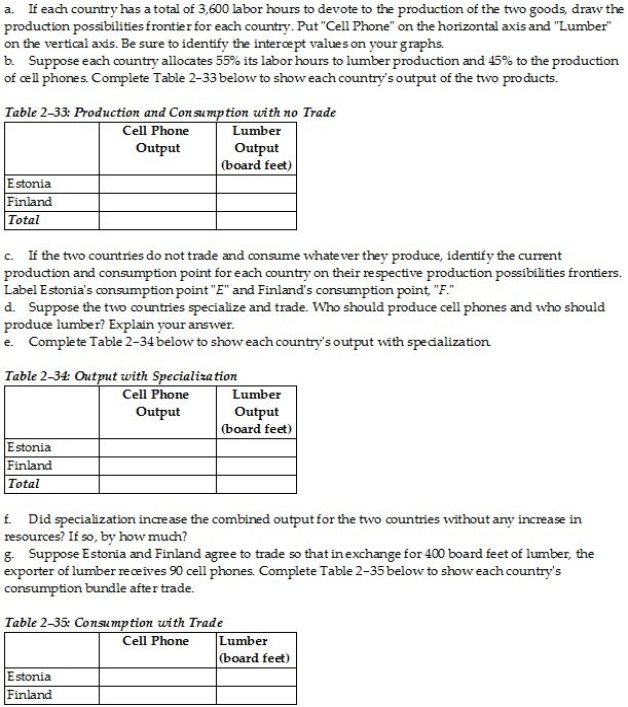 h.Show the consumption points after trade on each country's production possibilities frontier.Label these points "X" for Estonia and "Y" for Finland.
i.Has trade made the two countries better off? Explain your answer.
h.Show the consumption points after trade on each country's production possibilities frontier.Label these points "X" for Estonia and "Y" for Finland.
i.Has trade made the two countries better off? Explain your answer. (Essay)
4.8/5 (87)
(87) According to the production possibility model,if more resources are allocated to the production of physical and human capital,then which of the following is likely to happen?
(Multiple Choice)
4.9/5 (89)
(89) A decrease in population shifts the production possibility frontier outwards over time.
(True/False)
4.8/5 (76)
(76) Which of the following is not a flow in the circular flow model?
(Multiple Choice)
4.7/5 (90)
(90) ________ exists because unlimited wants exceed the limited resources available to fulfill those wants.
(Multiple Choice)
5.0/5 (84)
(84) 
Filters
- Essay(0)
- Multiple Choice(0)
- Short Answer(0)
- True False(0)
- Matching(0)